
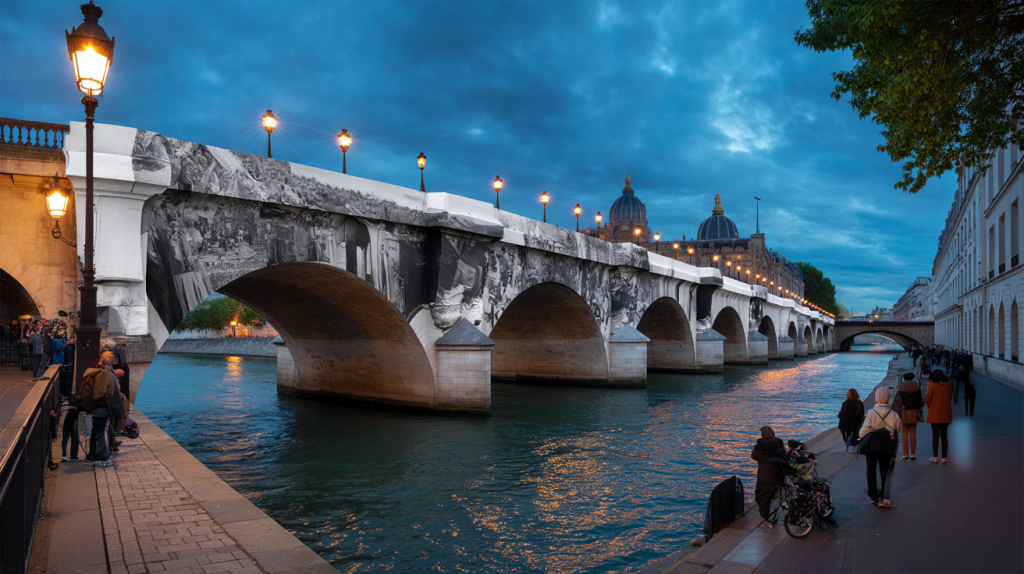
JR Pont Neuf 2026 explained : what is known, how it might look, where to watch, and the key numbers that show why this Paris bridge is a monumental canvas.
Talk of a JR project on the Pont Neuf in 2026 has Paris on alert. An iconic bridge, a headline artist, and a city that knows how to stage a spectacle: the ingredients are all there, and curiosity is high.
The search intent is clear: is JR coming to Pont Neuf, when could it happen, and how to see it up close. Official details remain under wraps at the time of writing, yet the context points to a major urban intervention if confirmed, with precedent set by the bridge’s own history and JR’s track record of crowd‑drawing illusions.
JR Pont Neuf 2026: what is known now
JR works in situ, at scale, and in public space. His Paris pieces have already transformed familiar landmarks, including the Louvre Pyramid in 2016 and 2019, each time with a vast black‑and‑white collage that briefly shifted how the monument appears, according to the Musée du Louvre’s public notes on those interventions.
Pont Neuf is the oldest standing bridge in Paris, opened in 1607 under King Henry IV, per the City of Paris. Any new intervention on that site requires permits, a precise safety plan, and coordination with river traffic. Those steps usually become public only after approvals, which explains the current wait for specifics.
Why 2026 matters to culture watchers: this would be the bridge’s most talked‑about artistic moment since Christo and Jeanne‑Claude’s wrap in 1985. The Christo and Jeanne‑Claude Foundation documents that project with hard numbers: about 40,000 square meters of fabric and several kilometers of rope, completed over weeks and viewed by large crowds along the Seine.
Pont Neuf in numbers: why the site tests any installation
The bridge spans roughly 232 meters with 12 arches and a width near 22 meters, crossing both arms of the Seine at the western tip of Île de la Cité. Those dimensions set the scale. They also dictate how a piece must be engineered and how visitors can move around it.
Two currents, two sidewalks, and multiple sightlines from quays and parallel bridges create a natural amphitheater. That is a gift for photography. It is also a challenge for crowd management, with pedestrian flows that can swell quickly on sunny evenings or during holiday periods.
Past major operations on the Seine have come with temporary changes to traffic, river navigation, and access to quays. Expect similar guardrails if a 2026 JR piece is confirmed, typically announced in advance by the Préfecture de Police and City of Paris when schedules lock.
Visiting tips: best spots and routes to see JR on the Seine
Most readers want a plan to experience the work safely and with great views. The riverside geography offers several options that frame Pont Neuf without the crush at mid‑span.
- Square du Vert‑Galant at the tip of Île de la Cité gives a low‑angle cinematic view toward the arches.
- Pont des Arts and Quai de Conti set up a wider, postcard perspective with room to step back.
- Early morning light flattens reflections, dusk brings the glow of bridge lamps, and both times thin the crowds.
- Transit is simple: Métro line 7 to Pont Neuf, line 1 to Louvre‑Rivoli, line 4 to Cité, RER B and C via Saint‑Michel Notre‑Dame for river‑level access.
Photographers often aim for a stitched panorama from the Left Bank. Casual visitors tend to prefer the Right Bank quays for easier café stops. Families may want to avoid peak weekend hours and choose weekday mornings to accomodate strollers and space.
Past JR projects and one famous wrap that set the tone
JR’s playbook is public and bold. In 2016 he made the Louvre Pyramid visually disappear with a giant photographic collage, then in 2019 he created a trompe‑l’œil chasm around it for the monument’s anniversary. Both pieces lived only a few days, then vanished, a hallmark of his approach.
He has worked across continents through the “Inside Out” participatory portraits since 2011, with thousands of large‑format faces pasted in streets and on façades. In Italy in 2021, “La Ferita” transformed Palazzo Strozzi into an optical wound, again a short‑life illusion documented by the foundation that hosted it.
For Pont Neuf, the historical benchmark stays Christo’s 1985 wrap. The numbers tell the story: tens of thousands of square meters of fabric, intricate rigging, and a result that reframed a 17th‑century structure for a new audience. If JR’s 2026 project proceeds, expect a different medium, likely photographic and architectural, but with the same ambition to alter perception rather than the monument itself.
So the missing piece right now is timing. Once permits, dates, and access plans are posted by City of Paris channels or JR’s studio, the picture becomes clear. Until then, the bridge’s scale, the artist’s methods, and the site’s track record already outline what a Paris‑defining moment could look like in 2026.