
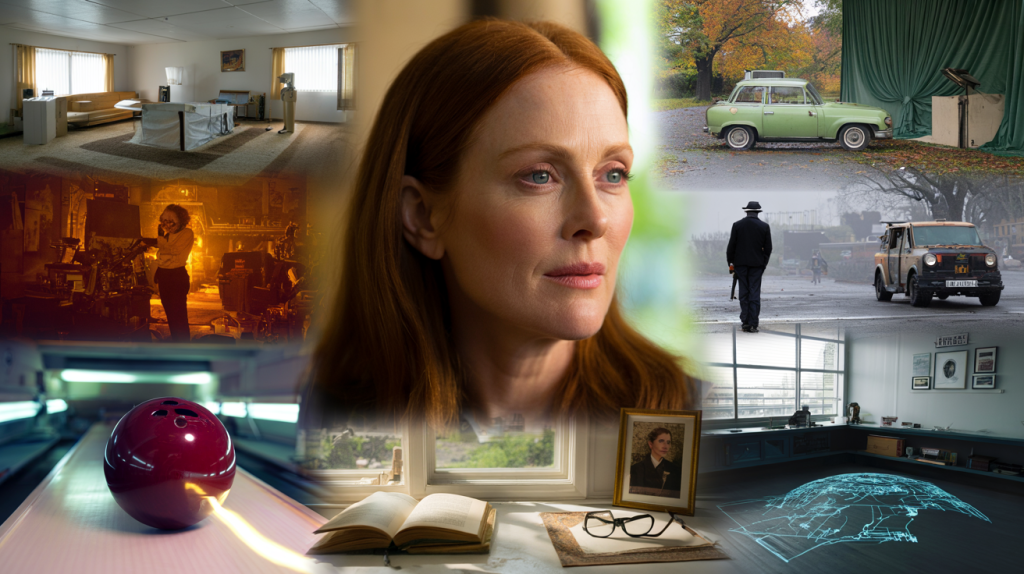
From indie breakthroughs to Oscar glory, explore Julianne Moore’s filmography with key dates, awards, and must-watch films to plan a perfect viewing path.
Few actors glide between art house and blockbuster like Julianne Moore. Across four decades, the actor has stacked 5 Academy Award nominations with 1 win for Best Actress in 2015 for “Still Alice” according to the Academy of Motion Picture Arts and Sciences, along with 2 Emmys, 2 Golden Globes per the Hollywood Foreign Press Association, a BAFTA win for “Still Alice” and Best Actress at Cannes for “Maps to the Stars” in 2014. That résumé sets the tone for a career built on risk, detail, and staying power.
The range is real: breakout indie turns in the 1990s, prestige dramas through the 2000s, then worldwide hits like “The Hunger Games: Mockingjay” films, which grossed about 755 million dollars in 2014 and 653 million dollars in 2015 worldwide per Box Office Mojo. Add “The Lost World: Jurassic Park” at 618 million dollars in 1997 and “Hannibal” at 351 million dollars in 2001, and the filmography reads like a map of modern cinema.
Julianne Moore filmography in one glance : awards, roles, timeline
The throughline starts in the early 1990s with Robert Altman’s “Short Cuts” in 1993, runs through “Safe” in 1995 and “Boogie Nights” in 1997, then blooms into dual Oscar nominations in 2003 for “The Hours” and “Far from Heaven” for 2002 releases, as listed by the Academy. By the 2010s, Moore balances festival titles and global franchises, culminating in that Oscar for “Still Alice” in 2015.
Television shaped the picture too. Julianne Moore won a Daytime Emmy in 1988 for “As the World Turns” and a Primetime Emmy in 2012 for “Game Change”, per the Television Academy. The result: a performer equally at home in limited series and big-screen ensembles, shifting tone without losing intensity.
Breakthrough 1990s : from “Short Cuts” to “Magnolia”
Altman’s mosaic “Short Cuts” in 1993 put Moore on the indie map. Then came Todd Haynes’ “Safe” in 1995, a clinical, unsettling performance often cited by critics as a 90s standout. Paul Thomas Anderson’s “Boogie Nights” in 1997 delivered her first Oscar nomination, per the Academy’s records, and made the industry look twice.
There was range to spare. “The Lost World: Jurassic Park” in 1997 delivered mainstream reach, with 618 million dollars worldwide per Box Office Mojo. “The Big Lebowski” arrived in 1998, followed by the ensemble “Magnolia” in 1999, where Moore’s volatility matched the film’s stormy energy. Skipping these titles is the common mistake: audiences sometimes jump straight to “Still Alice” and miss the 90s foundation that explains the later acclaim.
Awards peak and mainstream hits : “Still Alice”, “Far from Heaven”, “The Hunger Games”
Two pivotal 2002 performances defined the early 2000s. “Far from Heaven” earned Julianne Moore the Coppa Volpi for Best Actress at Venice in 2002 and an Oscar nomination in 2003, while “The Hours” added a supporting nomination the same year, per La Biennale di Venezia and the Academy. In 2006, “Children of Men” added a grounded, urgent turn to a modern classic.
The next decade mixed acclaim and reach. “The Kids Are All Right” in 2010 made about 34 million dollars worldwide on a modest budget per Box Office Mojo, and “Crazy, Stupid, Love” in 2011 crossed 145 million dollars worldwide. “Still Alice” in 2014 brought a sweep: Oscar Best Actress, Golden Globe Best Actress, and BAFTA Best Actress in 2015 according to AMPAS, HFPA, and BAFTA. The same year, she joined “The Hunger Games: Mockingjay – Part 1” and returned in 2015’s Part 2, both global successes per Box Office Mojo.
Recent years keep the line unbroken. “Gloria Bell” in 2018 revisited a character study with director Sebastián Lelio. In 2023, “May December” teamed Moore with director Todd Haynes again, while “Sharper” in 2023 offered sleek, twisty crime. Cannes had already honored her with Best Actress for “Maps to the Stars” in 2014, per the Festival de Cannes.
Where to start with Julianne Moore : essential films to watch first
Looking for a smart entry route that captures range, history, and momentum? Start small, swing wide, then go big.
- “Short Cuts” (1993, Robert Altman) – ensemble launchpad that announced her risk-taking.
- “Safe” (1995, Todd Haynes) – icy, meticulous character study that critics still cite.
- “Boogie Nights” (1997, Paul Thomas Anderson) – Oscar-nominated turn that changed her trajectory.
- “The Big Lebowski” (1998, Joel Coen) – sharp, offbeat support with staying power.
- “Far from Heaven” (2002, Todd Haynes) – Venice Best Actress, Oscar-nominated elegance.
- “Children of Men” (2006, Alfonso Cuarón) – lean, humane sci-fi anchor.
- “Still Alice” (2014, Richard Glatzer et Wash Westmoreland) – Oscar, BAFTA, Golden Globe trifecta.
- “The Hunger Games: Mockingjay” Parts 1 and 2 (2014-2015, Francis Lawrence) – global reach and political steel.
To navigate her filmography without fatigue, alternate eras and tones: pair a 90s indie with a 2010s hit, then drop into a prestige drama. That rhythm mirrors the career itself and keeps attention high. Want one last nudge? “Safe” and “Still Alice” bookend the evolution of her method, while “Boogie Nights” and “The Hunger Games” show how star power can coexist with risk. It is definitly the quickest way to see why the awards tallies from AMPAS, BAFTA, HFPA, Venice, and Cannes keep circling the same name.