
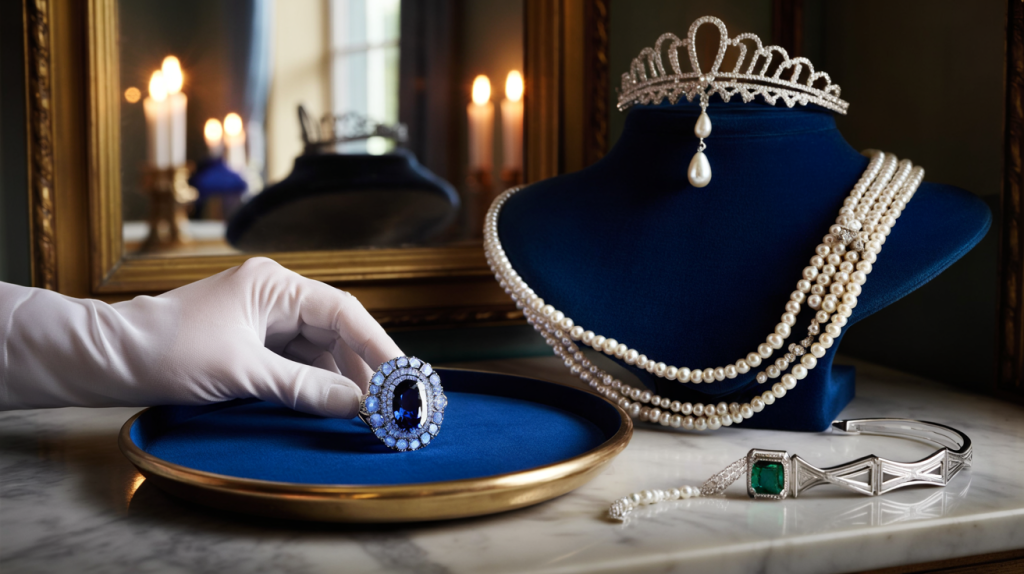
One royal jewel can reset a trend overnight. When Catherine, Princess of Wales, reaches for an antique piece, searches spike, jewelers field calls and the photo becomes a reference. That “bijou ancien” pull rests on a handful of storied heirlooms she wears on the biggest stages, each loaded with date, origin and family history.
The essentials arrive fast. The Garrard sapphire engagement ring first chosen by Diana in 1981, passed to Catherine at the couple’s 16 November 2010 engagement, reappeared for the 29 April 2011 wedding and never left her hand. The Cartier Halo tiara, created in 1936 and held by the Royal Collection Trust, crowned her on that wedding day. She has alternated the 1914 Queen Mary’s Lover’s Knot tiara with the Lotus Flower tiara for state events. For solemn moments, she reached for Queen Elizabeth II’s Japanese Pearl choker with a diamond clasp at Prince Philip’s funeral on 17 April 2021, and for a greener note, Queen Mary’s Art Deco emerald choker at the Earthshot Prize awards in December 2022.
Kate Middleton’s antique jewel canon : sapphire, tiaras, pearls
The Garrard sapphire ring carries the clearest facts. Reports describe a 12 carat Ceylon sapphire encircled by 14 diamonds set in 18 carat white gold, originally selected by Diana in February 1981, then worn by Catherine since 2010. The piece sits at the heart of her visual identity and signals continuity between generations.
Wedding headpiece history is just as precise. The Royal Collection Trust records the Cartier Halo tiara as a 1936 commission by King George VI for Queen Elizabeth, later loaned to Princess Elizabeth, and again loaned in 2011 to Catherine. On later state occasions, Catherine appeared in Queen Mary’s Lover’s Knot tiara, designed in 1914 with swinging pearls, a favorite of Diana in the late 1980s.
Two pearl moments drew wide attention. The four strand Japanese Pearl choker, created from pearls gifted to Queen Elizabeth II by the Japanese government in the 1970s, framed Catherine’s neckline during the 2021 funeral service. She paired it with Bahrain pearl drop earrings, assembled from pearls presented to the then Princess Elizabeth in 1947. These are documented pieces within the Royal Collection, often deployed for remembrance and diplomacy.
Why these heirlooms matter : history, protocol, quiet power
Antique jewels do more than sparkle. They solve a recurring royal problem, sending respect without words. Wearing the Japanese Pearl choker at a funeral reads as restraint and memory. Reaching for Queen Mary’s emerald choker during the 2022 Earthshot Prize, a climate focused event, nods to sustainable reuse and archival styling. Choosing the Lover’s Knot tiara at a state banquet links Catherine to queenly precedent that spans more than a century.
Dates help decode the message. Jewelry with a 1914 or 1936 origin tells viewers this is not a trend piece. It is heritage in action. By selecting items already in the Royal Collection, Catherine reinforces a circular approach long before the modern resale boom. The fact that these jewels have documented provenance through the Royal Collection Trust or historic royal jewelers like Garrard also reduces controversy and anchors coverage in verifiable records.
There is a personal layer too. The sapphire ring connects William to his mother and to the global memory of 1981. That link matters whenever Catherine appears at engagements related to child welfare, mental health or Diana’s legacy projects. The jewelry becomes shorthand for family continuity without a single spoken line.
Common mistakes when decoding royal jewellry and how to avoid them
People often assume every diamond belongs to Catherine personally. Many do not. Much of what she wears remains part of the Royal Collection, loaned for the occasion and returned afterward, a detail the Royal Household has repeated for decades.
Another slip appears around naming. The Lover’s Knot tiara often gets called the Cambridge Lover’s Knot, which can blur lines with similar nineteenth century designs. The Royal Collection Trust distinguishes Queen Mary’s Lover’s Knot, dated to 1914, from earlier versions and that distinction matters when tracking provenance.
Photos also prompt speculation about alterations. Some jewels have been resized for comfort, yet core settings stay consistent. The sapphire ring’s cluster setting and diamond count remain widely reported as unchanged since 1981. When in doubt, cross reference with Royal Collection Trust records or statements released by Kensington Palace around major events such as the 2011 wedding or the 2021 funeral service.
Style it at home : the “bijou ancien” look on a real life budget
Catherine’s choices translate surprisingly well to daily wardrobes. The secret lies in shapes, not price. Round white pearls, navette or cluster settings, and clean Art Deco lines instantly echo her most photographed moments. Start with discreet pieces and build up for evening.
Try this practical route, piece by piece.
- Cluster ring silhouette : choose a deep blue center stone and a halo of white stones on sterling silver. Aim for a low profile setting for comfort.
- Pearl choker feel : a four strand collar sits at about 36 to 38 centimeters. Swap diamonds for a simple central clasp with a small crystal.
- Art Deco hint : look for baguette accents and geometric plaques in vintage or vintage inspired costume jewelry dated to the 1930s or 1940s.
- Responsible sourcing : consider antique dealers with hallmarked stock, museum shop replicas noted by provenance, or short term rental for big events.
One last detail closes the loop. Catherine’s headline pieces come with exact dates and maker names that stand up to scrutiny. When a jewel tells a story as clearly as 1914, 1936, 1981 or 2011, audiences listen. That is the “bijou ancien” effect at work, and it keeps drawing eyes every time the Princess of Wales steps into the light.