
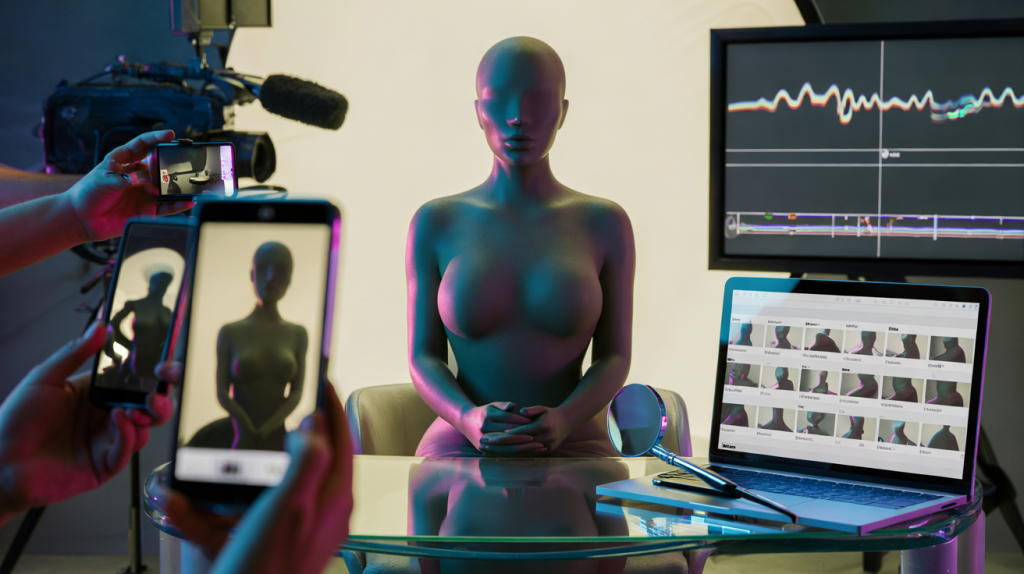
A mysterious clip claims to show Kim Kardashian giving a masked interview. Real footage or clever recut ? Here is the context, the receipts, and how to verify fast.
That masked interview video labeled as Kim Kardashian is racing across feeds, stitched, cropped, and stripped of credits. The frame is striking : a covered face, clipped answers, the aura of secrecy. Viewers want to know if it is authentic or a mashup built for quick views.
Context matters. Kim Kardashian has embraced full-coverage looks on high‑profile stages, which feeds confusion when fragments resurface without source. On 13 September 2021, she arrived at the Met Gala in a faceless Balenciaga ensemble that dominated headlines (source : Vogue, 13 Sept. 2021). In March 2022, she appeared at Paris Fashion Week in a Balenciaga tape outfit that also obscured much of her features (source : Vogue Runway, March 2022). When a new clip appears without the original outlet’s logo or captions, viewers can easily misread fashion footage as a fresh, masked sit‑down.
What the “Kim Kardashian masked interview” clip really shows
Most versions circulating today look like short vertical edits. The lighting is studio‑clean but panel mics or a branded backdrop are missing. No lower thirds, no network bug, no uploader credit. That detail alone signals a recut rather than a clean master from a broadcaster.
There is precedent for confusion. During the 2021 Met Gala cycle, multiple red‑carpet angles of Kim Kardashian in a full face covering were reposted with new captions and different audio. Some edits spliced her silent carpet walk with unrelated Q&A audio from other appearances that week in New York promoting Saturday Night Live on 9 October 2021 (source : NBC, 9 Oct. 2021). Crops like these travel fast, look new, and shed context.
So the core question : does an official, long‑form masked interview with Kim Kardashian exist? Publicly indexed archives from major entertainment outlets do not show a branded, sit‑down video where she remains fully masked throughout. When masked footage of her appears, it typically originates from fashion events or arrivals rather than interviews, then reappears in edits that imply an interview took place.
How to verify a viral Kim Kardashian clip in under 2 minutes
There is a simple playbook that works across Instagram, TikTok, X and YouTube Shorts. It is quick, repeatable and saves you from sharing a fake.
- Pause on a clear frame and run a reverse image search : Google Images or Yandex can surface the original broadcast or red‑carpet gallery.
- Match the outfit to a dated appearance : the Met Gala 2021 and Paris Fashion Week March 2022 looks are heavily reused in edits (sources : Vogue, 13 Sept. 2021; Vogue Runway, March 2022).
- Cross‑check her official channels : if an interview is real, a cut‑down typically lands on @kimkardashian, @kardashianshulu, or a partner media page the same week.
- Look for lower thirds or a mic flag : outlets brand interviews. If none appear, assume the clip is recut until proven otherwise.
- Search the quoted lines : copy a sentence into quotes on Google. If it comes from another interview, you will see a date and outlet.
Why these masked videos go viral now : edits, algorithms, and deepfakes
Short‑form platforms reward bold visuals and strong hooks. A fully covered celebrity face is both. That drives creators to repackage runway or carpet footage as “never‑before‑seen” interviews. The result : millions of views for a clip with zero new reporting.
There is a second layer to consider. Deepfake and synthetic media supply new raw material for misleading edits. The first comprehensive audit by Deeptrace, later renamed Sensity, found 14,698 deepfake videos online in 2019, with the total doubling roughly every six months and 96 percent classified as non‑consensual pornographic content (source : Deeptrace, “The State of Deepfakes 2019”). Even if your feed is not showing obvious face swaps, the ecosystem trained audiences to expect that anything could be real, which dulls sourcing instincts.
Scale amplifies the effect. TikTok announced it surpassed 1 billion monthly active users in September 2021 (source : TikTok Newsroom, Sept. 2021). YouTube reports more than 2 billion logged‑in monthly users (source : Google, YouTube Press). When a mislabeled celebrity clip takes off in that environment, it can outrun corrections by a wide margin.
So what solves the puzzle for this masked interview label? Provenance. If a clip lacks an original outlet, date, or consistent audio that matches the speaker’s mouth and environment, treat it as an edit. Ask the uploader for the source. Search for the outfit on a specific date. Rely on established entertainment newsrooms that publish full videos with credits. Without those anchors, the most likely answer is the simplest one : footage from Kim Kardashian’s masked fashion moments recut to simulate an interview. That may feel unoficial, because it is.