
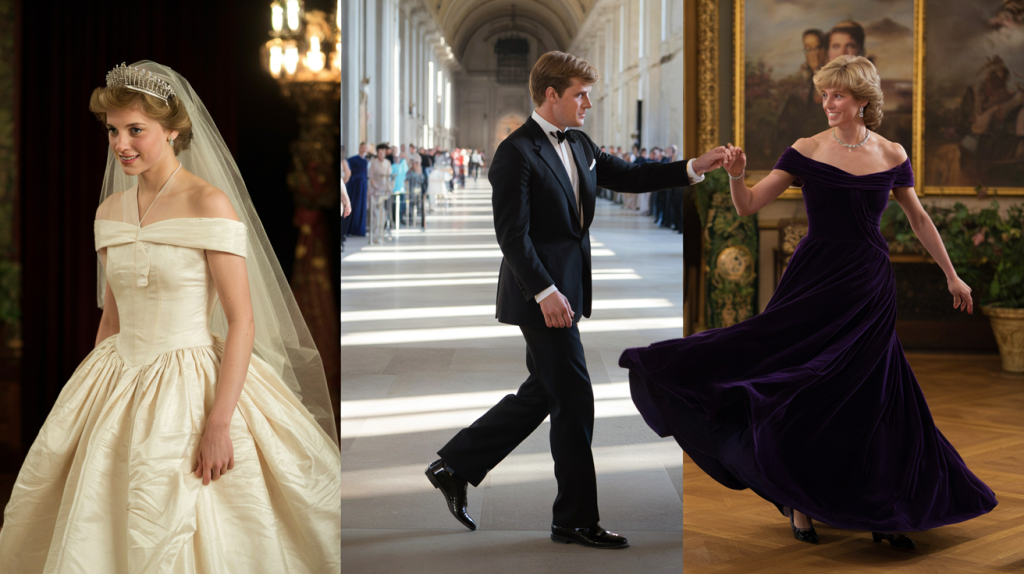
Two dresses turned Lady Diana Spencer into a fashion legend before and after the fairy tale cracked. On 29 July 1981, the world watched her step into St Paul’s Cathedral in an ivory silk taffeta gown by David and Elizabeth Emanuel, its 25-foot train gliding behind like a comet tail. Thirteen years later, on 29 June 1994, a little black number by Christina Stambolian cut through the London night – and straight across the front pages – the very evening Prince Charles spoke openly about his marriage on television.
Between those moments lives a story of craftsmanship, strategy and cultural shockwaves that still ripple through museums, auctions and social feeds. The numbers are real, the dates precise, the impact measurable. And yes, the myths get loud. Here is the history that holds.
Princess Diana’s 1981 wedding dress – the facts that matter
The wedding took place on 29 July 1981 at St Paul’s Cathedral, London. The Emanuels designed an ivory silk taffeta dress embroidered with sequins and pearls, using antique Carrickmacross lace once owned by Queen Mary. The veil measured roughly 153 yards of tulle, while the train – 25 feet – set a royal record at the time.
Details tell the rest of the story. A tiny blue bow sat at the waistband for luck, alongside a gold horseshoe stitched inside. The Spencer family tiara anchored the veil. A backup dress was quietly made in case of leaks. The carriage ride famously creased the skirt, a reminder that spectacle and logistics rarely glide in step.
The 1994 Stambolian revenge dress – why it rewrote royal style
On 29 June 1994, at the Serpentine Gallery summer party, Diana wore an off-the-shoulder black silk dress by Christina Stambolian. She had owned it for years and hesitated to debut it, then chose that very night – as a television documentary featuring Prince Charles aired – to step out with bare shoulders, a choker and confidence.
The image moved fast and far. The dress, sharp and modern, reframed royal eveningwear as narrative, not just protocol. It resurfaced in major displays, including exhibitions at Kensington Palace, showing how a single look can pivot public perception more than any speech.
Beyond the headlines – the Travolta dress and record sales
Another pivot point: November 1985, a White House dinner hosted by President Ronald Reagan. Diana’s midnight-blue velvet gown by Victor Edelstein met John Travolta on the dance floor. Cameras clicked, the moment froze in time, and the dress earned its popular name.
The market later put hard numbers on that aura. In 1997, Christie’s in New York auctioned 79 of Diana’s dresses, raising 3.25 million dollars for AIDS and cancer charities, including the AIDS Crisis Trust and the Royal Marsden Cancer Fund. Years on, the Edelstein gown entered the care of Historic Royal Palaces in 2019 for 264,000 pounds, confirming sustained value long after the last flashbulb.
How to read Lady Di’s dresses today – context, clarity, places to see them
Here is where confusion creeps in. People often mix designers, dates and venues, or credit a tiara to a dressmaker. The fix is simple: pair each gown with its moment, its maker and its measurable trace – a date, a length, a sale figure, an exhibition label.
There is also ownership and legacy. Diana’s will placed personal effects with her sons. The wedding dress was transferred to Princes William and Harry in 2014, then displayed by Historic Royal Palaces at Kensington Palace in 2021, giving new visitors a close, careful view of the workmanship that television once softened.
For quick orientation, keep the timeline tight and the details familar.
- 29 July 1981 – Wedding dress by David and Elizabeth Emanuel, ivory silk taffeta with antique lace, 25-foot train, veil around 153 yards of tulle, St Paul’s Cathedral.
- November 1985 – Victor Edelstein midnight-blue velvet, the “Travolta dress”, danced at the White House with John Travolta, later acquired in 2019 for £264,000.
- 29 June 1994 – Christina Stambolian black dress, worn to the Serpentine Gallery on the same night of a televised interview with Prince Charles.
- 25 June 1997 – Christie’s auction of 79 dresses, total of $3.25 million raised for AIDS and cancer charities.
What ties these chapters together is not a single silhouette but strategy. The 1981 gown projected dynasty at scale. The 1994 dress signaled autonomy. The Edelstein velvet proved that memory turns into museum-grade artifact with clear provenance and public appetite. Modern exhibitions now provide the rest – labels with dates, makers, materials – so the story stays anchored in what can be seen, measured and verified, whether one comes for fashion, history or both. No guesswork needed, just the right names and numbers stitched to the right night.