
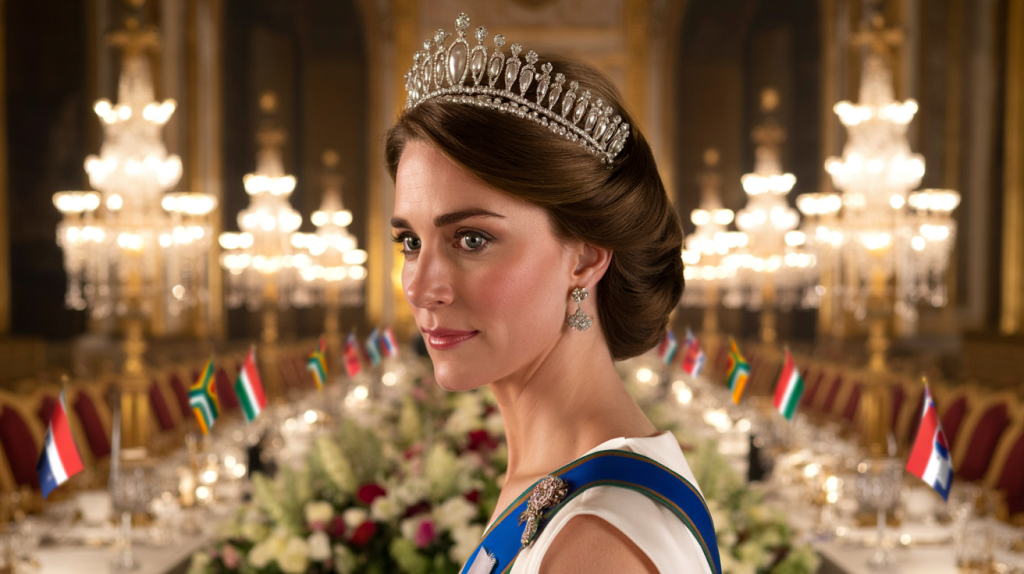
Kate Middleton keeps bringing back Lady Diana’s most iconic tiara. The dates, the meaning, the quiet message behind the pearls – and why it still stuns.
One glance at the diamond arches and swinging pearls and the room shifts. When Catherine, Princess of Wales, steps out in Lady Diana’s beloved Lover’s Knot tiara, she taps a living thread of royal memory and modern influence. The piece, created in 1914 by Garrard for Queen Mary, signals continuity the second it appears.
The context is clear. Loaned to Diana after her 1981 wedding and returned to Queen Elizabeth II in 1996, the tiara later re-emerged on Catherine on December 8, 2015 at Buckingham Palace’s Diplomatic Corps reception. Since then it has crowned key state moments – October 23, 2018 with the Netherlands, June 3, 2019 with the United States, November 22, 2022 with South Africa, and November 21, 2023 with South Korea – aligning personal legacy with public duty.
Lady Diana’s Lover’s Knot Tiara on Kate Middleton: the signal behind the sparkle
The main idea lands fast: this is not just jewelery. The Lover’s Knot carries a message of stability in transition. Catherine often chooses it for diplomatic dinners that demand gravitas, and the choice reads instantly to audiences who remember Diana’s images from the 1980s and 1990s.
Observation meets expectation. The tiara’s design – diamond bows and 19 suspended pearl drops – gives it a formal silhouette that photographs beautifully under banquet lighting. The public reads the pearls as elegant, the diamonds as ceremonial. No need to explain too much on a night of speeches and toasts.
The potential problem, for any royal woman, sits in the shadow of comparison. Wear Diana’s signature piece, invite memories. Avoid it, risk disappointing those who look for continuity. Catherine navigates that line by timing: not at every gala, only when history helps the story of the evening.
Dates and meaning: when Catherine wore Diana’s tiara, and why those nights count
After its 2015 return, the tiara appeared regularly at the Diplomatic Corps receptions in December, including 2016 and 2017, setting a rhythm to the royal calendar. Then came the high-profile state banquets: the Netherlands on October 23, 2018 at Buckingham Palace, the United States on June 3, 2019, the South Africa visit on November 22, 2022, and South Korea on November 21, 2023.
These are not random choices. State banquets celebrate trade ties, security cooperation, cultural exchange. The tiara’s history adds soft power to the table plan. Images published the next morning do part of the diplomacy, traveling worldwide within minutes.
Numbers help frame it. Built in 1914 and associated with two of the most photographed royal women of the last 40 years, the Lover’s Knot marries century-old craft to a modern media cycle that runs 24 hours. The effect is consistent: attention, then message, then a lasting visual.
Craft and lineage: Garrard, Queen Mary, and the quiet authority of design
The piece’s origin is straight from the royal workshop. Garrard created the tiara for Queen Mary in 1914, reportedly inspired by a lover’s knot design linked to Princess Augusta of Hesse. It blends platinum and gold, pavé diamonds, and those distinctive pearl drops that sway with movement.
Its silhouette carries authority because it is unmistakable. The diamond arches form repeating hearts, the bows sit like punctuation, and the pearls – baroque and luminous – keep the eye moving. On camera the tiara reads regal before a single word is spoken.
The lineage matters. Queen Mary to Queen Elizabeth II, then a long-term loan to Diana starting in 1981, back to the monarch in 1996, and finally worn by Catherine from 2015. That is a clear, traceable chain. No ambiguity, just continuity with a human face.
Quick facts that readers often search for :
- Year of creation : 1914, by Garrard for Queen Mary
- Signature details : diamond lover’s knots with 19 suspended pearl drops
- Diana’s timeline : on loan after July 29, 1981 – returned in 1996
- Catherine’s first appearance : December 8, 2015 – Diplomatic Corps reception
- Major state banquets : Netherlands 2018, United States 2019, South Africa 2022, South Korea 2023
Why it still captivates: protocol, media, and what to watch next
There is practical protocol here. Tiaras are reserved for state banquets, coronations, and white-tie receptions. Catherine also rotates pieces – the Lotus Flower tiara, the Cartier Halo – to match the formality of the guest and the scale of the occasion.
Media logic seals the rest. The tiara’s association with Diana creates instant recognition. Pair that with Catherine’s steady schedule of formal duties and the result is consistent global coverage, from front pages to social feeds, within hours.
Looking ahead, the next likely window sits with the annual Diplomatic Corps reception at Buckingham Palace, traditionally in early December, or any incoming state visit confirmed by the palace calendar. When the Lover’s Knot returns, expect what it always delivers: a bridge between eras, a refined signal amid ceremony, and a photograph that travels farther than any speech.