
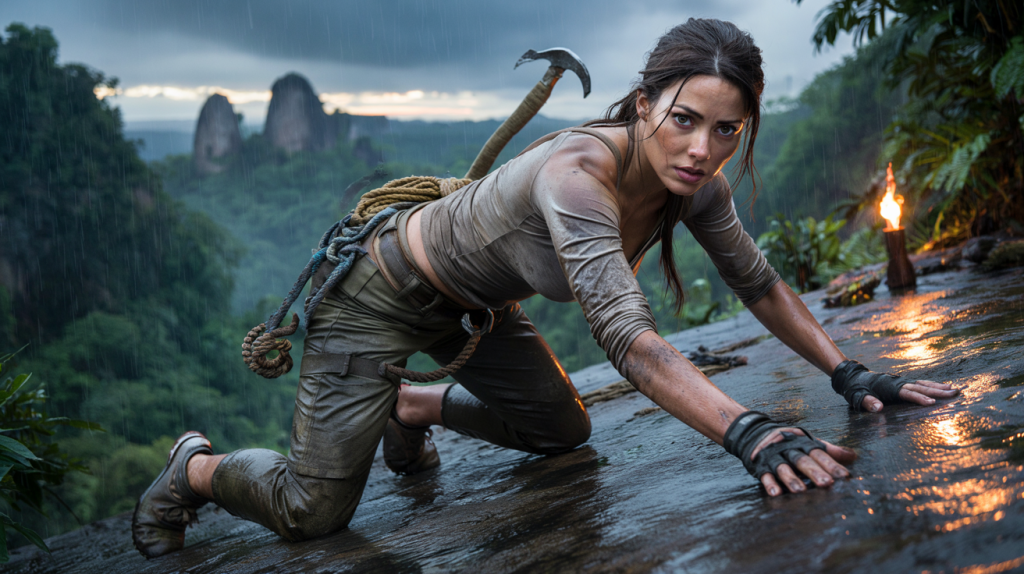
Lara Croft changed, sales kept climbing. Dates, data, and what this redesign really did to Tomb Raider’s future.
Lara Croft did not just swap shorts for a climbing axe. With the 2013 reboot, Crystal Dynamics reframed a global icon around function, trauma, and survival, dialing down the pin-up silhouette and dialing up believability. The pivot became a reference point for how blockbuster games present women today.
The results were not only cultural. Crystal Dynamics reported in 2023 that the modern reboot trilogy sold 38 million units, while the franchise passed 95 million sales worldwide, a figure echoed across anniversary materials. On film, the 2018 Tomb Raider starring Alicia Vikander grossed about 274 million dollars worldwide according to Box Office Mojo. This shift, started in 2013 and carried into 2015 and 2018 releases, shows a strategy: less gaze, more grit, and a bigger audience.
From 1996 to 2013 : what actually changed in Lara Croft’s design
In 1996, Core Design introduced Lara Croft with sharp polygons and exaggerated proportions that dominated magazine covers and ads. The style matched the era’s tech and marketing, and it worked for visibility.
By the mid-2000s, updates in Legend and Anniversary softened the model but kept the classic silhouette. Then came the break. In March 2013, the reboot arrived with performance capture led by Camilla Luddington, practical clothing, visible scars, and gear that looked like it was bought, not airbrushed. Crystal Dynamics positioned the game as an origin story, with animation and camera choices centered on survival, not cheesecake.
Those choices continued in Rise of the Tomb Raider in 2015 and Shadow of the Tomb Raider in 2018. The trilogy kept athletic realism, consistent proportions, weathered textures, and climbing-first framing. Marketing mirrored the shift with key art focused on terrain, gear, and story stakes.
The business impact : sales, audiences, and cross-media proof
Hard numbers tell a clear story. In 2023, Crystal Dynamics highlighted more than 95 million lifetime franchise sales and 38 million for the reboot trilogy alone. That puts the reboot era as a commercial engine, not a detour.
Cinema backed that up. Box Office Mojo lists the 2018 film at roughly 274 million dollars worldwide, showing that a grounded Lara travels beyond the console audience.
The wider market changed too. The Entertainment Software Association measured that 46 percent of U.S. players identified as women in 2023. Developers faced a broader, older audience, with different expectations about representation, camera work, and tone. Desexualization did not happen in a vacuum, it met a market moving in the same direction.
Debate pitfalls : common traps when reading Lara Croft’s evolution
Debates around Lara Croft often talk past each other. Here are recurring traps that blur the real picture.
- Confusing marketing art with gameplay cameras and animation, which changed faster and deeper than posters.
- Assuming desexualization equals prudishness, rather than a shift toward function and grounded storytelling.
- Ignoring ratings boards and regional sensitivities that influence clothing, framing, and gore as much as gender norms.
- Claiming the pivot hurt sales, despite Crystal Dynamics’ 2023 figures showing the reboot trilogy’s strong performance.
- Forgetting the medium jump: film and TV need silhouettes and costumes that read at distance and in motion.
Context matters. The 2013 model aimed for physical credibility under stress, so fabrics looked heavier, tools sat where a climber would place them, and the face tracked pain and determination more than a poster smile. None of that prevents charisma. It just routes it through performance capture and level design.
What’s next : Netflix, Unreal Engine 5, and a unified Lara
Crystal Dynamics announced in April 2022 that the next Tomb Raider is in development on Unreal Engine 5. In December 2022, Amazon Games said it will publish the project globally. That pairing suggests bigger environments, tighter facial capture, and consistency across platforms.
On the screen side, Netflix set an animated series titled Tomb Raider: The Legend of Lara Croft for 2024 with Hayley Atwell voicing the lead. Cross-media plans typically push toward a unified character bible, so outfits, proportions, and even emotional beats line up between episodes and games.
Expect continuity rather than a swing back to 1996. The market skews older, tech enables subtler acting, and the brand already proved the model. For players who care about representation and for long-time fans who just want rock-solid adventure design, the same decision pays twice. The practical look helps animation read cleanly in action, and it keeps the focus on traversal, puzzles, and stakes. Sounds simple, but it’s definitly hard to do at blockbuster scale.
If you track the next reveal, watch for three tells that signal the ongoing approach : camera language centered on movement and problem solving, gear and clothing that serve mechanics first, and cross-promotion art that mirrors in-game proportions. When those align, the desexualized Lara Croft is not a message, it is the brand working as designed.