
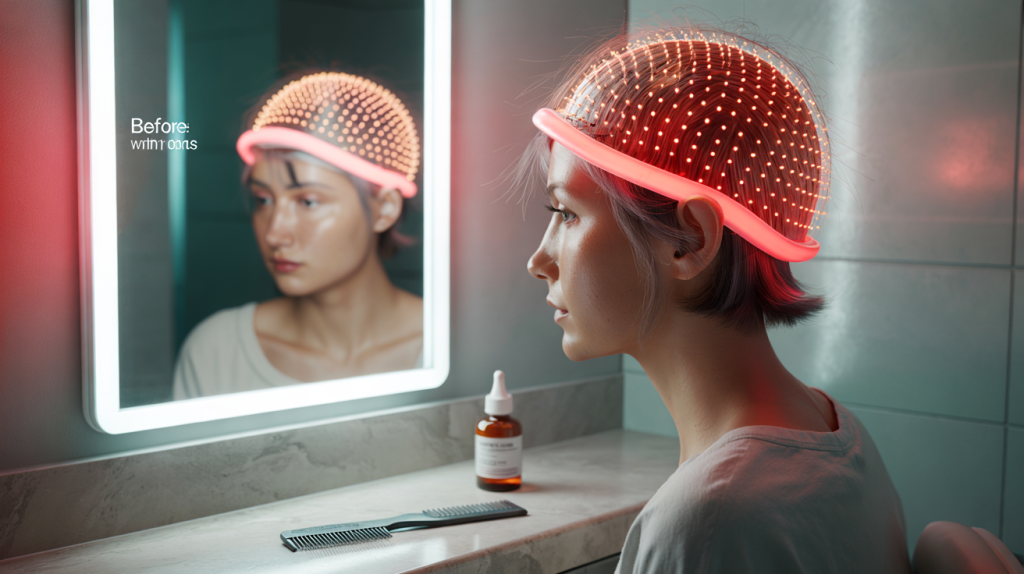
Thinning hair meets wearable light. LED hair helmets promise denser strands without drugs or needles, and the headline question pops up fast : do they really work. In short, controlled studies have reported meaningful gains in hair counts for men and women with androgenetic alopecia when these devices are used consistently for several months.
Evidence has stacked up since the first home device gained United States Food and Drug Administration clearance in 2007 for men and 2011 for women. A JAMA Dermatology meta‑analysis in 2017 led by Azeem Adil and Michael Godwin found low level light therapy increased hair density by roughly 17 hairs per square centimeter over 16 to 26 weeks versus sham devices, with few adverse effects reported. That is the scale of benefit readers usually search for.
LED hair helmet effectiveness : quick context and the core idea
Androgenetic alopecia miniaturizes hair follicles. Red and near infrared light in specific wavelengths appears to nudge follicles into a growth phase and improve cellular energy, a mechanism discussed in a 2013 review by Turgay Avci and colleagues in Seminars in Cutaneous Medicine and Surgery. Helmets spread that light evenly across the scalp, unlike small combs.
So the solvable problem is persistence and coverage. Users want a hands free routine that targets the whole scalp, three times a week, without adding another daily chore. That is where helmets fit the gap.
The medical framing matters. The American Academy of Dermatology guideline update in 2018 lists low level light therapy as an option for androgenetic alopecia, typically as an adjunct to proven treatments such as topical minoxidil and oral finasteride, given a favorable safety profile.
What the studies and numbers actually say about results
Randomized, sham controlled trials underpin the claim. In 2014, Raymond Lanzafame and coauthors reported significant terminal hair count increases after 16 weeks of using a 655 nanometer light device compared with a look alike sham in adults with pattern hair loss. The design was double blind and multi center, adding weight to the findings.
Pooling trials is even more telling. The 2017 JAMA Dermatology meta‑analysis concluded that low level light therapy produced a statistically significant increase in hair density of about 17 hairs per square centimeter within roughly four to six months. That puts expectations on a realistic clock rather than overnight wishful thinking.
Safety data reads as reassuring. Reviews in Lasers in Surgery and Medicine in 2021 by Aditya Gupta and colleagues summarize that adverse events are uncommon and usually mild, like transient scalp redness or itching, reported by a small minority of participants across studies. No systemic side effects stood out in the evidence base cited.
Using an LED hair helmet correctly : timing, mistakes, and a simple routine
Consistency is the make or break. Most cleared devices recommend about 15 to 30 minutes per session, three times per week, for at least 12 to 16 weeks before judging response. Miss weeks, lose momentum. Stay steady, and incremental gains tend to show up first as less shedding, then better coverage.
Common missteps keep popping up in clinics. Starting and stopping every few weeks. Wearing the helmet daily hoping to speed things up. Expecting regrowth on completely shiny scalp where follicles have long scarred. The hair cycle has rules, and light works with it, not against it.
One practical example helps. Many users notice a small bump in shedding around weeks six to eight, a known shift as follicles synchronize into anagen growth. That temporary change can precede density improvements seen at the three to four month mark in trials, so abandoning the device too soon risks missing the payoff.
Before tapping buy, a quick checklist keeps choices grounded :
- Wavelengths disclosed in the red or near infrared range, commonly around 630 to 680 nanometers, sometimes paired with 780 to 850 nanometers, as summarized by Avci et al. in 2013.
- Regulatory status stated clearly, for example United States FDA clearance for androgenetic alopecia with the model name.
- Session plan that fits life, typically three times per week, 15 to 30 minutes, with automatic shutoff.
- Design that covers the entire thinning area to avoid patchy exposure.
- Compatibility guidance with minoxidil or finasteride if already prescribed by a clinician.
Who benefits most, safety notes, costs, and how to stack treatments
Candidates with mild to moderate androgenetic alopecia usually respond best, especially when miniaturized hairs are still present. Severe, long standing bald areas with slick skin seldom respond, a pattern consistent across the trials and reviews cited.
Side effects remain uncommon. Across controlled studies and systematic reviews, events were mostly localized and mild, like warmth, temporary redness, or itching that settled after sessions. If a scalp condition like psoriasis or active dermatitis is present, dermatology input helps tailor timing.
Costs vary by brand and region, often in the several hundred to low thousand dollar range. That upfront spend spans many months of use, since helmets are reusable and sessions are short. For many, pairing light therapy with topical minoxidil or a physician prescribed oral such as finasteride aligns with guideline based care and may yield additive gains, a point echoed in the 2018 AAD guidance even if head to head numbers differ by study.
There is a final piece that completes the picture. Results take time and a steady schedule, but the bar is realistic : controlled evidence shows measurable density increases within four to six months using red light helmets that meet clinical wavelengths and clear regulatory marks. Definetely not science fiction, just biology on a timetable.