
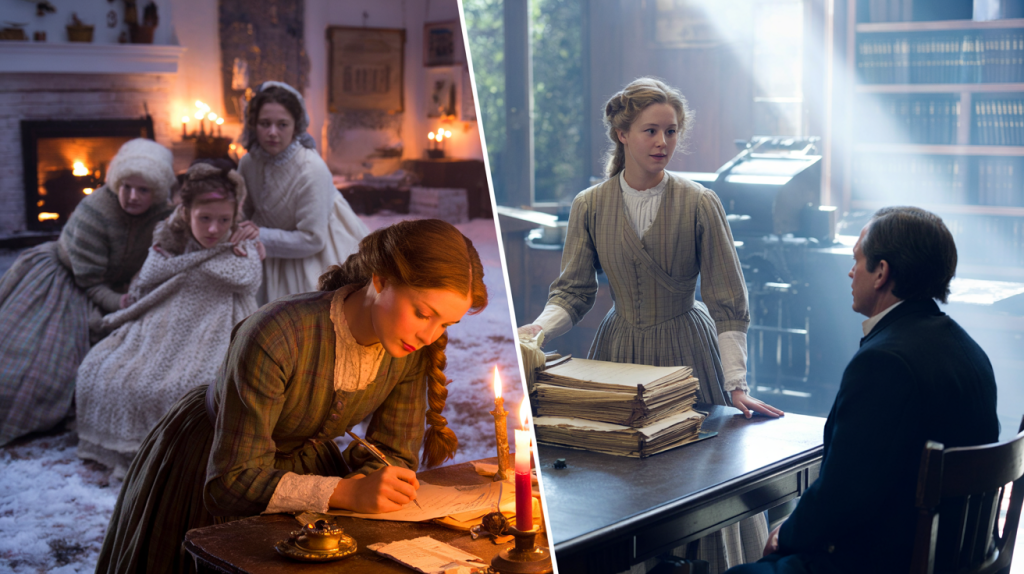
Little Women 2019 vs 1994 : the big differences that matter now
Two beloved films, one timeless novel. Gillian Armstrong’s 1994 Little Women arrived on December 21, 1994 with a linear, comforting telling of the March sisters’ journey. Greta Gerwig’s 2019 version, released December 25, 2019, flips the timeline, splices past with present, and turns Jo’s publishing battle into the emotional engine.
The numbers underline the split in impact. According to Box Office Mojo, the 2019 film earned about 218 million dollars worldwide on an estimated 40 million dollar budget, while the 1994 film took roughly 50 million dollars globally. Awards tell a similar story. The 2019 movie scored 6 Oscar nominations and won Best Costume Design. The 1994 classic earned 3 Oscar nominations, including Best Actress for Winona Ryder.
Cast and performances : Saoirse Ronan or Winona Ryder, Florence Pugh or Kirsten Dunst
Star power frames each era. The 1994 ensemble features Winona Ryder as Jo, Susan Sarandon as Marmee, Kirsten Dunst as young Amy, Claire Danes as Beth, Christian Bale as Laurie, and Gabriel Byrne as Professor Bhaer. Warmth and sincerity guide the performances, with a youthful spark that defined 90s coming-of-age drama.
The 2019 cast shifts textures. Saoirse Ronan brings a quicksilver Jo. Florence Pugh, nominated for Best Supporting Actress, delivers a fully realized Amy, equal parts ambition and vulnerability. Eliza Scanlen’s Beth is quiet resilience. Emma Watson’s Meg grounds the family. Timothée Chalamet’s Laurie reads fleet and mercurial. Laura Dern’s Marmee carries modern steel without losing tenderness, and Meryl Streep’s Aunt March adds tart, scene-stealing gravity.
Craft choices : timeline, look, music, and costumes with awards
Structure drives feeling. The 1994 film moves chronologically, and that steady line softens the harder turns. Beth’s illness unfolds as a gentle dread. Jo’s growth lands as a classic bildungsroman. It is inviting, uncluttered, faithful to the beats many read in school.
The 2019 film intercuts childhood glow with adult consequence. Scenes echo each other for maximum emotional hit. A dance in the past sits next to quiet grief in the present. The famous ending doubles as process story, tracking Jo’s negotiation for fair pay and control over her manuscript. That contract scene is not just meta. It reframes authorship and value in a way that resonated with a 2019 audience.
On the senses, both films linger. The 1994 score by Thomas Newman earned an Oscar nomination and wraps the story in wintery lyricism. The 2019 score by Alexandre Desplat was also Oscar nominated, light on its feet yet melancholy when needed. Costumes are a headline. Jacqueline Durran’s work in 2019 won the Oscar, using color to track time and character arcs. The 1994 wardrobe aims for textured authenticity that reads homey and lived in.
Box office, Oscars, and how to pick your Little Women tonight
Hard facts help with the tie-breaker. The 2019 film runs about 135 minutes and is rated PG. The 1994 version runs about 115 minutes and is also rated PG. Both are widely available to rent digitally in the United States and rotate through major streaming services depending on licensing windows.
Choosing between them is less a contest, more a mood check. One speaks in confident revision, the other in classic tenderness. Both honor Louisa May Alcott without smudging her voice.
If the search is for a quick guide, use this simple compass :
- Want pure comfort and a straight-through story : try 1994 for its linear arc, hearthside tone, and Winona Ryder’s Oscar-nominated Jo.
- Craving a modern spark and a sharper take on authorship : pick 2019 for the nonlinear structure and Jo’s contract showdown.
- Watching with teens new to Alcott : 2019 often lands fastest thanks to pace and Florence Pugh’s definitly layered Amy.
- Looking for holiday feels and snow-dusted nostalgia : 1994 brings the cozy textures and Thomas Newman’s gentle score.
- Curious about awards highlights : 2019 won the Costume Design Oscar and notched 6 nominations in total.
There is also the Laurie factor. Christian Bale’s 1994 Laurie reads earnest and romantic, anchored in restraint. Timothée Chalamet’s 2019 Laurie plays flirtatious bravado until the façade cracks. Two valid readings, two different emotional paths to the same proposal scene, each clarifying why Jo says no.
Finally, the big-picture takeaway for story lovers is about form. Linear storytelling in 1994 builds attachment through time spent and seasonal rhythms. The 2019 crosscutting compresses parallels, letting scenes answer each other across years. That edit choice changes how loss is felt and how ambition is seen, which is exactly why viewers keep debating which version to watch first.