
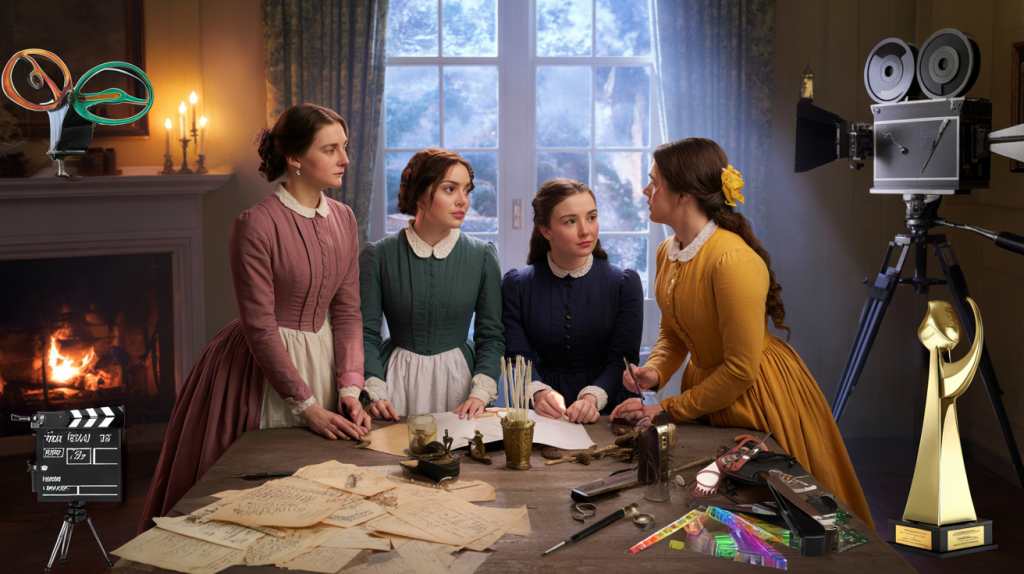
Awards, box office and craft: discover which “Little Women” versions rise to the top, from 1933 to Greta Gerwig’s 2019 sensation, without wasting a minute.
Looking for the best “Quatre filles du docteur March” to watch right now is a fair question. The story keeps returning to screens for a reason, and a few versions stand well above the rest. Greta Gerwig’s 2019 film earned about 218 million dollars worldwide and six Academy Award nominations, Gillian Armstrong’s 1994 hit drew roughly 95 million dollars and three Oscar nods, the 1933 classic won Best Adaptation, and the 1949 Technicolor remake collected an Oscar for art direction. That is a clear scoreboard.
Louisa May Alcott’s novel arrived in two volumes in 1868 and 1869, and filmmakers have been testing its heart, humor and ambition ever since. Across eras, the winning adaptations share measurable strengths: critical recognition, awards momentum, solid box office and ensembles that leave a trace. The picks below line up with those facts.
The criteria that crown the best “Little Women” adaptations
The main idea is simple: sort hype from history using public data. Fidelity to Alcott’s spirit matters, yet the decisive signals are on record. Think release dates, awards, money earned, and the durability of performances audiences return to decades later. When those align, the label “best” stops sounding subjective.
Viewers often stumble on the same frustration: too many versions, not enough time. A practical filter helps. Lift up the films that combined recognition in their moment with long tail influence in classrooms, living rooms and, yes, streaming queues. One more thing. Craft choices like structure, costumes and music are not just vibes when they show up in nominations.
Below are the adaptations that consistently appear at the top of lists, supported by concrete facts and dates. This is the short list people ask for when they want a definitive starting point.
- Little Women (2019) by Greta Gerwig : six Oscar nominations and one win, about 218 million dollars worldwide, with Saoirse Ronan and Florence Pugh driving fresh momentum.
- Little Women (1994) by Gillian Armstrong : three Oscar nominations, around 95 million dollars worldwide, Winona Ryder’s Best Actress nod marking its prestige run.
- Little Women (1933) by George Cukor : Academy Award for Best Adaptation at the 1934 ceremony, Katharine Hepburn’s Jo setting an early cinematic benchmark.
- Little Women (1949) by Mervyn LeRoy : Oscar for Best Art Direction and Set Decoration, Color at the 1950 ceremony, Technicolor glow with June Allyson and Elizabeth Taylor.
Greta Gerwig’s 2019 “Little Women” : numbers and craft in sync
Released in December 2019 by Sony, the film closed its global run at approximately 218 million dollars according to industry tallies. It received six Academy Award nominations including Best Picture, Best Actress for Saoirse Ronan and Best Supporting Actress for Florence Pugh, and won Best Costume Design. That award footprint is public, verifiable and hard to argue against.
Gerwig reorders the timeline, cutting between childhood and adulthood. The approach keeps Alcott’s arc intact while sharpening themes of authorship and economic choice. Sales figures and nominations suggest audiences and voters tracked that intent. Dialogue feels modern without abandoning period detail, a balance the costume win underlines.
For anyone asking where to start, the 2019 film solves the problem in one sitting. Contemporary pacing, recognizable cast, measurable impact. It is definitly the clearest on-ramp.
Gillian Armstrong’s 1994 version : prestige that aged with grace
Columbia Pictures released the film in December 1994. It earned approximately 95 million dollars worldwide and landed three Academy Award nominations: Best Actress for Winona Ryder, Best Original Score for Thomas Newman and Best Costume Design. Those figures placed it firmly among the season’s prestige titles.
The ensemble mattered: Ryder, Susan Sarandon, Christian Bale, Claire Danes and a young Kirsten Dunst. Period production and New England locations brought texture without excess. The film’s awards profile and long life on home media built a steady second act, the kind numbers over the years tend to confirm.
When classrooms screen “Little Women” for a 90s read, this is usually the version, not by opinion but by track record. It connects across ages while staying close to Alcott’s tone.
Golden age standards : 1933 George Cukor and 1949 Mervyn LeRoy
The 1933 adaptation, directed by George Cukor for RKO, won the Academy Award for Best Adaptation at the 1934 ceremony. Katharine Hepburn’s Jo arrives brisk and flinty, a performance many histories cite when mapping screen heroines before World War II. The award is a durable marker of its stature.
MGM’s 1949 Technicolor remake, directed by Mervyn LeRoy with June Allyson, Janet Leigh, Margaret O’Brien and Elizabeth Taylor, secured the Oscar for Best Art Direction and Set Decoration, Color in 1950. Production design and color strategy are not just trivia here. They define the viewing experience in a way the Academy formally recognized.
Seen together, the 1933 and 1949 films show how studio era craft shaped the March family on screen, then passed the baton to later adaptations with fresh cultural contexts. The two Oscars, separated by nearly two decades, make that influence visible in the record.