
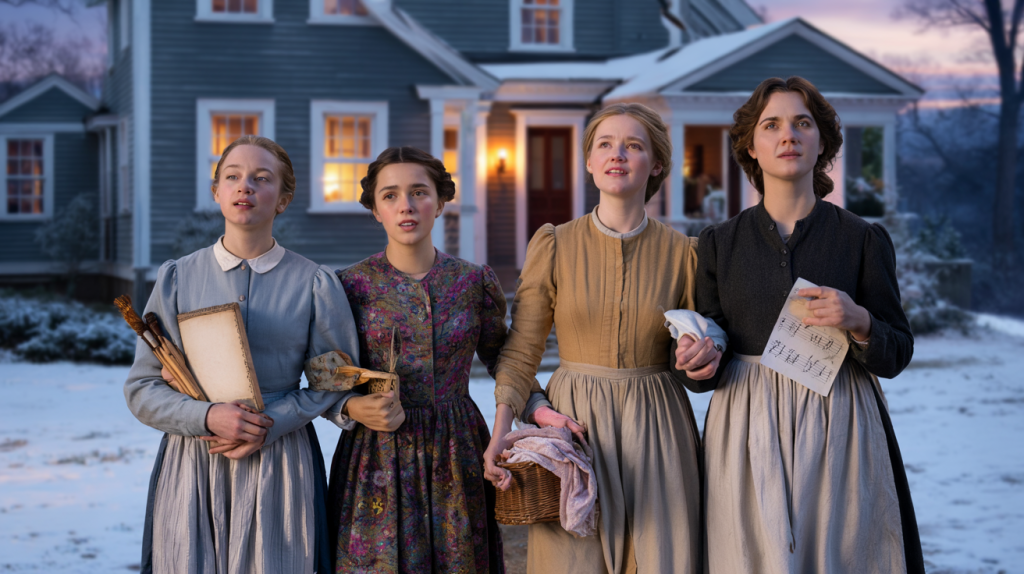
Searching for the best “Little Women” on film usually points to two towering choices right away. Greta Gerwig’s 2019 adaptation became a modern classic, earning 6 Academy Award nominations and winning Best Costume Design, while grossing 218.9 million dollars worldwide according to Box Office Mojo. Gillian Armstrong’s 1994 film, with Winona Ryder and Christian Bale, remains a holiday staple, recognized with 3 Oscar nominations and a worldwide gross reported around 95 million dollars.
Go back further and the studio-era gems still count. George Cukor’s 1933 version with Katharine Hepburn won the Academy Award for Best Adaptation at the 6th Oscars. Mervyn LeRoy’s Technicolor 1949 take won for Best Art Direction – Set Decoration, Color. Different eras, different textures, same core: Louisa May Alcott’s March sisters feel alive, and each film frames their ambitions in a language the time understood.
Why “Little Women” film adaptations stand out now
The main idea lands fast: audiences want a faithful heart with fresh eyes. That is why searches spike around the 2019 and 1994 versions, while curiosity still brings viewers to 1933 and 1949 for context and craft. The problem many face is simple: which version to start with tonight, and why.
Critical reception offers a clear signal. Rotten Tomatoes lists the 2019 film at 95 percent, a figure that rarely shifts by much, and the Academy of Motion Picture Arts and Sciences confirms its 6 nominations including Best Picture. Those numbers frame the conversation before a single scene plays.
To avoid a mismatch, think tone and pacing. One version reshuffles the timeline with confidence. Another leans into warmth. The classics bring period studio scale. Here is a quick, fact-first map.
– 2019 – Director : Greta Gerwig. Cast : Saoirse Ronan, Florence Pugh, Emma Watson, Eliza Scanlen, Timothée Chalamet, Laura Dern, Meryl Streep. Oscars : 6 nominations, 1 win (Best Costume Design) per the Academy. Box office : 218.9 million dollars worldwide (Box Office Mojo). RT : 95 percent (Rotten Tomatoes).
– 1994 – Director : Gillian Armstrong. Cast : Winona Ryder, Susan Sarandon, Claire Danes, Kirsten Dunst, Christian Bale. Oscars : 3 nominations including Best Actress for Winona Ryder (Academy). Worldwide gross : about 95 million dollars (Box Office Mojo/The Numbers).
– 1933 – Director : George Cukor. Cast : Katharine Hepburn, Joan Bennett, Frances Dee. Oscars : Best Adaptation win at the 6th Academy Awards (Academy).
– 1949 – Director : Mervyn LeRoy. Cast : June Allyson, Elizabeth Taylor, Janet Leigh, Margaret O’Brien. Oscars : Best Art Direction – Set Decoration, Color (Academy).
Greta Gerwig’s 2019 “Little Women” : numbers, impact, staying power
Released in the United States on 25 December 2019, Gerwig’s film played like a conversation with the novel. Nonlinear structure, an editorial framing of authorship, and a brisk tempo invited new viewers without losing the book’s generosity. The awards run confirms that balance: 6 Oscar nominations including Best Picture and Best Adapted Screenplay, plus Costume Design winner.
That reach turned into ticket sales. Box Office Mojo reports a 218.9 million dollar global haul, a robust figure for a literary adaptation in late December. It traveled well, it held into early 2020, and word-of-mouth stayed loud.
For families or classes comparing text to screen, this version makes analysis easy. Themes of creative labor and economic reality sit on the surface, and Florence Pugh’s Amy arc, widely cited in criticism at the time, shifts old debates into the present tense.
Gillian Armstrong’s 1994 film : warmth, performances, period texture
Armstrong’s version arrived on 21 December 1994 in the U.S. and felt instantly timeless. The Academy recognized it with three nominations: Best Actress for Winona Ryder, Best Original Score for Thomas Newman, and Best Costume Design. The Numbers and Box Office Mojo place the worldwide gross around 95 million dollars, notable for a mid-1990s period drama.
The draw here is ensemble chemistry. Young Kirsten Dunst’s Amy, Claire Danes’s Beth, and Susan Sarandon’s Marmee deliver a familial cadence that many viewers return to every winter. Production design and costuming support that glow without tipping into gloss.
Teachers often pick this cut for pacing and clarity. Scenes line up with chapters in a way that helps younger audiences track choices and consequences. No homework vibes, just humane storytelling.
Classic studio jewels : 1933 Cukor and 1949 LeRoy
George Cukor’s 1933 film did not just adapt the book – it helped define how Hollywood adapts literature. The Academy’s Best Adaptation award, given to Sarah Y. Mason and Victor Heerman, marks a formal recognition at a time when sound-era storytelling was still tightening screws.
Mervyn LeRoy’s 1949 remake shifts into Technicolor pageantry. The Oscar for Best Art Direction – Set Decoration, Color underlines its lavish look, while a young Elizabeth Taylor adds star heat that drew audiences into theaters.
Both versions read as history lessons and art objects. Watch them to see how studio systems staged domestic space, how dialogue clipped along in the 1930s and 1940s, and how Jo’s ambition was framed in each decade’s vocabulary. For completists, definitly essential.
So which to watch first. For a contemporary conversation with the text, pick 2019. For a comforting, chapter-friendly journey, choose 1994. For cinema history and award-winning craft, 1933 and 1949 close the loop, giving context that makes every later version feel newly earned.