
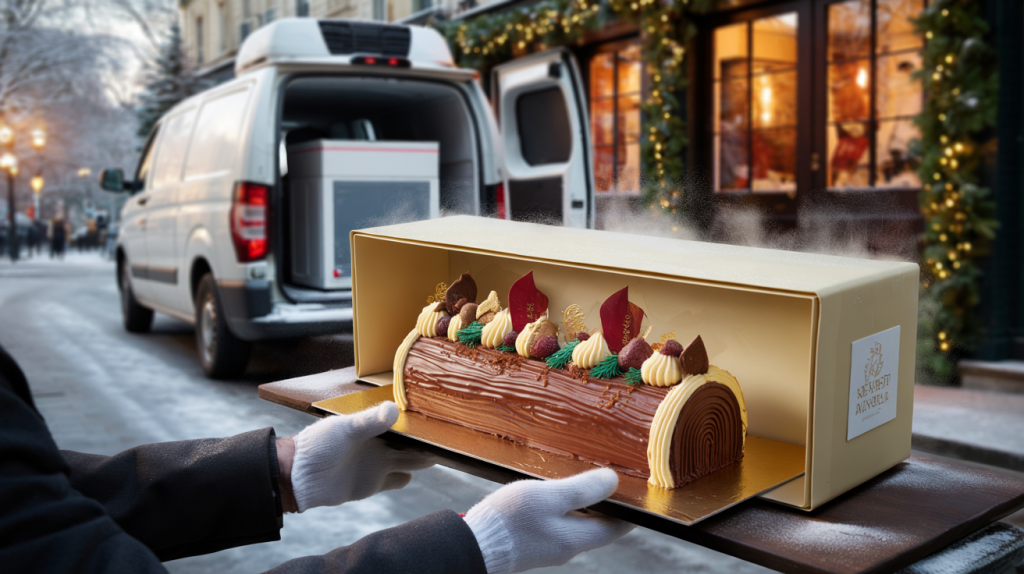
December clicks rise fast, and so does stress. A pastry-chef bûche de Noël can travel, yes, but only with the right logistics, the right slot, and a cold chain that never breaks. Here is how livraison bûche de Noël pâtissier actually works right now, so the log that arrives at your door looks like it does in the photos.
The core facts come first. Chilled desserts must stay between 0 and 4°C according to ANSES guidelines, which is exactly why pastry houses rely on refrigerated couriers or dedicated routes in town. Nationwide, cold delivery services such as Chronofresh operate next day for fresh goods with temperature control. And there is another pressure point: digital demand keeps climbing. FEVAD reported French e-commerce reached 159.9 billion euros in 2023, up 10.5 percent year over year, which squeezes festive delivery capacity even more in the last week before Christmas.
How livraison bûche de Noël works from the lab to your table
In the pastry lab, your bûche is finished as late as possible. It goes into a protective insert and a stiff, insulated box with cold packs. The courier collects within a narrow window, then heads directly to you or to a city hub where coolers wait. No mystery here, just a chain that stays cold from door to door.
Size matters for planning. A 500 g bûche usually serves 4, 700 g serves 6, and around 1 kg serves 8 to 10. Cream-based entremets need the fridge set between 0 and 4°C, the range ANSES recommends for chilled storage. An iced or sorbet bûche travels frozen and returns to service at -18°C storage, then softens at fridge temperature for texture.
Timing at home is the last meter. Once delivered, keep the box closed until plating. Most cream bûches reveal their best texture after 15 to 20 minutes at room temperature, while iced versions need a shorter bench time. Leftovers go back to the fridge within two hours and are best eaten within 48 hours.
Delivery slots, cut-offs, and what to expect on fees
Peak days are fixed by the calendar. The window from 20 to 24 December concentrates most deliveries, with the tightest capacity on 23 and 24. Many maisons keep nationwide cold shipping earlier in the week, then limit the last two days to city couriers and click and collect. That shift protects quality more than it drives sales.
Think of slots as inventory. Early-morning or early-afternoon arrivals mean cooler streets and fewer delays. Evening slots can collide with traffic and overbooked routes. A practical move: align delivery with someone at home and a cleared fridge shelf ready to accomodate the box upright.
Fees vary by zone and service level. City courier services charge for a timed window, while refrigerated national services price by weight and distance. Expect an added cost for temperature control, which pays for the cold chain and a dedicated handoff rather than a generic parcel drop.
Avoid the classic mistakes: checklist for a flawless bûche delivery
Simple moves prevent the common mishaps and keep pastry-chef work intact.
- Choose style by travel distance : cream entremets for city delivery, iced or frozen bûches for longer routes.
- Book before the last week : peak slots vanish around the third week of December.
- Pick a cooler slot : late morning or early afternoon beats evening runs.
- Confirm cold chain : ask for 0 to 4°C transport for chilled logs or frozen chain for iced styles.
- Prepare the fridge : one full shelf cleared, flat, and pre-chilled to 4°C.
- Plan the handoff : a reachable phone number, street access, and a contact authorized to receive.
- Rest time right before serving : 15 to 20 minutes for cream, shorter for iced.
- Keep a fallback : if the slot fails, switch to click and collect at the same shop if available.
Where to order : pastry-chef names, platforms, and nationwide options
Big maisons handle both city drops and cold shipping early in the week. In Paris and major cities, teams from houses like Pierre Hermé, Lenôtre, Philippe Conticini, Yann Couvreur or Cyril Lignac work with professional couriers trained for fragile cakes. These runs are short and controlled, often with a narrow delivery window to reduce risk.
For same-day or next-day in several French cities, platforms such as Epicery connect local patisseries to couriers who know how to carry boxed desserts upright. The value there is proximity: fewer kilometers, fewer bumps, and a delivery person who calls on arrival instead of leaving a box at the door.
Nationwide, refrigerated specialists such as Chronofresh operate temperature-controlled routes with next-day service for fresh products across metropolitan France. Those services keep desserts at 0 to 4°C, consistent with ANSES storage guidance, and hand off in person. When a maison closes national shipping after a certain date, it is to keep this cold chain realistic during the Christmas rush.
Let’s be honest. The last touch decides the story. A simple change of slot, an earlier ship date with overnight cold delivery, or a pivot to a city courier can turn a risky plan into a calm one. The only missing piece is speed: reserve while stock and slots remain, then align the handoff with a ready fridge and a serving plan that starts the minute the box walks in.