
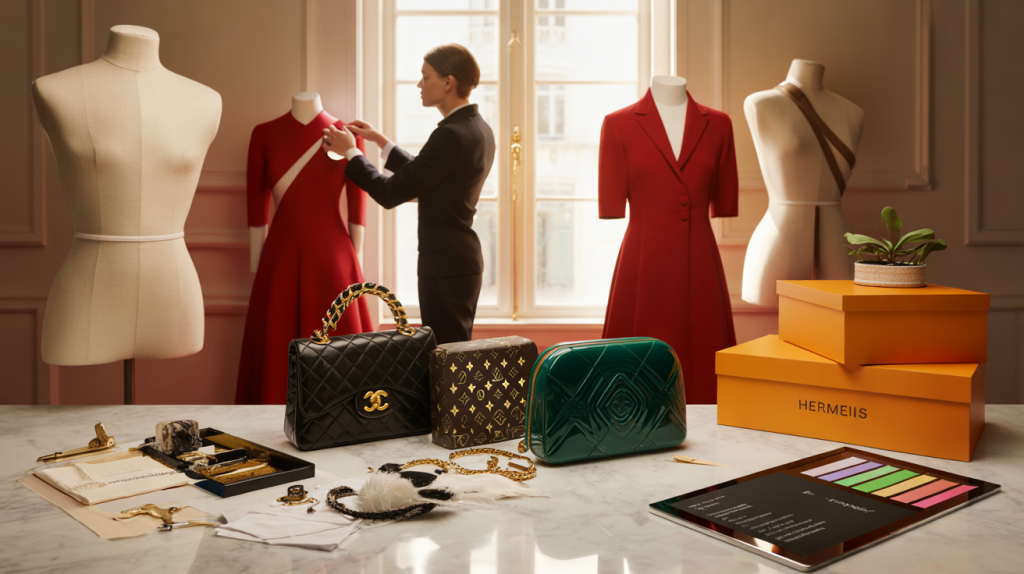
The luxury map shifts fast. One runway show, a single bag drop, and search trends spike across markets. Behind those jolts sit creative directors who tune desire, set prices, and dictate silhouettes that ripple from couture to street style within days.
The scale explains the heat. The personal luxury goods market reached €362 billion in 2023, up 4 percent at current exchange rates according to Bain and Company with Altagamma, with Europe resilient and the United States and China moving at different speeds. At group level, LVMH posted €86.2 billion in revenue for 2023, Hermès reported €13.4 billion, and Kering reached €19.6 billion, figures disclosed in their annual results.
Luxury fashion designers and market reality: where creativity meets hard data
Creative direction shapes sell-through, pricing, and cultural relevance. When a house changes its vision, the market reacts quickly in boutiques and on the resale platforms that mirror demand almost in real time.
Price dynamics clarify the stakes. Chanel has increased the price of its Classic Flap multiple times since 2020, with cumulative rises exceeding 60 percent since 2019 according to Reuters coverage of the brand’s pricing strategy. That momentum intersects with supply control, limited distribution, and a calendar that builds anticipation through pre-collections and special capsules.
Scale adds leverage. LVMH’s Fashion and Leather Goods division reported strong organic growth in 2023, supported by Louis Vuitton and Dior, while Hermès continued double-digit expansion fueled by leather goods capacity ramp-up and disciplined distribution, numbers detailed in company filings. Those facts set the backdrop for designers who must deliver consistency and novelty at once.
From Gucci to Valentino: creative director moves that shift sales
Leadership changes reframe entire categories. Sabato De Sarno debuted at Gucci in September 2023 during Milan Fashion Week, introducing pared-back tailoring and the Ancora red palette. Kering’s 2023 results placed Gucci as the group’s largest brand while navigating that transition, with figures presented in February 2024.
Alessandro Michele was annouced as creative director of Valentino in March 2024, following the exit of Pierpaolo Piccioli the same month. The appointment set expectations for a maximalist twist at a house known for couture prowess and a lucrative accessories engine.
Other shifts reshaped lineups. Sarah Burton left Alexander McQueen in 2023, with Seán McGirr named creative director in October 2023. Pharrell Williams took over Louis Vuitton Men in February 2023, unveiling his first show that June in Paris. Each move recalibrated aesthetics, marketing narratives, and celebrity dressing pipelines that directly impact store traffic and waitlists.
How luxury designers build desire: craft, icons, culture
Desire is manufactured with craft and consistency. Workshops expand capacity to meet demand without eroding exclusivity, as seen at Hermès where leather goods remain tightly controlled. Designers translate that craft into icons, from Dior’s Saddle to Bottega Veneta’s intrecciato, then push variations that keep core lines alive while adding seasonal energy.
Culture amplifies the message. Celebrity styling, music crossovers, and social media short-circuit the old runway-to-retail lag. Pharrell Williams at Louis Vuitton shows how a familiar voice can widen reach without losing luxury codes, while Maria Grazia Chiuri at Dior sustains a focus on artisanal detail and a defined silhouette that reads from a distance.
For readers tracking who to watch and when to act, simple signals help decode the noise.
- Consistency across three consecutive collections usually precedes a hit accessories cycle.
- Sell-out windows that compress from weeks to days indicate accelerating demand, not just marketing buzz.
- Price cadence matters. Fewer hikes with quality upgrades often signal long-term positioning rather than tactical scarcity.
- Secondary market stability on core items is a stronger sign than one-off spikes on limited editions.
- Fabric and hardware upgrades across entry lines suggest a house preparing for broader growth.
Prices, sustainability, and what comes next for luxury fashion designers
Pricing will keep testing the ceiling, but the framework is changing. Bain and Company projected a more normalized growth path into 2024, with macro headwinds and travel retail recovery moving at different speeds by region. At the same time, houses have linked creative strategy to impact goals. Kering has set a target to reduce absolute emissions by 40 percent by 2035 versus 2021, detailed in its climate roadmap, while groups continue to scale traceability pilots and repair services.
The creative calendar still anchors the industry. Four women’s and men’s fashion weeks across New York, London, Milan, and Paris bookend pre-collections, resort shows, and occasional couture. Designers who align storytelling with this rhythm, then translate it into retail windows and digital moments, tend to convert better at full price.
To read the next wave, combine three lenses. Track director tenure and the third collection inflection point. Follow official financials for revenue mix and comparable growth by region. Watch pricing announcements and materials upgrades on permanent lines. That simple dashboard helps separate momentum from a one-season spike and lets buying decisions accomodate real signals rather than noise.