
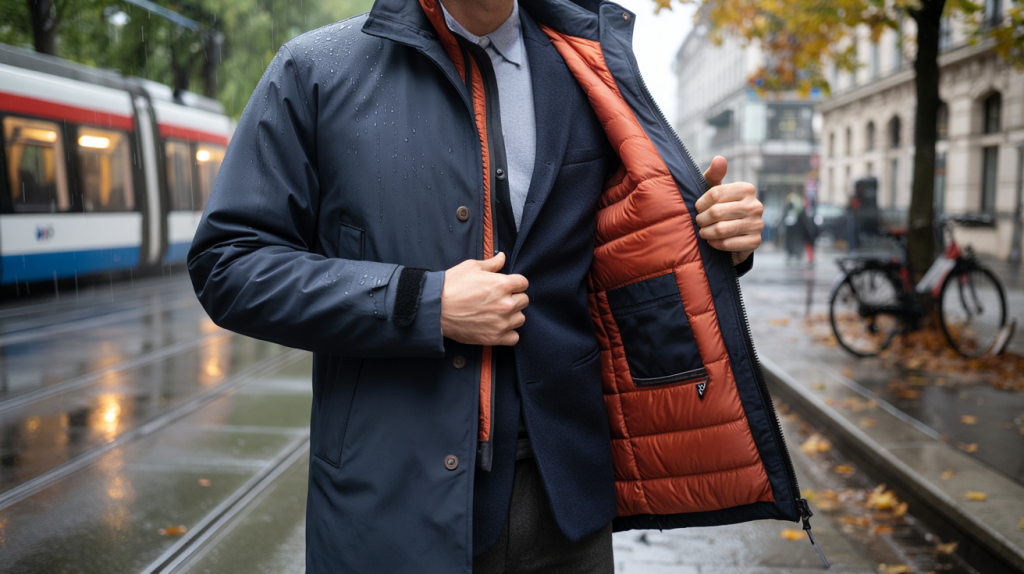
What is a manteau convertible with removable lining ?
Cold morning, mild afternoon, wet commute. A convertible coat with removable lining adapts to all three. The French phrase “manteau convertible doublure amovible” simply means a coat that lets the padded or fleece liner zip out, turning a winter piece into a lighter mid-season layer.
The idea solves a real-life hassle. One coat, two temperatures, less clutter. It answers a practical need right now: stretch a wardrobe without multiplying purchases, stay warm without overheating, stay dry without lugging heavy insulation every day.
Why a convertible coat pays off : durability, cost per wear et impact
Here is the wider frame. Textiles generate a notable footprint in Europe. The European Environment Agency reported in 2022 that EU consumption of textiles accounted per person for about 9 m³ of water use, 400 m² of land use et 270 kg CO₂-equivalent emissions (European Environment Agency, 2022).
Keeping one adaptable coat in rotation longer cuts that footprint. WRAP found that extending a garment’s active life by 9 months can reduce its carbon, water et waste footprints by 20 to 30 percent (WRAP, 2017). A convertible coat that works in October and in January raises actual wear count, which is the point.
Another data point adds context. The Ellen MacArthur Foundation noted in 2017 that less than 1 percent of clothing is recycled into new clothing, while a large share is landfilled or incinerated (Ellen MacArthur Foundation, 2017). Buying fewer, more versatile items helps sidestep that churn.
Buying guide : materials, waterproof ratings, zips, fit
Main idea first. A good convertible coat blends a weatherproof shell with a secure, easy-to-remove liner. The shell faces rain and wind. The liner brings warmth when temperatures drop.
Common mistake : focusing only on the liner’s warmth and ignoring the shell. Look for at least a 10,000 mm water column rating for regular city rain, plus taped or sealed seams. If winters get harsher, 15,000 mm and up improves storm performance.
Insulation has signals. Synthetic liners often list gram weight : 60 to 100 g for light warmth, 120 to 160 g for colder commutes. Down lists fill power : 650 to 800 indicates high loft, but down needs a water-resistant shell to stay effective in wet conditions.
Hardware matters. Weak attachment points ruin the experience. Prefer full-perimeter zips or multiple anchor snaps at collar, cuffs et hem. YKK or RiRi zippers are a plus. Test if sleeves of the liner stay aligned when moving.
Fit lives in layers. Try the coat over a blazer or thick knit. Shoulders should not bite, armholes need room, and the liner must not pull at the back when reaching forward. If in doubt, size for layering, not for a T-shirt-only fit.
Breathability keeps you comfortable. A shell with a listed breathability of 10,000 g/m²/24h or pit vents prevents that sticky, overheated feeling on public transport. City life demands stop-start comfort.
One last snag people hit : care. If the liner is down, check for a removable hood and baffles that keep feathers in place during washing. Synthetic liners are easier, but always read the care label before months of use. A quick habit now saves repairs later.
Quick checklist, saved for when the store lighting makes everything look great :
- Shell rating : at least 10,000 mm waterproof et taped seams
- Liner spec : 60-160 g synthetic or 650+ fill power down, secured sleeves
- Fastenings : full-perimeter zip or multi-point snaps, sturdy zipper brand
- Fit test : wear over a blazer, reach forward, no pulling at upper back
- Breathability : 10,000 g/m²/24h or vents for stop-start commutes
- Pockets : inside zip pocket for phone, fleece hand pockets for winter
- Care details : separate wash for liner, reproof shell when water stops beading
- Repairability : spare snaps, extra zipper pull, clear warranty terms
Care and daily use : commute to weekend, one coat all year
Observation from the street. The coat that gets worn most is the one by the door. Make it easy. In shoulder seasons, run only the shell over a sweater. When forecasts dip, zip in the liner in under a minute and go.
Cleaning rhythm helps the coat last. Wash the removable liner at lower frequency than shirts, close all zips, and dry thoroughly so insulation regains loft. Reproof the shell when raindrops stop beading on the surface, typically after a few dozen wears in wet weather.
Logical outcome : better utilisation. More wears per year spreads the purchase cost and the environmental cost across more days. That is where the data above meets daily comfort, quietly.
Missing piece that ties it all together : sizing for your real life. If travel is frequent, a mid-thigh length packs easier than a long hem. If cycling, look for a two-way front zip for saddle comfort. Occassionally, the small details decide whether a coat becomes a staple or a regret.
Sources : European Environment Agency, 2022 ; WRAP, 2017 ; Ellen MacArthur Foundation, 2017.