
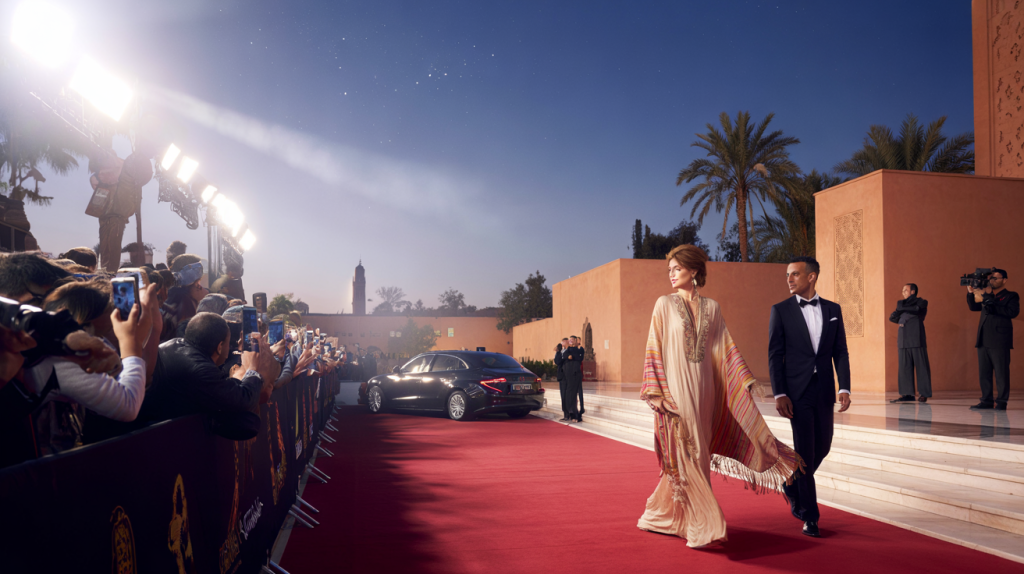
Marrakech International Film Festival red carpet: what happens and where
Spotlights blaze against terracotta walls, music swells, and the steps of the Palais des Congrès turn into a catwalk for global cinema. The Marrakech International Film Festival, launched in 2001 according to the Marrakech International Film Festival Foundation, stages one of North Africa’s most photogenic red carpets – a nightly ritual before gala screenings that draws industry icons and curious locals alike.
Here is the context that matters fast : this is an open city moment. While invitations control access inside, the arrival line unfolds in public view outside the Palais des Congrès, and crowds often gather along barriers to watch gowns, caftans and tuxedos sweep in. The festival runs annually at the end of the year, and the foundation – chaired by Prince Moulay Rachid – anchors the official ceremonies in the modern conference district while Marrakech’s old medina hosts free screenings on Jemaa el‑Fna.
How to attend the red carpet in Marrakech without an invitation
Main idea first: you can see the red carpet without a badge. Plan to arrive early at the Palais des Congrès plaza in Hivernage, where security sets up fan areas along the approach route. Staff guide spectators to viewing zones, and once the first black cars roll in, the flow is steady and exciting. Phones up, yes, but eyes up too – the silhouettes against the sunset are the Marrakech moment people remember.
There is a common snag. Visitors show up too late and end up three rows back, missing the name calls and the quick step-and-repeat. Better timing wins. Red carpet arrivals typically begin shortly before the evening gala, and in Marrakech traffic can compress everything. Leave a time cushion, hydrate, and keep your angle: side-on views near the photo call often yield the clearest shots.
Concrete context helps. The Moroccan Cinema Center states that Morocco offers a 30 percent cash rebate on eligible film spends, a policy that keeps international productions, talent and industry press flowing through the country. That incentive, cited by the Centre Cinématographique Marocain, indirectly fuels the festival’s draw – the red carpet gathers people who are already working or premiering films in the region.
Dress code, timing and etiquette on the red carpet
Observation: Marrakech is elegant but not stiff. You will see haute couture beside tailored Moroccan caftans, and many guests adopt a touch of local craft – embroidery, sabra silk, a djellaba coat after dark. Spectators do not need formalwear, though evening-smart always photographs better next to spotlights and marble.
- Arrive at least 45 minutes before gala arrivals to secure a front spot along the barriers.
- Choose comfortable shoes – you will stand, and sometimes wait, longer than planned.
- Respect security lines and photo pits; crossing tape means losing your place.
- Low-light settings favor steady video and night-mode photos; hold for 3–5 seconds.
- If asking for a selfie, be brief and step back quickly so the line continues.
A small but useful tip: the plaza breeze can be cool after sunset, even in November. A light shawl or blazer saves the ocassion. And yes, the light changes fast – golden hour flips to neon in minutes – so set your camera exposure before the first arrivals.
Why this red carpet matters for cinema in Morocco
The festival’s red carpet is not only glitter. Since 2001, as the foundation notes, Marrakech has positioned itself as a bridge between Arab, African and global cinema, with public tributes and open-air screenings on Jemaa el‑Fna turning cinephilia into a citywide ritual. The nightly arrivals signal who is in conversation with that mission: directors unveiling new work, actors presenting premieres, craftspeople championing design.
Numbers anchor the story. A launch year is not just a date – 2001 marked Morocco’s push to platform cinema culture at scale, while the 30 percent production rebate from the Moroccan Cinema Center illustrates the structural bet on screen industries. Put together, there is a pipeline: productions shoot in Ouarzazate or Casablanca, post in Rabat, then step onto the Marrakech red carpet to meet audiences and press.
The missing link many travelers overlook is proximity. Unlike larger closed-door festivals, the Marrakech red carpet lives in a public square feel, where residents and visitors share the same threshold to the official program. That shared threshold is the point: the carpet is a stage, but also an invitation – arrive early, stand where the light hits, and let the Ochre City do the rest.