
Martin Parr, at a glance: dates, works, style
Martin Parr has spent five decades turning everyday life into unforgettable pictures. Born on 23 May 1952 in Epsom, England, the British photographer became famous for saturated color, ring-flash intimacy, and an unflinching look at leisure, consumer habits, and the quirks of modern life. Think seaside chips, package holidays, posh parties, and real people in real moments. And yes, the colors pop.
Key milestones frame this biography. Martin Parr studied photography at Manchester Polytechnic from 1970 to 1973. The breakthrough arrived with the mid 1980s series “The Last Resort”, shot in New Brighton and published in 1986. He joined Magnum Photos in 1994 and served as its president from 2013 to 2017. The National Portrait Gallery presented “Only Human: Photographs by Martin Parr” in 2019, and the Martin Parr Foundation opened in Bristol in 2017 to champion British and Irish photography. The arc is clear and still active.
Early years to Magnum: the making of a singular eye
Curiosity started early. As a teenager, Martin Parr spent summers visiting his grandfather, a keen amateur photographer, and picked up the craft by watching and trying. The move to Manchester in 1970 locked in the vocation. By the mid 1970s, Martin Parr lived in West Yorkshire and photographed Hebden Bridge’s communities, laying the groundwork for a lifelong interest in social rituals and the texture of place.
The shift from black and white to bold color in the early 1980s changed everything. Martin Parr embraced 35 mm, flash, and a close-up perspective that felt both comic and forensic. “The Last Resort” captured British seaside life during the decade’s economic and cultural churn, sparking debate and attention. Then came “The Cost of Living” in 1989, moving through middle-class interiors, and the global travel satire “Small World” in 1995, a sharp look at tourism’s clichés.
Recognition followed with speed. Martin Parr published over 100 photobooks across his career, edited many more, and exhibited widely. Membership of Magnum Photos in 1994 cemented his influence inside the documentary tradition, while pushing its language toward color, irony, and directness. That dual identity – insider of a classic agency, challenger of its visual habits – defines much of his impact.
Style, debates, and why Martin Parr’s work endures
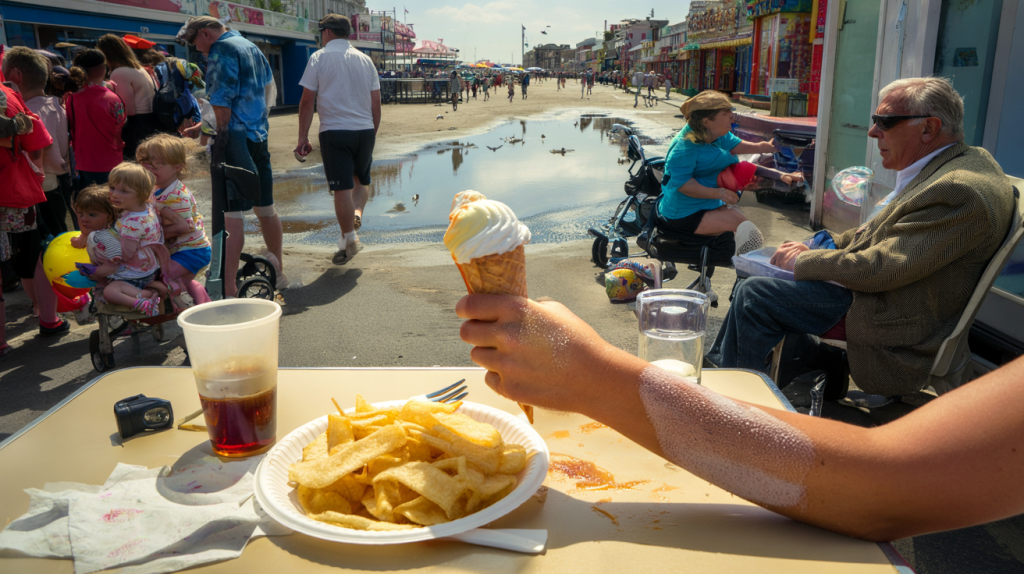
Let’s be concrete about the style. Martin Parr uses saturated color, on-camera flash, and a tight frame to isolate gestures and objects – a dripping ice cream, a sunburned shoulder, a logo, a paper plate. The pictures read fast, then keep talking. They tell how branding slips into daily life, how leisure looks on a wet Tuesday, how people occupy public space together.
Critics sometimes misread the humor as mockery. Context helps. Martin Parr photographs across classes and countries, applying the same unblinking gaze to luxury parties, art fairs, and budget beaches. The impulse is cataloguing social performance rather than pointing fingers. Closeness creates comedy, but also dignity, which is why the images stick rather than sneer. And yes, the work can sting – that is part of the documentary tradition he inhabits.
Institutional roles widened the field of action. Between 2013 and 2017, Martin Parr led Magnum Photos through a period of digital transition. In 2017, the Martin Parr Foundation opened in Bristol to support British and Irish photography through exhibitions, grants, and an archive that includes Martin Parr’s own papers and prints. The 2019 National Portrait Gallery show “Only Human” mapped how identity and national mood surfaced in portraits from the 1990s to the 2010s.
Where to start: essential series, books, and places to see Martin Parr
New to the work or returning after a while, the quickest path is through the landmark series and titles. Each one opens a door into a different social stage, with dates that help anchor the journey.
– The Last Resort (1986) – British seaside life in New Brighton, shot 1983 to 1985
– The Cost of Living (1989) – middle-class rituals in late 1980s Britain
– Small World (1995) – tourism’s global choreography under a bright, unsparing light
– Common Sense (1999) – extreme color and detail, a punchy catalogue of consumption
– Think of England (2000) – a wry, affectionate portrait of national habits
– Only Human: Photographs by Martin Parr (2019) – portraits that track identity and change
For in-person discovery, the Martin Parr Foundation in Bristol – founded in 2017 – hosts exhibitions, talks, and research visits. The space preserves Martin Parr’s archive and showcases other photographers whose work dialogues with British social history. Major public collections also hold Martin Parr prints, and the photobooks remain widely available through publishers and libraries. A practical tip: browsing the books in sequence reveals how the language tightened from the 1980s to the 2000s, then loosened again around portraiture in the 2010s.
A last note that makes the picture complete. Martin Parr’s biography is not a single line through British life but a set of returns: to beaches, fairs, queues, posh rooms, and budget flights. The consistency lets readers compare eras. The details – a logo changing, a plate switching material, a posture repeating – tell the slow story of culture. That is why this work still feels urgent today, and why exploring beyond the famous images definitly pays off.