
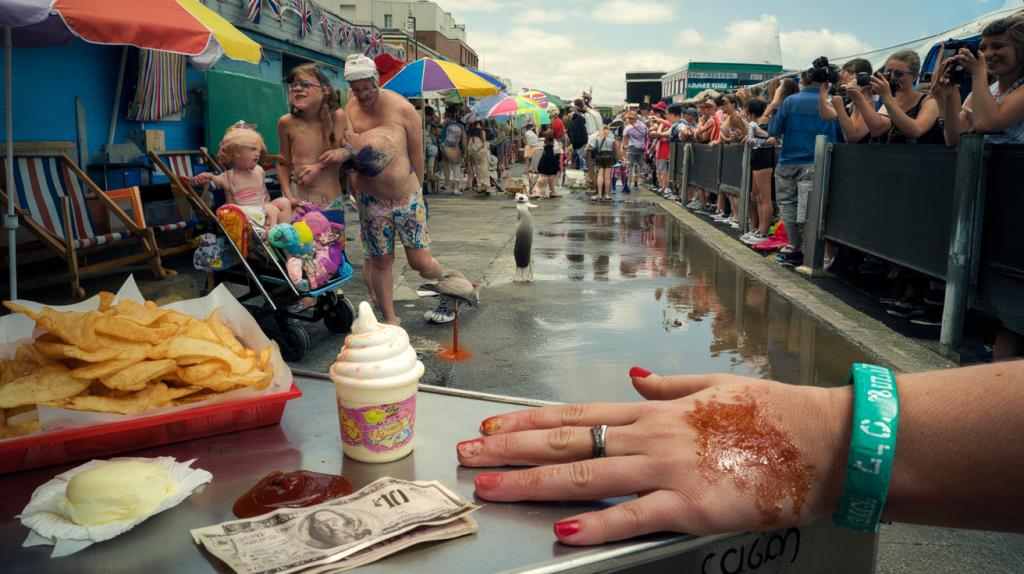
Martin Parr is the documentary photographer who turned everyday British life into sharp, saturated theatre. Think plastic trays, sunburned shoulders, greed and joy, all captured with a gaze that is both affectionate and unsparing. A key member of Magnum Photos since 1994, Parr helped push color documentary into the mainstream, and built a global following with images that feel funny until they sting.
The essentials come fast. Born in 1952 in Epsom, England, Parr made his name with The Last Resort, shot in New Brighton in the mid 1980s and published in 1986, a series that ignited debate about class and dignity. He later dissected mass tourism in Small World in 1995, then the British character with Think of England in 2000. According to the Martin Parr Foundation, he has published over 100 books and edited about 30, and joined Magnum Photos in 1988 before becoming a full member in 1994. The National Portrait Gallery in London staged Only Human from 7 March to 27 May 2019, proof that his way of seeing keeps landing in major institutions.
Martin Parr, documentary photographer of British life
The central idea is simple. Parr documents the ordinary, then reveals what our habits say about who we are. He watches how people eat, queue, flirt, spend, holiday. The humor draws attention. The detail keeps it. The result is documentary that entertains and informs at the same time.
There was a problem he could solve. Color documentary once struggled for respect. By embracing ring flash, close focus and unapologetically bright palettes, Parr made color carry meaning rather than just prettiness. That approach gave social observation a new visual punch, and a recognisable signature.
Travel changed his scope. As global tourism exploded, Parr found a universal stage. The United Nations World Tourism Organization reported 1.4 billion international tourist arrivals in 2018, a rise of 6 percent year on year. Source : UNWTO, 2019. Small World, first published in 1995, captured the early wave of that boom, from selfie precursors to coach queues, showing how leisure becomes a ritual.
From The Last Resort to Small World : key series and dates
Parr’s series often come with precise places and years, which helps readers anchor the work and assess the context. A few landmarks define the arc of his career and the evolution of his look.
In The Last Resort, shot between 1983 and 1985 and published in 1986, Parr photographed families at the seaside in New Brighton. Lurid color, sticky counters, overloaded prams, and the chaos of pleasure. The work was hugely debated in the UK press at the time for how it portrayed working class holidaymakers, and it cemented his reputation as both witty and relentless.
Then came Small World in 1995, a globe-spanning study of tourism culture, released as a photobook that is still regularly reprinted. Think of England arrived in 2000, turning the gaze back onto pubs, fairs, churches and national rituals during a period of rapid change. Earlier black and white projects like The Non Conformists, shot in West Yorkshire between 1975 and 1980 and published in 2013, show how his attention to community predates the signature color style.
In institutional terms, Martin Parr joined Magnum Photos in 1988, became a full member in 1994, and later served as the agency’s president between 2014 and 2017. Source : Magnum Photos. His museum footprint grew steadily, with Only Human at the National Portrait Gallery, London, running from 7 March to 27 May 2019. Source : National Portrait Gallery.
Style, ethics and the Parr debate
What makes a Parr image feel definitly Parr. The ring flash flattens light, the close-up exaggerates texture, and the saturated color pushes detail into the spotlight. Cake icing, sun lotion, crumpled notes, nail varnish, all rendered with hyper-clarity. The style looks comic at first glance, then shifts into critique.
Ethics keep returning as a topic around his work. Some critics argue the gaze can be mocking, especially in The Last Resort. Others counter that the camera treats leisure, consumption and class with the same intensity in every setting, whether a budget beach or an art fair. The debate matters, because it asks what documentary owes its subjects, and what audiences do with their own complicity when they laugh.
An easy mistake when reading Parr is to stop at the color and the joke. The smarter reading tracks behavior and systems. In Small World, queues, branded umbrellas and guided poses map an industry that, as the UNWTO numbers show, grew into billions of trips a year. The bright surface becomes evidence for how tourism standardises experience.
Where to see Martin Parr today : books, shows and the Martin Parr Foundation
Parr’s work is widely accessible. The Martin Parr Foundation, established in Bristol in 2017, preserves and presents British documentary photography and his own archive. Source : Martin Parr Foundation. Major prints are held in international collections, and new commissions continue to appear around elections, seaside seasons and local rituals.
For readers building a viewing path, printed books remain the best entry point, since Parr sequences images for narrative impact and rhythm. Libraries and bookshops stock core titles, and the Foundation regularly reissues rarities. Exhibitions like Only Human, with portraits made in the wake of the 2016 referendum, show how he updates long running themes to match current moods.
Want a lean starting kit that still feels complete. Try one early, one mid career, one contemporary, then add a deep cut for context.
- The Last Resort, 1986 : British seaside leisure in the mid 1980s
- Small World, 1995 : mass tourism across continents
- Think of England, 2000 : ritual, pride and awkward charm in the UK
- The Non Conformists, photographs 1975 to 1980, book 2013 : early community work in West Yorkshire
Why the work still lands today comes down to clarity. Parr builds images that read instantly on a phone, then reward long looking in a book or gallery. The data points set the context, the color sets the hook, and the social reading keeps the mind busy. That balance is rare in documentary, and it explains the staying power.