
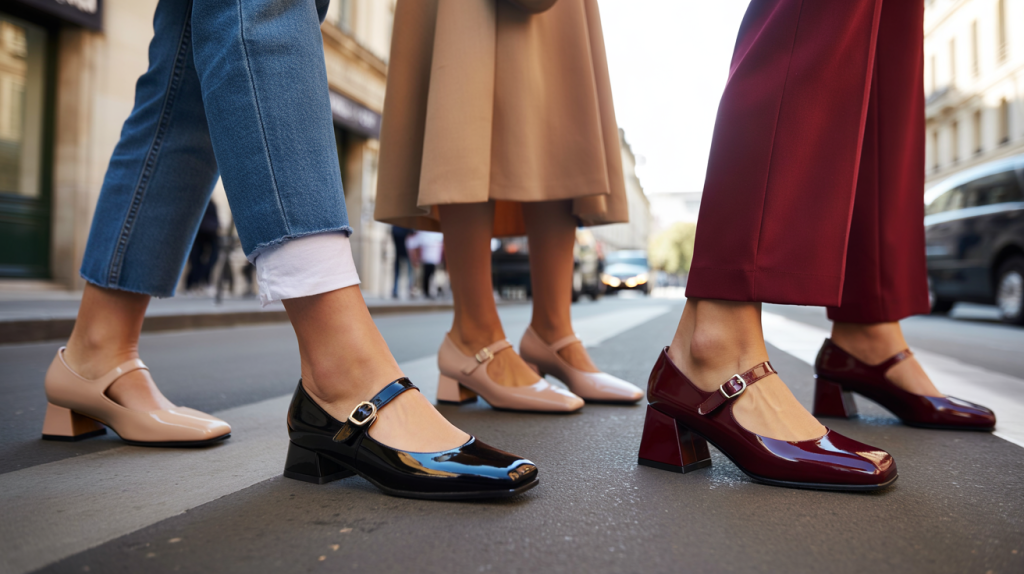
One strap, instant charm. Mary Jane shoes for women, known in France as “babies”, have surged from nostalgic favorite to everyday staple. Office looks, date nights, weekend denim, they handle all three without fuss and with a confident, modern edge.
The appeal feels simple. A secure strap, a rounded or almond toe, a flat or block heel, materials that move from glossy patent to soft nappa. The style reads polished yet friendly. That balance explains the revival across runways and street style, while solving a real problem many have with pumps that slip or loafers that pinch.
Women’s Mary Jane shoes in 2024 : why the “babies” win now
There is context behind the trend. The term “Mary Jane” entered fashion language in the early twentieth century. Merriam-Webster lists its first known use in 1904, a date that roots the silhouette in timelessness rather than a fleeting fad.
That heritage matters because it influences how the shoe behaves today. With one strap, the foot feels held. The look stays neat even in motion, a detail loved by commuters and anyone who walks a lot between meetings. Designers have leaned into that practicality while playing with proportion, from low flats to chunky platforms, from matte calf to mirror patent.
Seen on city pavements, the shoe solves a daily dilemma. Sneakers feel too casual for some settings, stiletto pumps feel too fragile for long days. A Mary Jane hits that middle ground, flattering the ankle, adding structure, and keeping a human level of comfort. It is fashion with a bit of grace.
How to choose Mary Janes : fit, comfort, materials that last
Sizing comes first. The American Academy of Orthopaedic Surgeons advises leaving about one half inch of space in front of the longest toe, roughly 1.3 cm, so the foot can move without friction. Source : AAOS, “How to Select Shoes”.
Heel height changes pressure patterns. The American Podiatric Medical Association encourages lower daily heels, under 2 inches, to reduce forefoot strain and help posture across a full day. Source : APMA footwear guidance.
European sizing works on Paris points. ISO 19407 defines one Paris point as 6.67 mm, a useful number if you oscillate between sizes or sit between a 38 and 39. Source : ISO 19407 shoe sizing standard.
Materials signal both comfort and lifespan. Full‑grain calf adapts to the foot after a few wears and resists creasing. Patent creates a sharp, mirror finish yet needs care around scuffs. Suede feels soft and molds quickly, better for dry days. A strap with several holes or a discreet elastic insert helps adjust for midday swelling, which typically increases as hours pass.
If the strap rubs, a quick fix helps. A gel dot under the buckle or a thin moleskin strip under the strap’s edge smooths contact. Insoles with a gentle arch keep the foot from sliding forward inside block heel versions. Small tweaks, big comfort gains.
- Try shoes late in the day : feet are slightly larger, so the fit you approve then will remain comfortable.
- Check toe room : about 1.3 cm beyond the longest toe, as AAOS recommends.
- Test the strap : secure without cutting in, with at least two alternative holes.
- Pick heel types for the setting : flat or low block for commute, mid block for desk to dinner.
- Read lining details : leather lining breathes better than synthetics in warm months.
Outfits that work : flats, block heels, platforms, and the “babies” effect
Flats pair with straight jeans and crisp shirts for a clean line that still feels dressed. The strap keeps the shoe from reading too minimal, which helps balance cropped hems or ankle length trousers.
Low block heels lift tailoring without the wobble of thin stilettos. A mid heel Mary Jane with a narrow strap sits well with midi skirts, pleated dresses, or suits when a classic pump feels too formal.
Platforms flip the mood to playful. Think minidresses or wide leg trousers that skim the top of the shoe. The strap prevents sliding on smooth floors and adds a visual break that shortens the foot, which many find flattering in photos.
Color moves the needle. Black patent for graphic clarity. Nude leather that matches skin tone for a leg lengthening effect. Deep burgundy or forest green for fall textures. Metallics turn into party pieces and photograph beautifully at night. Pick one for the occassion and the rest follows.
Care and smart shopping : price ranges, longevity, trusted cues
Rotation extends life. Alternating pairs across days lets leather dry and return to shape, which reduces creasing and odor. Cedar shoe trees help maintain the vamp and control moisture overnight.
Maintenance is simple and pays back fast. A cream polish every few weeks nourishes smooth leather. Patent likes a gentle microfibre wipe and a dab of petroleum jelly on scuffs. Suede responds to a soft brush and a protective spray before the first wear.
When shopping online, measure both feet on a sheet of paper and compare with the brand’s size chart in millimeters, not only EU or US labels. Remember the Paris point step of 6.67 mm from ISO helps explain why some brands run snug or roomy by a third of a size. Look for return windows and strap hole count in the product photos. More holes usually means a safer fit across seasons.
A final note on build quality. A stitched outsole outlasts simple cemented constructions, especially on pairs you plan to resole. Leather lining and a stable heel base add years. Those details turn Mary Janes from a trend purchase into a reliable part of a weekly rotation, which is really the point of a great “babies” shoe.