
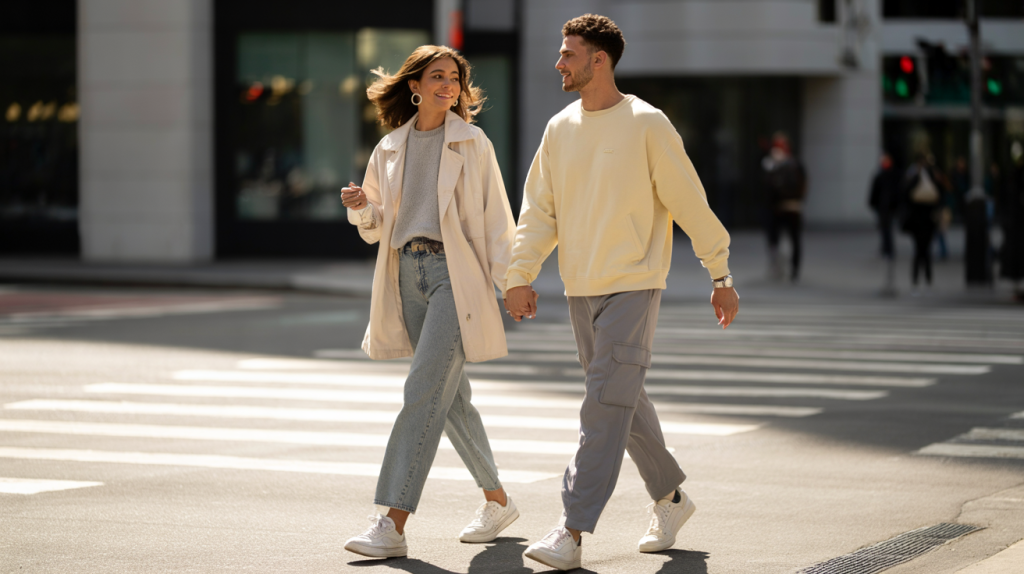
Matching couple outfits are back in everyday life and feeds, from airport fits to low-key coffee runs. People type “tenues assorties couple” because they want coordinated looks that read modern, not costume. The shift is visible where style spreads: Accenture projects social commerce to hit 1.2 trillion dollars by 2025, driven largely by Gen Z and Millennials Accenture, 2022. TikTok passed 1.5 billion monthly active users in 2023, so one short video can set the tone for how couples dress next weekend Statista, 2023.
Gifting habits push the trend into real life. The National Retail Federation expects Valentine’s Day 2024 spending at 25.8 billion dollars, with 19 percent of shoppers planning to gift clothing, a natural entry point for coordinated looks NRF, 2024. So the goal is clear: pick outfits that sync in color, vibe, and context, then wear them comfortably in photos and IRL.
Matching couple outfits in 2024 : what the trend really solves
The main idea lands fast. Coordinated dressing creates visual cohesion, which photographs better and makes planning easier. One shared color or fabric ties two wardrobes without forcing identical pieces.
There is also practicality. Packing for a trip or a wedding guest weekend gets simpler when both aim for the same palette and dress code. The result travels well on camera and works under different lighting.
Social reach adds momentum. With platforms amplifying micro trends at speed, a simple pairing – denim on denim, olive with cream, black with metal accents – becomes a repeatable formula that couples can adapt to body types and budgets.
Tenues assorties couple : simple style rules that always work
People hesitate because matchy looks can feel staged. The fix is to coordinate, not clone. Keep it relaxed and intentional.
Try these rules when building a duo look:
- Start with one color pallete and echo it twice, for example navy jacket for one, navy sneakers for the other.
- Match fabrics or textures, not just colors: linen with linen in summer, wool with wool in winter.
- Balance fits so silhouettes talk to each other: wide-leg with cropped top on one, straight-leg with relaxed sweater on the other.
- Repeat one accessory family only once each: metal tone, cap, belt, or bag logo. Then stop.
- Shift shades to avoid clones: charcoal with light grey, sand with camel, forest with sage.
- Think background: city concrete likes contrast, beaches need lighter tones that do not glare on camera.
Outfit formulas for dates, trips, and big moments
Weeknight date. One wears a black knit polo with dark denim and loafers, the other a black ribbed dress with low heels and a silver hoop. The silver repeats once and the knits align in texture.
Saturday city stroll. A cream sweatshirt pairs with grey cargos and white sneakers, the partner picks a cream trench over grey jeans and retro runners. The cream-into-grey theme holds in both layers.
Travel day. Matching nylon outer layers in different cuts – bomber and anorak – sit over tees, both with navy track pants. Luggage straps in the same color quietly tie it up for photos.
Wedding guest. One goes midnight blue suit with a subtle stripe, the other chooses a midnight blue slip dress with a soft wrap. Keep metals in the same tone to avoid visual noise.
Where to shop, how much to spend, and when to order
Capsules come together fastest with modular basics. Uniqlo, H and M, and COS cover neutral tees, chinos, and outer layers that mix seamlessly. Streetwear labels and sportswear – Nike and Adidas tracksuits or sneakers – give easy twin moments without shouting.
Looking for custom prints or dates on tees and sweatshirts for proposals or anniversaries. Marketplaces like Etsy gather independent makers who offer color options for both cuts, useful when sizes or fits differ.
Budget ranges vary by fabric and construction. Cotton tees sit from 10 to 40 dollars, midweight overshirts from 40 to 120 dollars, and tailored separates from 150 dollars upward. Plan shipping early for events – two weeks for made-to-order is common – and check return windows, which sit around 30 days at many retailers.
The last gap to close is timing. Use the event date to anchor choices, then lock the shared palette first. With one color family chosen, every other decision gets faster and the photos read clean on any feed.