
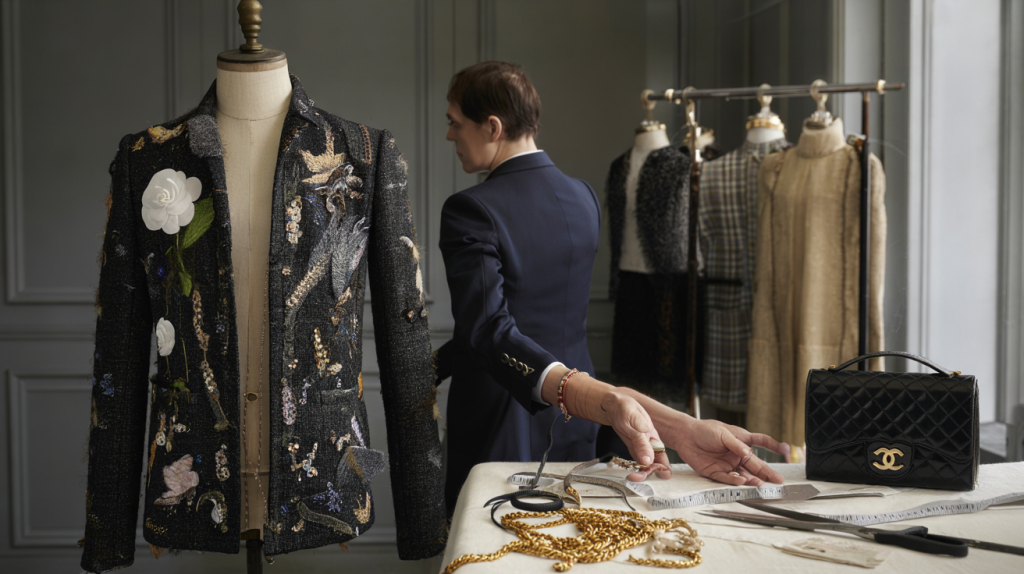
Matthieu Blazy’s name sits at the center of fashion’s favorite question : who will steer Chanel after Virginie Viard’s June 2024 departure. All eyes lock onto the house’s most telling stage – the Métiers d’Art collection – because it concentrates Chanel’s craft, image and business in one high-stakes moment.
Métiers d’Art, created in 2002 by Karl Lagerfeld, traditionally unfolds each December to spotlight the specialist ateliers gathered under Chanel’s Paraffection. Recent stops say a lot : Dakar on 6 December 2022, then Manchester on 7 December 2023. With leadership in transition, the timing and direction of the next Métiers d’Art chapter are under close watch.
Matthieu Blazy : career facts and why his name surfaces at Chanel
Matthieu Blazy built a reputation on rigorous craft made deceptively effortless. After early acclaim at Maison Martin Margiela’s Artisanal line, he contributed at Céline under Phoebe Philo, then worked at Calvin Klein with Raf Simons. He joined Bottega Veneta in 2020, was appointed creative director in November 2021, and unveiled his first collection in February 2022.
That debut crystallized his signature : trompe-l’oeil leather that looks like denim, quiet tailoring with obsessive construction, and materials worked to the limit. The approach aligns with Métiers d’Art’s purpose – celebrate artisanship that reads modern on the street, not just on a museum plinth. Which explains the chatter. Fashion media have repeatedly listed Matthieu Blazy among potential successors at Chanel following June 2024. As of late 2024, though, Chanel had not named a new creative director.
The market context weighs in. Chanel reported revenue of about 19.7 billion dollars for 2023, up 16 percent at constant currency, with operating profit around 6.4 billion dollars. Those numbers, shared in May 2024 in the brand’s annual update, frame Métiers d’Art not as a niche capsule but as a growth engine for image, leather goods and ready-to-wear.
Chanel Métiers d’Art : what it represents, where it travels, who makes it
Born in 2002 to keep couture-level skills alive, Métiers d’Art is the runway that spotlights the maisons of Paraffection – the Chanel entity set up in 1997 to support specialist craft. Think Lesage for embroidery, Montex for embellishment, Lemarié for feathers and flowers, Goossens for metalwork, Massaro for shoes, Maison Michel for millinery. The ecosystem counts more than 30 ateliers, each with its own language and century-old gestures.
The show travels because place matters to the story. Salzburg in 2014, Rome in 2015, Hamburg in 2017, New York in 2018. Then a pivot to new cultural dialogues : Dakar on 6 December 2022, a first for a European luxury house at that scale in Senegal, and Manchester on 7 December 2023, where music heritage and British tailoring shaped the vibe. Dates are consistent – early December – and the narrative is always tightly woven to the city.
Production runs deep. Métiers d’Art pieces can require hundreds of hours, from hand-pleated silks to gold-smithing. The collection lands at boutiques with boutique-level quantities, yet it radiates far beyond the runway lookbook. Campaigns, exhibitions, and capsule drops extend the afterglow for months. That is the point : craft meets modern life.
What to watch next : appointment timing, show logistics, and realistic scenarios
The question people ask first is blunt : could Matthieu Blazy take charge in time to shape the next Métiers d’Art. Short answer – appointment dates determine everything. Métiers d’Art involves long development cycles across multiple ateliers, fittings, and site-specific staging. An external hire usually needs runway to build a team and align suppliers. When appointments arrive late in the year, brands often recalibrate dates or formats rather than rush a flagship show.
Contracts matter as well. Matthieu Blazy leads Bottega Veneta, part of Kering. Any move between groups tends to include notice periods and sometimes non-compete clauses. Those legal mechanics set the practical horizon for creative handovers. Past transitions inside Chanel moved faster because the successor had already been embedded. An external arrival typically follows a measured ramp-up.
Signals worth tracking are public and simple. First, an official Chanel appointment – name, title, start date. Second, a location announcement, which historically precedes a December Métiers d’Art by months so that artisans can tailor the story to the place. Third, a preview of atelier collaborations, often teased through workshops or exhibitions tied to the city. Until those appear, speculation keeps spinning while production reality stays quiet.
Where does this leave the Métiers d’Art conversation around Matthieu Blazy. The craft alignment is evident, the brand stakes are large, and the calendar is the real constraint. A definitly pragmatic reading is this : look for concrete corporate statements and calendar updates, not rumor loops, to understand when – and how – the next Métiers d’Art will crystallize.