
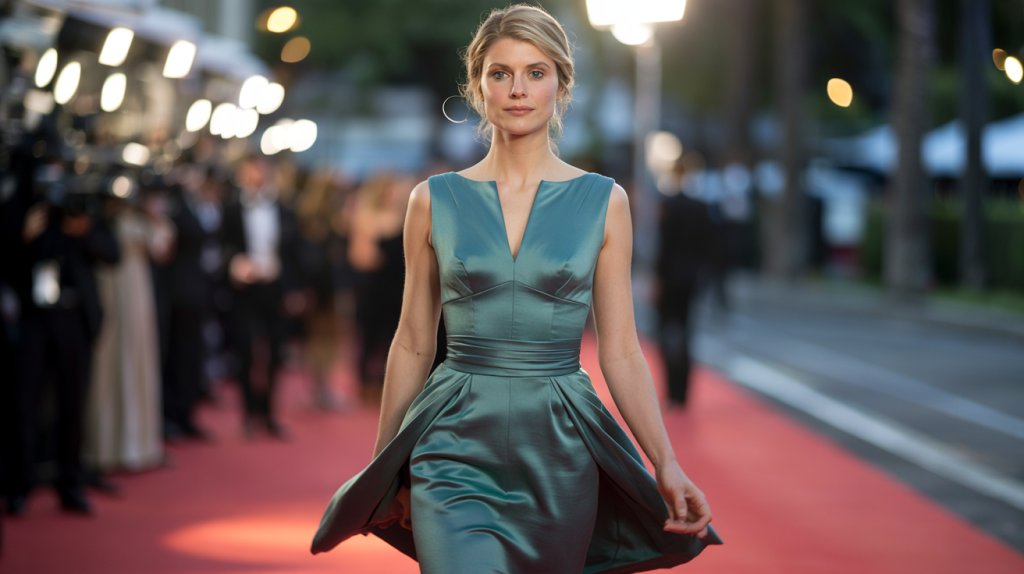
Spotlight on a silhouette that stops conversations. When French star Mélanie Laurent steps out in a wasp-waist dress, the eye goes straight to the cinched middle, then glides along flowing fabric. That is the essence of the “robe taille de guêpe” many search for: a sharp, sculpted waist balanced by graceful volume. The effect reads instantly on camera, on a red carpet, even across a street.
Context matters. Mélanie Laurent is not only the face from “Inglourious Basterds” – released in 2009 and grossing over 321 million dollars worldwide according to Box Office Mojo – she is also a filmmaker who co-won the César Award for Best Documentary Film in 2016 for “Demain”, after receiving the César for Most Promising Actress in 2007. She even hosted the Cannes Film Festival’s opening and closing ceremonies in 2011, per the festival. A résumé like that keeps lenses pointed her way, and a wasp-waist dress makes every frame stronger.
Mélanie Laurent and the wasp-waist dress: why the look works
The main idea is simple: structure the waist and let the rest breathe. A “robe taille de guêpe” uses tailoring, boning, or clever seams to narrow the midsection while skimming hips and legs. On Mélanie Laurent, the silhouette feels effortless because proportion takes the lead, not fuss or excess detail.
There is more than taste behind this. Research led by Devendra Singh in the 1990s found that a waist-to-hip ratio around 0.7 tends to be perceived as balanced and harmonious across cultures, with a seminal paper published in 1993 in the Journal of Personality and Social Psychology. Designers translate that idea with darts, waist seams, and strategic hemlines that frame the torso without squeezing it.
The problem many face: recreating this star-grade result without corsetry mishaps or stiff fabrics. On carpets from Cannes to Paris premieres, Mélanie Laurent’s dresses often land the proportions first, then add texture. That order changes everything.
Red carpet decoding: fabrics, cuts, and the cinched effect
Look closely at the architecture. A fitted bodice stabilizes the waist, sometimes with light boning or a hidden grosgrain. The skirt follows with movement – bias-cut silk, soft crepe, or tulle that floats. The eye reads a clear middle, then softness. That contrast delivers the wasp-waist illusion without strain.
Common mistakes show up fast: belts sitting too high, stiff satin that reflects in harsh blocks, or over-tight lacing that buckles seams. By contrast, Mélanie Laurent’s best looks lean on matte finishes, precise waist placement at the natural bend, and skirts that release volume right below the seam. The silhouette stays silouette, not armor.
A helpful benchmark comes from timing and tailoring. A simple alteration appointment, even 20 minutes for repositioning a waist seam or taking in side darts, can shift the line from standard to custom. That is the quiet secret behind the red carpet effect.
Style tips to channel the “robe taille de guêpe” at any budget
Here is the practical route that mirrors what works on Mélanie Laurent while staying wearable day to night.
- Pick structure up top: look for bodices with darts, princess seams, or a V-shaped waist seam that points to the center.
- Choose matte fabrics for the torso and fluid fabrics for the skirt to keep the waist crisp and the hem light.
- Place the waist where your torso naturally bends – not under the bust, not on the ribs.
- Swap belts for self-fabric sashes about 2 to 3 cm wider than standard – they cinch without cutting.
- Use shapewear lightly, or try a slip that smooths without compressing the waist seam.
- Hem length counts: midi that shows the slimmest part of the calf often balances a defined waist.
- Tailor, then accessorize. Even a 1 cm dart can change posture and presence on camera.
Sustainability and fit: the missing links that elevate the silhouette
Mélanie Laurent’s environmental work adds a layer to the story. “Demain” put solutions in focus in 2015, and the message travels to wardrobes too. Extending garment life with small alterations is not only chic – it is proven to help. According to WRAP’s “Valuing Our Clothes” report, extending the active life of clothing by nine months can cut carbon, water, and waste footprints by around 20 to 30 percent in the UK.
That dovetails with the wasp-waist approach. Invest in fit where it matters most – the waist seam, the bodice, the hem – then let fabric move. The result looks refined on screen and feels comfortable off it. It also means fewer one-night dresses and more pieces worn again, just styled differently.
So the formula that keeps cameras locked on Mélanie Laurent is not mysterious: sharp waist, soft movement, honest textures, and a hint of tailoring. With those ingredients, the “robe taille de guêpe” moves from red carpet fantasy to a quietly powerful everyday tool.