
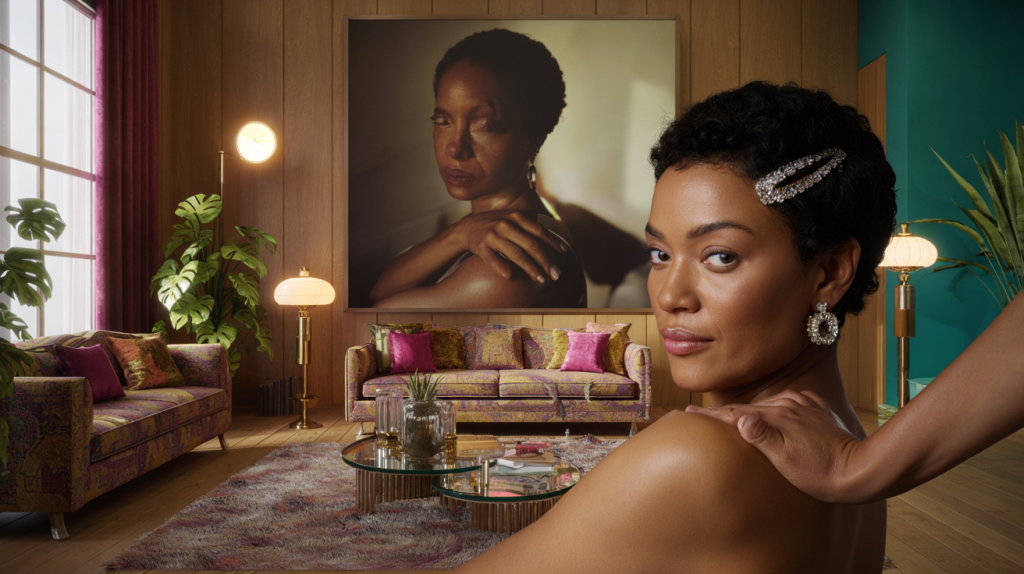
Inside the blockbuster show “Mickalene Thomas: All About Love” – what it reveals, what to notice, and why the title changes the whole conversation.
What is “Mickalene Thomas: All About Love”?
“Mickalene Thomas: All About Love” is a wide-angle museum survey that places beauty, intimacy, and power at the center of the conversation. Glittering rhinestones, saturated color, and 1970s-inspired interiors pull you in fast. Then the work starts peeling back layers of art history, sexuality, and Black womanhood with rare precision.
Staged by major institutions and spanning more than two decades of practice, the show maps Thomas’s evolution from late 1990s collages to recent large-scale paintings, photographs, and room-sized sets. The title nods directly to bell hooks’s landmark book “All About Love: New Visions” published in 2000 – love not as cliché, but as a social ethic and a method.
Inside Mickalene Thomas’s language : rhinestones, interiors, and care
Mickalene Thomas, born in 1971 in Camden, New Jersey, built a signature visual language out of acrylic, enamel, and rhinestones on wood panels, plus photography and video. The sparkle is not decoration. It is a strategy to re-stage who gets to shine in the canon and on the wall.
Her sitters – often friends, lovers, and collaborators – hold the gaze. Pose becomes agency. You will spot references to Édouard Manet’s 1863 “Le Déjeuner sur l’herbe” or Henri Matisse’s odalisques from the 1920s, but the power dynamic flips. Those old pictures invited viewing from one direction. Thomas’s do not.
Domestic sets appear as upholstered sanctuaries. Wood paneling, patterned textiles, and shag rugs evoke family rooms of the 1970s. They are not just stylish backdrops. They stage care. The interiors echo the ethos of bell hooks – tenderness as structure, not soft extra.
Why “All About Love” matters : from bell hooks to museum walls
The title changes how the work reads. bell hooks framed love as a practice with clarity and courage in 2000. She wrote about honesty, commitment, and community as the architecture of love. Thomas translates that thinking into images and spaces people can enter.
Look at the portraits of Sandra Bush, the artist’s mother, recurring since the 2000s. They track presence, aging, and devotion without sentimentality. The 2012 short film “Happy Birthday to a Beautiful Woman” – later broadcast by HBO in 2014 – adds voice and time to the archive. It sits within the exhibition logic like a heartbeat.
There is also a straight art history throughline. Thomas’s 2012 Brooklyn Museum exhibition “Origin of the Universe” put her in direct dialogue with canonical nudes and modernist color. “All About Love” expands the frame to include care networks and the politics of visibility. Same rigor, wider world.
How to experience the exhibit : what to look for and why it matters
Visitors sometimes rush the sparkle. Slow down. The surfaces are built – paint, paper, faux fur, wood veneer, then those rhinestones that catch light differently at every step.
Plan for a loop between mediums. Start with the paintings, move to collage and photographs, then walk the domestic installations. Seeing those moves across media reveals how Thomas composes identity like a set – and why it lands.
Five smart ways to get the most out of “All About Love” :
- Stand off-center with the large rhinestone works to watch the light shift across the face and body.
- Compare a work that cites Manet or Matisse with the historical image on your phone – year by year, the power recentering is clear.
- Read the wall text around bell hooks’s “All About Love” from 2000, then re-enter the galleries with that lens.
- Look closely at fabrics and veneers. Those materials carry memory – living rooms, salons, clubs – not just design.
- Leave time for the film components. They ground the glamour in lived time and voice.
Miss one piece, and an entire thread might slip by. The portraits ask for eye contact. The interiors want your body in the space. Even the photo collages hint at how culture is cut, pasted, and claimed.
A quick practical note : exhibitions of this scale often use timed tickets and sell out on weekends. Weekday afternoons are calmer. Audio guides, if available, help track references across the galleries and keep you from treating the show like a single-room selfie stop.
The bigger picture sits in plain sight. Thomas has spent more than 20 years building a counter-canon where Black women set the terms of beauty, desire, and representation. The exibit title underlines the method. Love, here, is craft plus ethics – how the work is made, how it looks back, and how it holds a room together.