
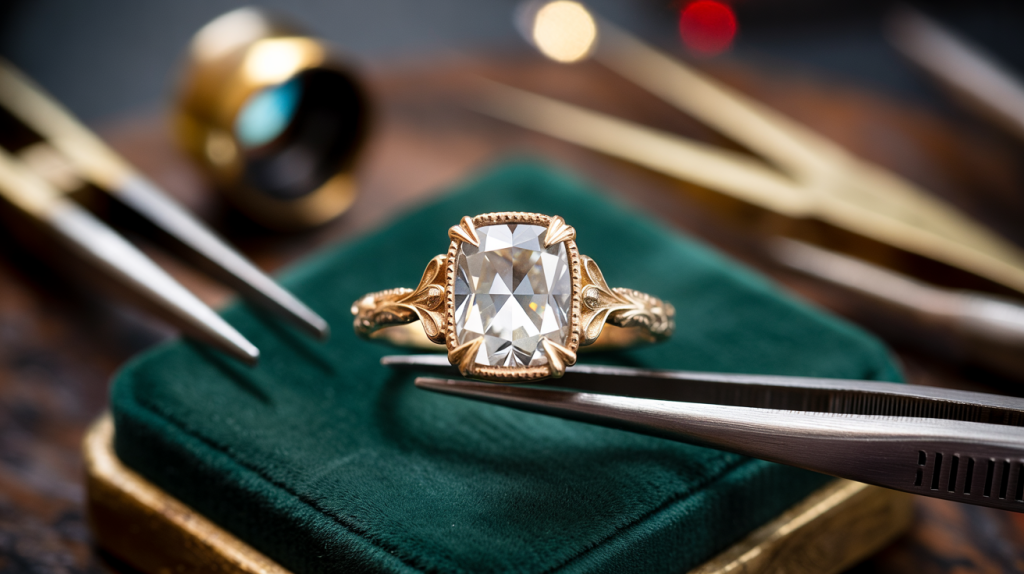
Yes, there is a clear answer. Miley Cyrus’s engagement ring was created by celebrity jeweler Neil Lane, a vintage specialist known for old mine cuts and ornate settings that read like Hollywood history. The piece that appeared during her 2012 engagement to Liam Hemsworth became one of the most searched rings of the decade.
What set it apart was not just sparkle but provenance. According to People in June 2012, Neil Lane set a hand-cut 19th century cushion diamond in handcrafted 18 karat gold, with a floral-inspired motif that nodded to Victorian romance. That mix of era and craftsmanship turned a personal symbol into a pop culture artifact (People, June 2012).
Who designed Miley Cyrus’s engagement ring : Neil Lane, the vintage jeweler of record
Neil Lane built a career around antique stones and period detailing, long before the ring entered the Miley Cyrus timeline. His name shows up on red carpets and on television franchises that lean into fairy-tale proposals, giving him a steady presence in the celebrity engagement space. The Cyrus piece fit his language: old diamond, warm gold, tailored silhouette.
The designer described sourcing antique diamonds for their character, then creating settings that honor the stone’s era rather than overpower it. That approach appears in the Cyrus ring, whose center diamond predates modern cutting standards, bringing softer facets and a candlelight glow rather than a laser-bright flash (People, June 2012).
The attention was immediate. Entertainment outlets highlighted that the ring’s core dates back to the 1800s, while the mount was newly handcrafted for Miley Cyrus, pairing history with present-tense celebrity visibility. The result felt deliberate, not generic.
The design details that made Miley Cyrus’s ring stand out
Design lives in the details. The Cyrus ring combined a cushion-cut antique diamond with an 18 karat gold setting shaped to echo botanical lines. That warm gold played against the stone’s older faceting style, which often shows broader flashes rather than tight scintillation, reinforcing the vintage mood.
People’s June 2012 report credits Neil Lane with the ring’s 19th century center, custom-fitted into a romantic, handcrafted mount. The aesthetic read as quietly lavish: not oversized, not iced-out, but textured, sculpted, and personal. It looked like a story on the finger, not just a carat count.
When Miley Cyrus later shared images during happier periods, the ring kept its narrative weight without any design tweaks, an indicator that the original brief landed exactly where it needed to.
Timeline : 2012 engagement, glimpses in 2016, wedding in 2018
The public timeline is straight. Engagement news surfaced in June 2012 with the Neil Lane ring front and center, documented by People at the time (People, June 2012). After a split and reconciliation, Miley Cyrus was photographed wearing the same ring again in early 2016, a detail covered by outlets that track celebrity style reappearances (People, January 2016).
Wedding photos posted in late December 2018 confirmed the couple had married in Tennessee, a private ceremony that capped years of on-off headlines (People, December 2018). The marriage ended later. The divorce was finalized in early 2020 according to widely cited court records reported by major entertainment newsrooms (People, January 2020).
The ring’s public arc mirrors that relationship arc, which is part of why the design still gets searched today. Fans remember the images and the precise look of that antique center stone.
How to spot Neil Lane’s signature and find a similar vintage-inspired ring
For readers hunting for a cousin to the Cyrus design, the secret sits in era, proportion, and craft. Neil Lane’s language is consistent across collections and custom work, so knowing the cues helps.
Here is a simple field guide that avoids guesswork and keeps budgets in focus :
- Seek antique or antique-style center stones, especially old mine or old European cuts, which show broader, romantic flashes rather than modern sparkle patterns.
- Choose warmer metals like 18 karat yellow or rose gold to complement vintage faceting and amplify that heirloom mood.
- Look for sculpted, hand-done details, from floral or foliate motifs to milgrain and tiny beadwork, rather than factory-smooth minimal mounts.
- Verify provenance when an antique center is claimed, asking for period assessments and any lab documents that cite cut style and approximate era.
- Prioritize a balanced silhouette over size, keeping finger coverage tasteful so the design feels wearable long-term.
One note on sourcing. Media coverage tied to Miley Cyrus references a 19th century diamond set freshly by Neil Lane in 2012, an approach that marries antique centers with modern craftsmanship for durability and fit (People, June 2012). This hybrid path remains common in high end vintage-inspired work, since original mounts often cannot meet contemporary wear expectations.
Culturally, the ring’s recognizability keeps resurfacing when Miley Cyrus enters a new musical cycle. Search spikes tend to follow major releases, a reminder that jewelry stories travel with the music. When a new era is unvieled, the ring history is pulled back into conversation, and that Neil Lane credit returns to top of mind.
For collectors and engaged couples, the takeaway is practical. If the goal is that same quiet romance, start with an old-cut center if possible, then commission or select a handcrafted gold setting that respects the stone’s age. That is exactly where the Miley Cyrus ring began in 2012, and why the designer behind it still gets named first when the question comes up.