
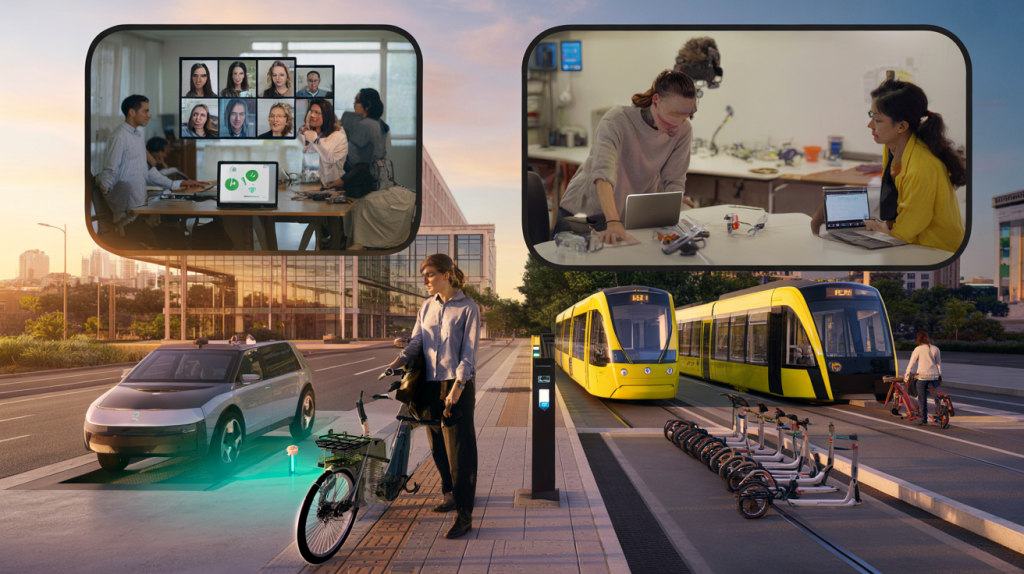
Mode mixte 2026 is not a buzzword. It is the way offices fill up midweek, classrooms stream lessons after lunch, and commuters hop between bike, train and EV on a single trip. The shift already started: 58% of U.S. workers can work remotely at least part of the week according to McKinsey in 2022, while Eurostat reported that 24% of EU employees worked from home at least occasionally in 2022. That is the everyday baseline pushing companies, schools and cities to retool by 2026.
Education felt the jolt first when school closures impacted 1.6 billion learners in 2020, UNESCO says. Learning gaps documented in OECD’s PISA 2022 – including the largest recorded drop in mathematics performance across OECD countries – still echo in lesson plans and exam rooms. Mobility is pivoting too: the IEA counted over 14 million electric cars sold in 2023, an 18% global market share, which reshapes charging and trip planning. The picture is clear: mixed-mode becomes default, not plan B.
Mode mixte 2026: definition, stakes and a moving deadline
At its core, mode mixte blends physical and digital participation, staggered time schedules and multi-modal movement. The aim is simple: better outcomes with fewer frictions.
The stakes grow as cities get denser. The United Nations estimates 56% of the world’s population lived in urban areas in 2023, with 68% projected by 2050. More people in tighter spaces means every timetable, classroom and intersection needs flexibility built in by design.
One more constraint sits in the background: budgets. Hybrid offers savings on real estate, energy and travel, yet only if usage is predictable. Without data-led planning, empty rooms and overcrowded peaks coexist – the worst mix.
Hybrid education in 2026: what works after the PISA shock
Schools and universities now mix in-person labs with recorded lectures and live Q&A. The goal is to recover learning while keeping access high for absent students and apprentices on the move.
Evidence helps redraw the map. UNESCO’s 2020 figure of 1.6 billion learners affected explains why asynchronous content remains standard. OECD’s PISA 2022 results justify targeted in-person blocks for mathematics and reading, where practice and feedback still outperform pure online delivery.
One common mistake keeps surfacing: technology first, pedagogy later. A better order is to set clear learning outcomes, then pick the right combo – seminar on site, small-group coaching online, assessment secured in person. Simple, but often skipped in the rush to equip.
Hybrid work in 2026: from policy to predictable rhythm
The search intent is blunt: how many days, and which ones. McKinsey’s 2022 survey found 58% of workers can go remote at least weekly. Eurostat observed 24% in the EU worked from home at least occasionally in 2022, with wide country variation. This is not a fad; it is the labor market’s steady state.
Teams that thrive settle on a cadence. Two anchor days for collaboration, two for deep work, one flexible – a pattern that reduces context-switching and crowding. What breaks hybrid fast are unclear rules, uneven workload for on-site staff, and meeting overload that punishes remote colleagues.
Facilities follow the data. Badge entries, room bookings and project milestones reveal true demand. That is what shrinks footprint without hurting delivery, and what aligns cleaning, security and café staffing. Small note: ignoring these signals tends to backfire and costs pile up, quick.
Mixed mobility in 2026: chaining modes without the headache
Mode mixte on the move is about chaining. Walk-bus-rail-scooter. Car-park-tram. The IEA’s 2024 data on EVs – 14 million sales in 2023, 18% share – highlights another layer: charging stops become part of trip planning, not an afterthought.
Cities nudge this along with reliable headways and integrated ticketing. Open standards already exist for timetables and vehicle locations, which powers real-time apps and Mobility-as-a-Service offers. The payoff is shorter door-to-door times and fewer private car trips during peaks.
One trap to avoid is treating micromobility as decor. If bike lanes are discontinuous or parking is chaotic, mode mixing collapses at the first transfer. Small gaps break whole journeys.
To hit the ground running in 2026, here is a compact checklist that leaders in schools, firms and city halls can adapt today :
- Define the default rhythm: who meets where, and on which days, then publish it.
- Align assessment and presence: key exams and labs in person, feedback loops online.
- Instrument spaces: collect anonymous occupancy, booking and travel data, then act monthly.
- Prioritize transfers: fix the weak link between modes – safe last kilometer beats flashy features.
- Train managers and teachers on facilitation, not just tools – hybrid is a people skill.
- Measure outcomes quarterly: learning gains, productivity, and commute time, not only attendance.
What ties all this together is interoperability more than shiny hardware. Calendars that sync across teams, learning platforms that talk to registrars, transit passes that unlock bikes and buses on the same account. Nothing fancy, just systems that agree on the same IDs and time windows.
The last missing piece is trust. People accept mixed-mode schedules when they are predictable and fair. Publish the rules, share the metrics, and adjust by season. By 2026, the winners will be those who adress hybrid not as a side project, but as the operating system of daily life.