
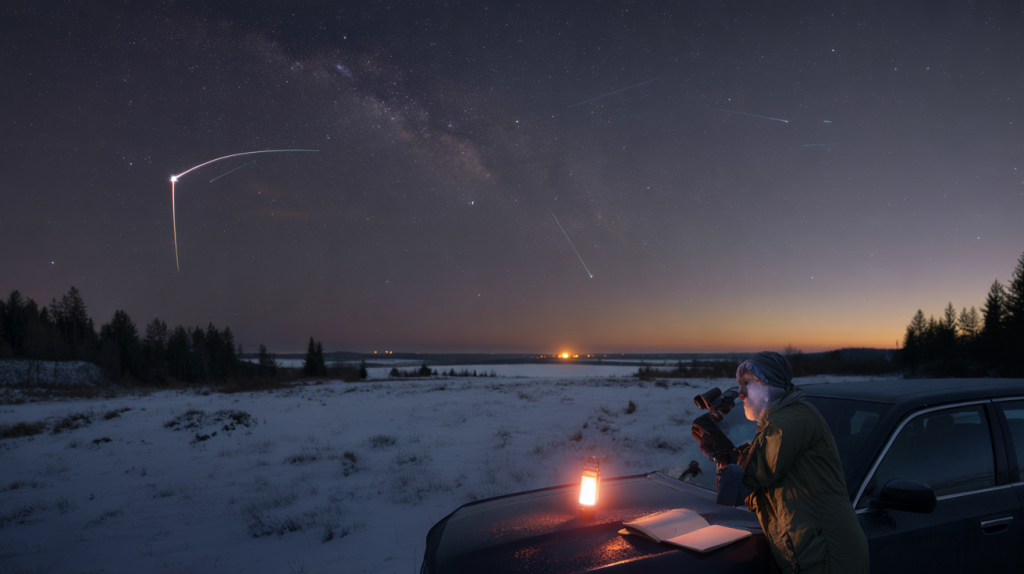
Saturday, December 20, 2025 brings a new moon that turns off lunar glare and gifts one of the darkest weekends of the year. Skywatchers get a clean slate, right before the December solstice, with darkness that boosts everything from faint constellations to the year’s last meteor shower.
New moon means the Sun and Moon align and the lunar disk is essentially at 0 percent illumination, invisible to the naked eye. Astronomers mark this phase as the moment of conjunction, not a visible sighting, and it happens once every synodic month of about 29.53 days according to NASA’s lunar data.
New Moon 20 December 2025: what changes in the sky
The main effect is simple. No moonlight, so contrast in the night sky jumps. That helps urban observers punch through light haze, and it lets rural skies feel almost cinematic.
This phase lands ahead of the solstice on December 21, when nights are long in the Northern Hemisphere. More darkness equals more observing hours, a small calendar gift that encourages slower, lingered looks.
Light pollution still bites. The New World Atlas of Artificial Night Sky Brightness reported that 83 percent of the world’s population lives under light polluted skies, and about 99 percent of people in the United States and Europe do as well, figures published by Fabio Falchi and colleagues in 2016 in Science Advances. A short drive to a darker spot changes the experience entirely.
Ursids 2025 and solstice timing: why this weekend matters
The Ursids meteor shower typically peaks around December 22 to 23 each year, with a zenithal hourly rate near 10 meteors according to the International Meteor Organization. Outbursts have spiked higher on rare years, which is why observers keep watch even when forecasts look modest.
With the Moon dark on December 20 and still a slim crescent by December 22, the window favors the Ursids. Best watching often runs after midnight toward pre dawn, when the radiant in Ursa Minor climbs and Earth rotates you into the stream.
If planning more than one session, the meteor shower payoff arrives a couple of nights after the new moon. That gap lets you scout a location on the 20th, then return when the shower approaches its peak.
How to observe the new moon night, even from the city
The new moon itself cannot be seen, so the goal is everything that surrounds it. The Milky Way in darker latitudes, faint clusters, winter constellations rising in the east, and quiet that city nights rarely deliver.
New to stargazing, still curious, a bit unsure where to start, that is normal. A simple plan with small steps works best, and it costs nothing to try.
- Pick a site with open horizons and turn off nearby lights, then give your eyes 20 to 30 minutes to adapt.
- Use binoculars if you have them, 7×50 or 10×50 show star fields and clusters with ease.
- Choose a printed star chart or a red-light mode app to find Cassiopeia, Perseus, Auriga, Orion, and Ursa Minor for the Ursids.
- Dress for temperatures several degrees colder than forecast, standing still chills fast in December.
- Plan a second visit for the Ursids peak on December 22 to 23, after midnight local time.
Expect the first thin crescent about 24 to 36 hours after the new moon if weather cooperates. Look low in the western sky after sunset, a delicate arc that fades quickly into the twilight. Many observers enjoy that short hunt as much as any telescope view.
For exact timing of the new moon in your time zone, check NASA’s SKYCAL or timeanddate phase tables. The moment itself is the same worldwide in Universal Time, though the local clock differs and the calendar date can shift near midnight.
Astrology note: a Sagittarius new moon, what people look for
With the Sun in Sagittarius until December 21, this new moon aligns in that sign. In astrological circles, Sagittarius often points to exploration, beliefs, learning, long distances. While not a scientific lens, many readers mark new moons as a reset for intentions, journaling, or clearing the to do list before year’s end.
The cultural rhythm matters here. A quiet Saturday without moonlight, the solstice the next day, and a gentle meteor shower just after, the sequence nudges reflection and fresh planning. Some prefer a simple ritual, others just step outside for ten steady breaths under a dark sky.
One last practical note. The synodic cycle is precise, 29.5306 days in NASA references, yet the monthly experience is human. Weather wins or loses the night, city lights dull contrast, energy levels vary. The trick is to line up a plan that accomodates real life, then let the new moon do the rest.
Sources at a glance : NASA Moon Phase data for synodic month length, International Meteor Organization on Ursids dates and rates, Falchi et al., 2016, Science Advances, New World Atlas of Artificial Night Sky Brightness.