
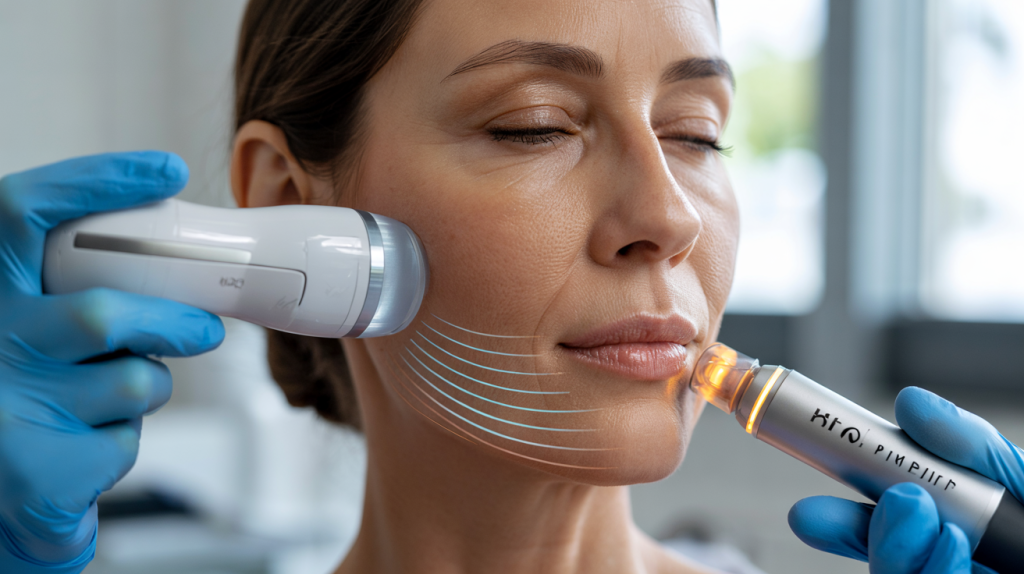
Thinking non surgical facelift? Compare HIFU and radiofrequency for lift, timelines, safety and costs, with FDA dates and clinic data that cut through hype.
Searches for a lift without surgery keep climbing, and two technologies lead the pack : high intensity focused ultrasound, better known as HIFU, and radiofrequency, often paired with microneedling. Both aim to tighten and lift, both stimulate collagen, yet they act at different skin depths and follow different playbooks.
Here is the core reality people want fast : HIFU targets deeper connective tissue to mimic a surgical lift’s support, while radiofrequency works more superficially and evenly to firm texture and soften lines. Results appear gradually. No scalpel, no general anesthesia. Just energy delivered with precision, then collagen takes over.
HIFU non surgical lifting : how it works and what to expect
HIFU concentrates ultrasound energy at controlled depths, typically 1.5, 3.0 and 4.5 mm, creating thermal coagulation points that trigger new collagen. That depth includes the superficial muscular aponeurotic system, the layer a surgeon lifts during a facelift. The promise : a subtle to noticeable lift of brows, jawline and upper neck without incisions.
The device most people know, Ultherapy, received United States FDA clearances in three steps : eyebrow lift in 2009, submental and neck lift in 2012, and improvement of chest lines in 2014. Those milestones matter because they set the indications and energy parameters used worldwide.
A typical session lasts 30 to 90 minutes depending on the areas treated. Many patients return to work the same day. The American Academy of Dermatology Association notes ultrasound tightening results appear over two to three months as collagen remodels, and can last about one year before maintenance is needed. Discomfort varies but is temporary and managed with cooling or analgesics.
Radiofrequency skin tightening : microneedling, results and downtime
Radiofrequency heats the dermis through electrical energy. In its classic form, it glides on the skin to uniformly warm collagen. In its microneedling form, insulated needles deliver heat deeper, often 1 to 4 mm, to tighten and improve pores, acne scarring and fine lines while sparing the surface.
Protocols look different from HIFU. The AAD indicates radiofrequency usually works best in a series. Many offices plan three to four sessions spaced around four weeks to build steady collagen. Cleveland Clinic guidance describes social downtime typically ranging from one to three days for RF microneedling, with pinkness, mild swelling and makeup back quickly.
People like that RF can refine texture and jawline at the same time. For laxity focused only under the chin or along the jowls, practitioners often layer RF series first, then add HIFU for a deeper lift once the skin quality improves. Staging matters because collagen remodeling continues for three to six months.
Safety, approvals and numbers that matter
Regulatory history is clear for ultrasound lifting : FDA clearances in 2009, 2012 and 2014 defined the noninvasive lift indications. That does not mean every face is a match. Good candidates show mild to moderate laxity, not heavy skin excess.
Adverse effects stay mostly minor with both energies. Expect transient redness or swelling. Published dermatology reviews describe rare temporary nerve irritation after HIFU that resolves, and pinpoint bleeding or crusting after RF microneedling that settles within days. Cleveland Clinic and AAD both emphasize that board certified expertise, correct depth mapping and conservative energy stacking reduce risks.
Timelines and satisfaction are data points to watch. The AAD reports ultrasound results build over two to three months and commonly last around one year, while radiofrequency often needs a series with maintenance at six to twelve months. RealSelf’s public snapshots list average costs around 2,000 to 4,000 dollars for HIFU based treatments and roughly 600 to 1,500 dollars per RF microneedling session in 2024, varying by city and extent. Session counts, device brand and practitioner skill drive the budget more than any single label.
Who is a candidate, how to choose HIFU or radiofrequency, and a simple checklist
Start with the main goal. If lift of a low brow or soft jowls is the priority, deeper focused energy from HIFU can reach supportive tissue. If texture, pores or acne scars also bother you, radiofrequency microneedling tends to multitask better in the dermis. Many plans combine both, just not on the same day.
Two practical bits often calm nerves. First, numbing cream and cooled ultrasound gel make sessions tolerable for most. Second, photography at baseline and at 12 weeks avoids the common trap : forgetting how the skin looked at the start, since changes are gradual and natural.
Use this quick checklist to have a productive consult with a dermatologist or plastic surgeon.
- Ask which device depths will be used : HIFU cartridges at 1.5, 3.0 or 4.5 mm, RF needles at 1 to 4 mm, and why those depths match your anatomy.
- Confirm sessions and spacing : single HIFU session with possible touch up at six to nine months, or three to four RF sessions about four weeks apart.
- Review downtime expectations : minutes to hours of redness with HIFU, one to three days of pinkness with RF microneedling per Cleveland Clinic.
- See documented indications : FDA clearances for lift areas and evidence for texture changes in peer reviewed dermatology journals.
- Clarify cost and maintenance : 12 month horizon with likely maintenance once collagen gains plateau.
One last piece often missing from the conversation : volume and skin weight. When heaviness from fat pads or significant sun damage dominates, energy alone may deliver limited lift. Experienced clinicians will say so, propose skin care to enhance collagen response, or suggest combining with injectables in a staged plan to recieve a balanced, credible result.