
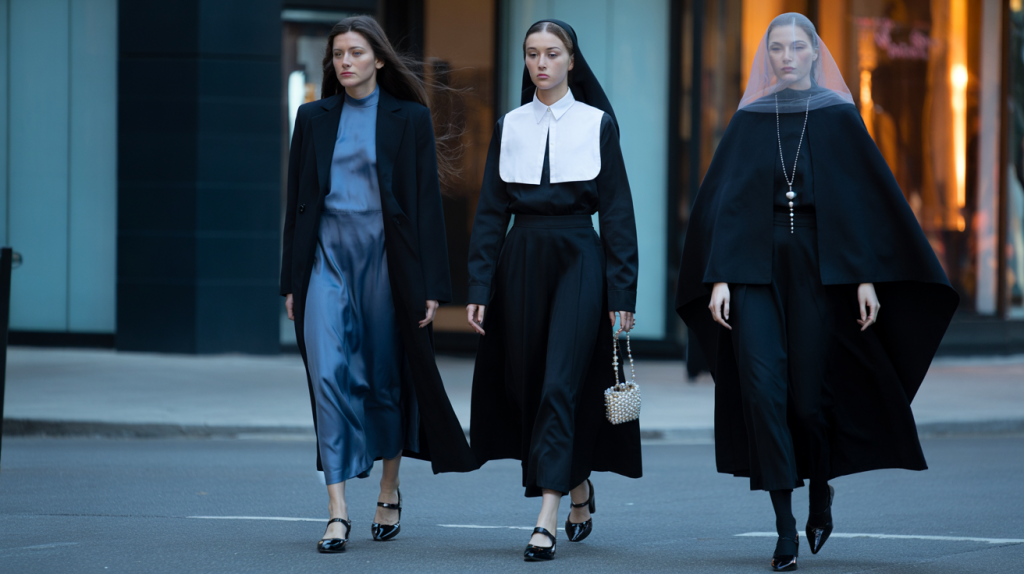
Veils on runways, prim collars in storefronts, long hemlines walking city streets. Nonnemania, the nun core wave, has jumped from niche aesthetic to mainstream conversation, shaping silhouettes with restraint and drama at the same time.
The context is not a whisper. The Metropolitan Museum of Art reported 1.66 million visitors to “Heavenly Bodies : Fashion and the Catholic Imagination” in 2018, the museum’s most visited exhibition to date. In parallel, DinarStandard’s “State of the Global Islamic Economy Report 2022” estimated Muslim spend on modest fashion at 295 billion dollars in 2021, with a forecast of 375 billion dollars by 2025. Those two markers, culture and commerce, help explain why this look resonates now.
What is nonnemania : the look, the codes, the references
At its core, the trend centers on covered silhouettes and clarity of line. Think high necks, crisp white collars, ankle grazing skirts, dark tailoring, structured capes, and accessories that recall rosary beads or wimples without reproducing religious dress.
Color stays mostly black, white, ink blue. Fabrics matter: wool suiting, dense cotton poplin, gabardine, satin with minimal shine. Proportions shift the mood from severe to elegant. A floor length skirt with a soft knit reads quiet, a razor sharp coat over a silk dress reads ceremonial.
Runway references keep piling up. Simone Rocha’s spring summer 2024 show in London worked with lace veils and jewel clusters, and her Jean Paul Gaultier haute couture collection in January 2024 made veiling and corsetry central. Maison Margiela Artisanal 2024 by John Galliano used veiling effects, face framing hoods, and strict lines that traveled accross social feeds for weeks.
Why nonnemania now : culture, data, runway signals
There is a practical reason. After years of logo maximalism, shoppers returned to quiet structure. Retail trackers have pointed to the ongoing rise of minimal tailoring since 2023, and editors read the mood as cyclical. The modest fashion economy provides additional pull, with the DinarStandard forecast anchoring real spending and growth expectations to 2025.
There is also the image bank created over a decade. The 2018 Met exhibition planted a visual language that mainstream audiences recognize instantly. When brands use veils, hoods, and stark palettes, the connection lands without explanation. It reads modern rather than nostalgic because cuts are sharp and materials are luxurious.
Design details changed the conversation. Collars became a styling tool instead of a school uniform cue. Head coverings moved from novelty to accessory, from silk scarves to hooded knits. The effect is protective, photo friendly, and easy to translate in retail without controversy when done as fashion, not costume.
How to wear nun core without costume : practical stylist moves
Approach it like a uniform. Start with one covered element, then balance with texture or shine. Retail is full of options, but the best versions come from precise shapes rather than heavy references.
Here is a simple path that works in real life.
- Pick a black midi skirt in wool or thick jersey, then add a white poplin shirt with a detachable collar.
- Layer a tailored coat that closes high at the neck. A single breasted shape keeps it clean.
- Choose headwear as styling, not statement: a fine knit hood, a satin headband, or a silk scarf tied low.
- Swap logos for texture: matte leather Mary Janes, suede ankle boots, or patent flats with a narrow strap.
- Finish with one lit detail. Pearls, a long silver chain, or a beaded bag that echoes rosary spacing without imagery.
Budget or rental helps. Black suiting and white shirts are easy to source secondhand, and alterations transform proportions in a day. For evening, a veil effect can be achieved with a tulle scarf pinned under a collar, avoiding literal references while keeping the line.
The last piece is context. Offices accept longer hemlines and strict collars because they read polished. Events take the look into couture territory when fabrics shine and construction tightens. Social media amplifies both ends of the spectrum, yet the middle is where most people live, a clean silhouette with one directional accessory.
If a brand cue helps, look at collections where veiling and structure were explored recently. Simone Rocha in 2024 showed how lace coverings can soften tailoring. Maison Margiela Artisanal 2024 demonstrated how hoods and capes frame the face and posture. The references are public, the translation can be subtle.
Nonnemania keeps attention because it solves a daily problem. It offers coverage without hiding shape, elegance without trend-chasing. The numbers point to sustained demand, the imagery is already part of the culture, and the styling translates into wardrobes with two or three precise pieces.