
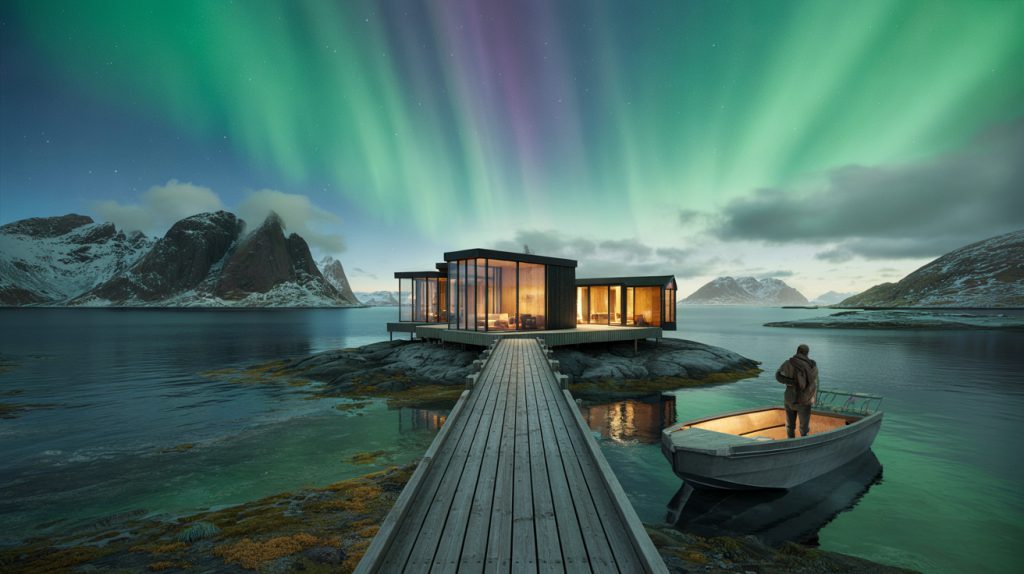
Want a private island hotel in Norway? Discover the real options, best seasons for aurora or midnight sun, access tips, and how to book your wild retreat.
Private island. Norway. Those words already feel like a spark. Yes, the country does have a handful of true island hideaways where cabins cantilever over the sea, boats are the only doorbell, and the skyline is mountains and gulls. This is not a fantasy poster. It is a very real kind of stay, different from a resort in the tropics, and closer to a slow adventure.
Here is the context that matters right away. A private island hotel in Norway often means a restored fishing outpost or a micro archipelago with modern sea cabins. Capacity is small, transfers run by boat, and seasons dictate what you will see. Think Northern Lights from September to March and midnight sun from late May to late July according to Visit Norway. With the right timing and the right spot, the experience lands somewhere between boutique hotel and expedition mood.
Private island hotel in Norway : what it really means
The phrase sounds glossy, yet the reality is more raw, and that is the appeal. Many of these places sit above the Arctic Circle at roughly 66°33′ N, a line noted by the Norwegian Polar Institute. You get dramatic light, quick weather shifts, quiet nights, and sea that looks like brushed steel.
Rooms are not palaces. They are design-forward cabins or historic rorbuer with big windows and thick duvets. Expect boat arrivals, fixed dinner times, and activity boards that list kayaking, fishing, or snorkeling. The tone is intimate. Staff remember your name. Silence does a lot of the work.
For travelers choosing between “private” and “remote”, in Norway those words often meet. Privacy comes from geography rather than high walls, and that sets the mood from the first minute ashore.
Where to find them : Manshausen and Håholmen, two island icons
Manshausen Island sits in Steigen, Nordland. The project was initiated by polar explorer Børge Ousland, with striking glass-fronted cabins by architect Snorre Stinessen, and the first units opened in 2015 according to Stinessen Arkitektur. Access typically starts via Bodø, a city named European Capital of Culture in 2024 by the European Commission, then a boat hop to the island. Days there can mix sea kayaking between skerries, a quick cold dip, then a sauna windowed to the horizon.
Håholmen Havstuer lies close to the Atlantic Road in Møre og Romsdal, a historic trading post turned hotel that keeps the soul of the old fishing village. The Atlantic Road itself runs about 8.3 km and opened in 1989 as documented by the Norwegian Public Roads Administration, a clue to how braided this coastline is. Guests boat in from Geitøya, then wander wooden piers, small museums, and sheltered coves that hold the wind at bay.
Both places feel simple on purpose. No neon distractions, no rush. When the weather clears, the sky becomes the headline. When it does not, the fireplace is the plan.
Best time to go for aurora or midnight sun
The choice hangs on light. For aurora, Visit Norway places the core season from September to March, with long nights and higher chances near the equinoxes. Solar activity has its cycles, yet patience often wins more than gear. Pick cabins with north facing views and step outside often.
For the midnight sun, the rule is straightforward. Above the Arctic Circle, the sun does not set roughly from late May to late July, a pattern confirmed by Visit Norway. That means long golden evenings, easy boat transfers, and hiking that can start after dinner because daylight stays stubborn.
Spring and early autumn sit in between. Quieter ferries, fewer crowds, better rates, and enough daylight to roam. Weather flips quickly, so layers beat bulky coats. Sea breezes add a chill even on bluebird days.
How to choose and book : access, budget, eco practices
Getting there is part of the story. Norway’s coastal transport has become greener too. Norled launched MF Ampere in 2015, cited as the world’s first fully electric car ferry, a small but telling step for low impact maritime travel. For island hotels, expect scheduled boats at fixed times rather than on demand shuttles. Plan flights to Bodø or Ålesund, then align the last mile with the hotel’s timetable.
To keep planning smooth, focus on the few details that change the stay more than any decor choice.
- Access : check total travel time from the nearest airport to the pier, and the day’s last boat.
- Seasons : aim for September to March for aurora, late May to late July for midnight sun, per Visit Norway.
- Meals : many islands run set menus, often local seafood. Ask about dietary options in advance.
- Orientation : cabins facing north help for aurora, west helps for sunset. A small detail, big payoff.
- Guides and safety : confirm certified guides for sea trips, plus lifejackets and VHF on boats.
- Eco policies : water use, energy sources, and waste handling tell you how the island really works.
One last practical note before hitting book. Summer weekends and school holidays lock early, sometimes months ahead, while shoulder weeks keep more breathing room. If the plan includes the Atlantic Road stop or a culture day in Bodø 2024 programming, stitch those dates first, then wrap the island stay around them.
What tends to seal the decision is not a list of amenities but the promise of time that feels unbroken. A place where waves write the schedule, dinner is at a long table, and stars arrive when they want. Choose the island, align the transfer, confirm meals and activities, and accept a little weather drama. That is the missing element that makes this kind of accomodation unforgettable.