
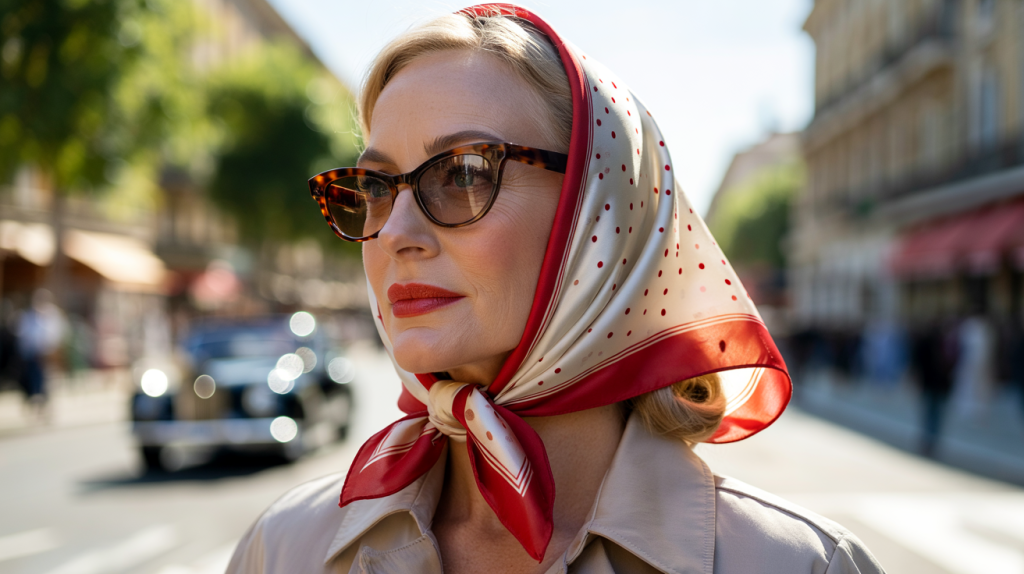
One square of silk, a pair of sunglasses, and the whole street suddenly feels cinematic. The Old Hollywood hair scarf – the classic foulard cheveux – is having a real moment again, because it does what trends rarely manage: it makes everyday hair look intentional in under a minute.
The appeal is clear and practical. Think Audrey Hepburn gliding through 1953’s “Roman Holiday” or Grace Kelly en route to the Riviera in “To Catch a Thief” in 1955. The template still works today for commutes, wind, or no-wash days. Ahead: the exact sizes to buy, the ties that hold through a breezy afternoon, and the small details that separate a glamorous look from a slippery mess.
Old Hollywood hair scarf icons: Hepburn, Kelly, Monroe – and why the look endures
Vintage film made the silhouette unforgettable: scarf folded into a triangle, tied under the chin, sunglasses on, lipstick steady. Audrey Hepburn’s travel scenes set the tone in the 1950s, then Marilyn Monroe and Sophia Loren pushed a sultry, convertible-ready version through the 1960s.
There is heritage behind the square. Hermès introduced its now-classic 90 x 90 cm silk carré in 1937, a format that still defines how a foulard drapes and frames the face. That size, or a 70 x 70 cm version, remains the sweet spot for most ties without bulk.
How to choose your foulard cheveux: size, fabric, color that flatters
The main problem people face today: scarves slipping or puffing up. Most of the time, the fabric or size is off for the job. A few rules of thumb solve it quickly and still leave room for personality.
Fabric matters because hair needs glide, not drag. Silk twill and silk satin glide and reduce snags. Lightweight cotton behaves crisply – good for structure – but can catch on textured hair. Polyester satin is budget friendly and shines on camera, less breathable on hot days.
Patterns do the heavy lifting on style. Small polka dots read retro and playful, equestrian prints feel luxurious, and color blocking modernizes the look fast. Choose a color pallette that mirrors lipstick or sunglasses frames for instant cohesion.
Quick-buy checklist for real life use :
- Sizes that work: 70 x 70 cm for short hair or petite frames, 90 x 90 cm for medium to long hair, 110 x 110 cm for full turban wraps
- Fabrics that protect: silk twill or satin for glide, cotton voile for airy structure
- Edge finish: rolled hem sits softer around the face than machine-stitched edges
- Print scale: small prints for small squares, larger motifs for 90 cm and up
- Grip helpers: small claw clip or two bobby pins hidden under the fold to stop slippage
Ways to tie it: babushka, bandana headband, turban twist
Babushka tie – the cinema classic. Fold the square into a triangle, place the long edge along the hairline, ends to the back. Bring ends forward under the chin and knot gently. For a modern tweak, shift the knot a finger-width to one side and tuck the point at the back with a bobby pin.
Bandana headband – clean and wearable at the office. Fold into a long rectangle, about 5 to 7 cm wide. Lay over the crown and tie at the nape. For more grip, place a small comb clip under the band at the back of the head.
Convertible turban – windproof elegance. Start with a 90 or 110 cm square. Fold to a wide band, center at the nape, bring ends to the top, cross once, bring back down, and knot low. Tuck ends. A scarf ring can replace the knot for a flatter profile under hats.
Care, sun, and staying power: what the screen did not show
Old Hollywood filmed in controlled air. Real streets are not. Two tiny pins under the fold – one above each ear – change everything, especially with silk. If hair is slippery, a spritz of texturizing spray at the hairline gives barely-there grip without residue.
On sunny days, a scarf helps shade the scalp, but it is not guaranteed sun protection. The Skin Cancer Foundation states UPF 50+ fabrics block at least 98% of UV rays, and many fashion scarves are untested. Pair the look with SPF on exposed skin or choose scarves labeled UPF 50+ for true coverage.
Storage keeps drape alive. Hang silk to avoid creases and keep it away from rough handbags that can abrade fibers. Hand wash cool with a silk-safe detergent, press inside a towel, then iron on low from the reverse to revive that soft sheen.
One last precision detail ties the story together. If the goal is era-authentic style that still works in 2025, pick a square between 70 and 90 cm, silk twill if possible, roll the hem toward the face for softness, and coordinate scarf tones with eyewear. The look lands in seconds, stays put with two discreet pins, and reads timeless from the first step outside.