
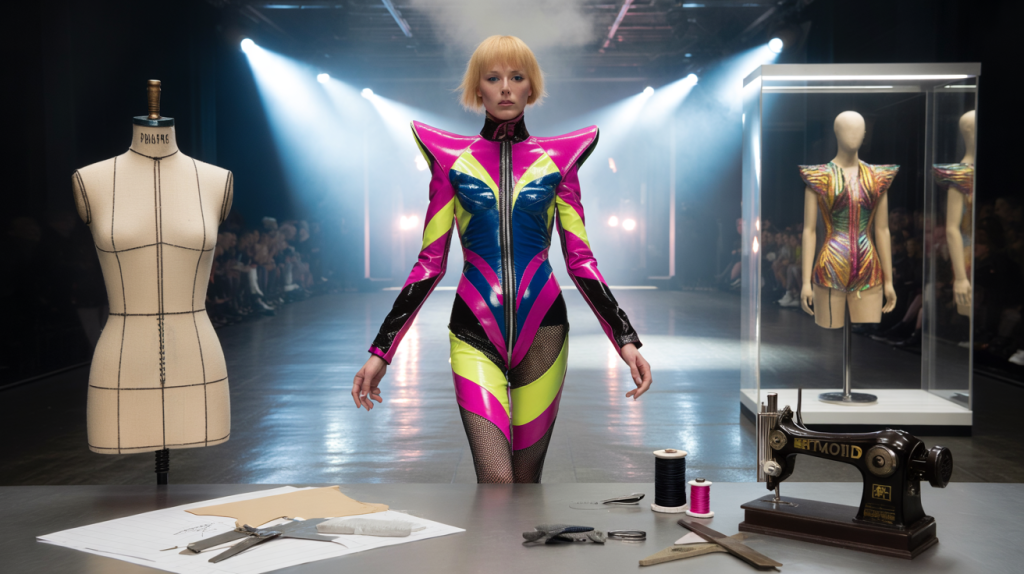
Electric colours, second skin catsuits, rock energy that never fades. Pam Hogg did not just design clothes, she built a visual language that still explodes on stages and runways after four decades. The Scottish creator sits at the crossroads of fashion, music, and art, with pieces worn by Debbie Harry, Siouxsie Sioux, Björk, Kylie Minogue, Lady Gaga, and Rihanna.
Searches for her story spike every season because the path is real and raw. Raised in Scotland, trained at Glasgow School of Art and the Royal College of Art in London, Pam Hogg broke out in the early 1980s club scene and returned to the London catwalk with force in 2009. Her work has hung in museums too, including the 2013 “Club to Catwalk” exhibition at the Victoria and Albert Museum.
Pam Hogg biography: where the rebel precision comes from
The main idea is simple. Pam Hogg fused fine art training with a performer’s instinct, then made clothes that move like music. The observation is just as clear. The label grew far beyond nightlife because the construction is couture sharp and the identity unmistakable.
For readers chasing the facts, the timeline matters. The designer emerged in the early 1980s London scene, built a signature around sculpted catsuits and bold latex, and kept momentum while many trends burned out. In 2009 she staged a runway comeback at London Fashion Week, reminding the industry that underground does not mean unfinished.
Some miss the point and reduce her to a single look. That shortcut hides the breadth. Pam Hogg is also a musician and filmmaker, a maker of stage wear and exhibition pieces, a collaborator who understands how performers need to breathe, jump, and command a crowd.
Early years and education of Pam Hogg
Pam Hogg grew up in Scotland with roots in Glasgow, a city that shapes makers who like to build things with their hands. She studied Fine Art and Printmaking at Glasgow School of Art, then continued at the Royal College of Art in London. That mix explains the precision. Pattern cutting arrives with painterly confidence, not just technical skill.
By the early 1980s she was showing collections that felt like live sets. London’s post punk and new wave energy met tight tailoring and saturated colour. The result traveled fast across clubs, magazines, and onto stages where the pieces truly lived.
Pam Hogg style, music, and celebrity collaborations
Stage gear is unforgiving. It must flex, shimmer under hot lights, and survive a tour schedule. Pam Hogg builds for that reality. The famous catsuits wrap the body like armour, then open up for movement. Sharp shoulders, metallic vinyl, crystal, mesh, and gloss catch the eye from the very back row.
The client list tells the story. The designer has dressed Debbie Harry and Siouxsie Sioux since the early days, then saw a new wave of stars wear her work through the 2000s and 2010s, including Björk, Kylie Minogue, Lady Gaga, and Rihanna. Red carpets, festivals, music videos, editorial covers. The looks cross media without losing identity.
The museum world noticed too. In 2013 the Victoria and Albert Museum’s “Club to Catwalk: London Fashion in the 1980s” featured pieces that mapped her impact on a generation. That same decade brought steady London Fashion Week shows, with collections landing across the 2010s and into the 2020s.
Pam Hogg timeline: key dates, shows, and honors
When readers ask for a clear path, this helps. It shows where to start and what to watch next.
- Early 1980s : Breakout in London’s club and runway scene after studies in Glasgow and at the Royal College of Art.
- Late 1980s to 1990s : Signature catsuits and stage wear appear on major performers across Europe and the United States.
- 2009 : Return to the catwalk at London Fashion Week, reigniting the label’s runway presence.
- 2013 : Work exhibited in “Club to Catwalk: London Fashion in the 1980s” at the Victoria and Albert Museum in London.
- 2016 : Honorary Doctorate of Design awarded by Glasgow Caledonian University, recognising sustained creative achievement.
- 2010s to 2020s : Regular London Fashion Week shows and new commissions for artists and performers.
So the throughline reads clean. A trained artist designs for bodies in motion, builds a cult audience in the 1980s, returns to the big stage in 2009, and sits in both museums and mosh pits. The practical takeaway for anyone discovering Pam Hogg now is simple. Look at the runway images from 2009 onward, then watch performance clips where those pieces move. The intent becomes crystal clear.