
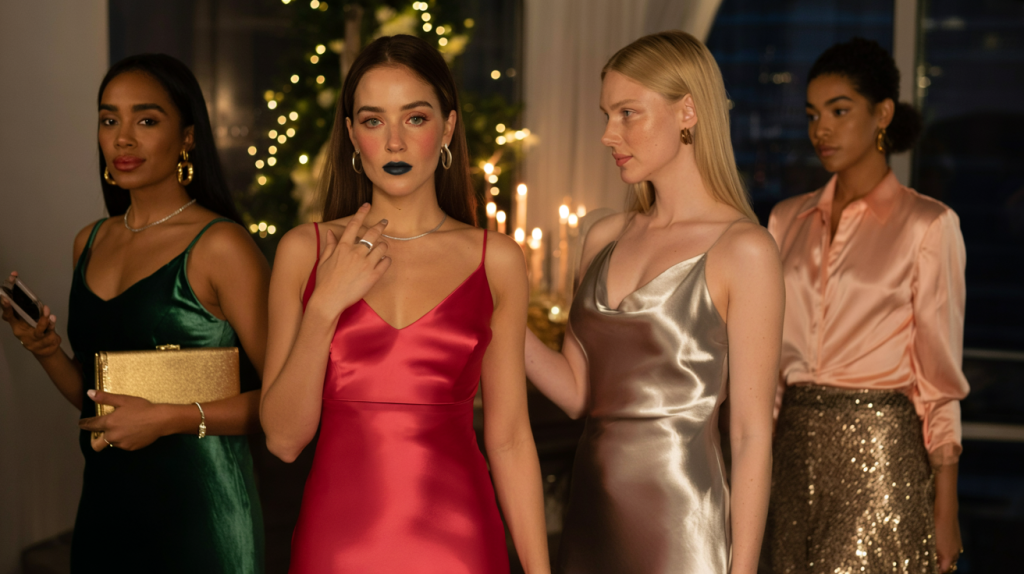
Stop guessing your party palette. See which shades actually flatter under night lights, in photos, and on different skin tones – with runway and research to back it.
Holiday lights change color : pick shades that thrive at night
Under warm bulbs, candlelight, and phone flash, colors shift fast. Cool tones can look dusty, pastels turn flat, and black sometimes reads dull on camera. The right hue makes fabric glow, brightens skin, and anchors the whole look without shouting.
Trends help, but they do not tell the whole story. Pantone’s 2024 pick “Peach Fuzz” put soft peach back on the map in December 2023, yet many party rooms still reward saturated jewel tones, classic metallics, and camera-friendly reds. The goal : a shade that looks great live and in photos, with minimal effort.
Party color rules that actually work in real life
Here is the reliable path : favor saturated jewel tones and clean metallics for evening. Emerald, cobalt, ruby, and amethyst read rich under warm lighting. Gold, silver, and gunmetal bounce light and lift even simple silhouettes.
Want a near-universal bet that flatters fast? True red, emerald green, and liquid-metal silver consistently elevate party outfits. Red energizes, emerald adds depth, silver sharpens lines and plays well with sequins or satin.
Balance matters. Use the 60-30-10 color rule from styling : one dominant shade, one supporting color, one accent. That keeps the eye focused and stops clashes with bag, shoes, or lipstick.
Data and trends : Pantone, runways, and psychology
Pantone named “Peach Fuzz 13-1023” as the 2024 Color of the Year on 7 December 2023, spotlighting a soft, luminous peach that pairs easily with gold and champagne metallics. Source : Pantone.
Research backs the pull of red in social settings. A 2008 study from the University of Rochester found that men rated women in red as more attractive compared with other colors, even when the image stayed identical apart from color. Source : University of Rochester.
Preference trends lean cool. In a 2015 multi-country survey, YouGov reported blue as the most popular color with 23 percent of respondents choosing it as their favorite. That explains the evergreen appeal of cobalt and navy for evening. Source : YouGov.
How to match your skin undertone and the dress code
Room lighting nudges undertones, so build from skin first, then the venue. Warm undertones love gold, bronze, coral red, and emerald. Cool undertones light up in silver, icy pink, cobalt, and true red. Neutral undertones handle both, especially rose gold and teal.
- Black tie : emerald satin, ruby velvet, or liquid silver; add minimal jewelery for a clean line.
- Cocktail : true red crepe, cobalt slip, or gunmetal sequin skirt with a matte top.
- Festive casual : soft peach or champagne with warm gold; or navy with a high-shine shoe.
- Day-to-night office party : deep navy or forest green plus a metallic clutch for quick lift.
Photo-proof combinations and last-minute fixes
Phone flash can drain pale pastels and gray-beige. Swap to deeper shades of the same family : blush to rose, lavender to amethyst, baby blue to cobalt. The richer pigment fights washout and keeps fabric texture visible.
Metal choice steers the whole palette. Gold warms and flatters olive and tan skin; silver cools and clarifies fair and pink undertones; rose gold bridges both. If a dress feels flat, switch hardware to the opposite metal and the color often pops.
Lip and nail color act like filters. A blue-red lipstick sharpens teeth and complements silver and cobalt. An orange-red energizes gold, coral, and warm emerald. Keep one lipstick that complemet your dominant palette in the bag.
Still unsure in store light? Do a 10-second test. Step near a window or doorway, take one no-flash photo and one with flash. If skin looks sallow or the shade turns muddy, size up to the deeper jewel tone or move to metallics. The right color survives both shots and the dance floor.