
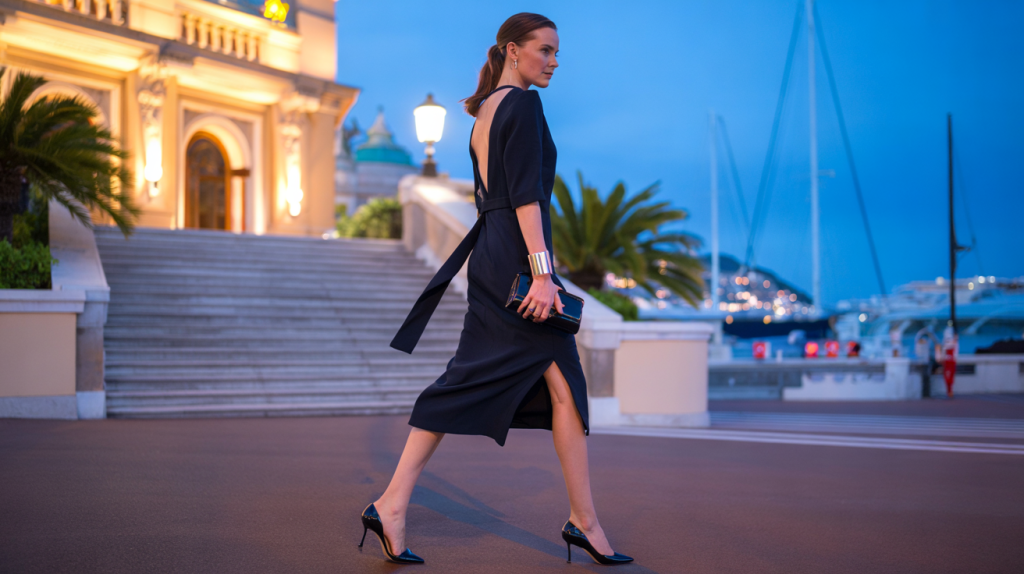
Pauline Ducruet sets the tone with a petite robe noire
All eyes turn when Pauline Ducruet steps out in a petite robe noire. The Monegasque designer gives the little black dress a clean, modern line that reads elegant at night and effortless by day, the kind of quiet-luxury uniform that travels anywhere in Monaco’s calendar.
The context helps. Pauline Ducruet, born in 1994, is the founder of Alter Designs, launched in 2018, with an early presentation in Paris in 2019 documented by Vogue Runway. That mix of couture discipline and upcycled thinking filters straight into her black dresses: minimal seams, precise fit, and fabric choices that feel current without shouting.
Pauline Ducruet, Alter Designs, and a Monaco take on timeless style
There is a fashion lineage at play. The petite robe noire has been a modern essential since 1926, when Vogue published Coco Chanel’s groundbreaking sketch and framed the black dress as a democratic, wearable icon. Nearly a century later, Pauline Ducruet picks up that thread and switches the lens to contemporary Monaco – sleek silhouettes, unfussy glam, movement built in.
Alter Designs, created in 2018, has leaned into reworked materials and crisp tailoring across collections. That ethos shows when Pauline Ducruet opts for black: she tends to favor sharp shoulders or a clean halter, a fluid midi-lenght hem, then one focal point – an open back, a square neckline, or a subtle cutout – that catches light without stealing the scene.
The result feels intentional. Accessories stay streamlined, jewelry often pared back to one sculptural piece, and shoes keep a low profile with a thin strap or a graphic pump. Nothing heavy. The dress does the work, the person wears the room.
How Pauline Ducruet styles a petite robe noire today
Start with cut. Pauline Ducruet gravitates to architectural lines that skim rather than cling, which suits red carpet angles and real-life movement. A bias-cut satin, a dense jersey, or a reworked twill sits close to the body then loosens below the knee. The eye reads polish, not fuss.
Then texture. Her looks often contrast matte and shine – a velvety dress with patent pumps, or a clean crepe dress under a glossy blazer. That tension adds depth on camera and in person. It is a small styling choice that lands big.
Color does the lifting through black itself. Editorial history backs it up. In 1926, Vogue framed black as the universal shade for a new era; in 2019, Alter’s Paris showcase underlined how a restrained palette makes recycled textiles look luxe. Both dates explain why Pauline Ducruet’s black dresses feel fresh instead of strict.
From Chanel’s 1926 sketch to Pauline Ducruet now : why the petite robe noire still wins
The logic is simple. A single, impeccably cut black dress reduces decisions and raises impact. That is why the piece survives trend cycles. Pauline Ducruet’s version adds a 2020s layer: purpose. By tapping the precision of tailoring with the resourcefulness of upcycling, her petite robe noire reads modern without being seasonal.
What completes the picture is proportion. She balances a revealing detail – an open back, a thigh-high slit – with higher coverage elsewhere, so the silhouette stays elegant under flashbulbs and city light. One statement at a time. The eye rests, the silhouette speaks.
Looking to channel that Monaco clarity, skip heavy ornament and pick one strong element: a squared neckline, a sculpted shoulder, or a fluid hem that moves on stairs. If the fabric feels good and the fit is exact, the petite robe noire does the rest. History provides the blueprint from 1926, Alter’s 2018 launch gives the update, and Pauline Ducruet shows the proof on the step-and-repeat.