
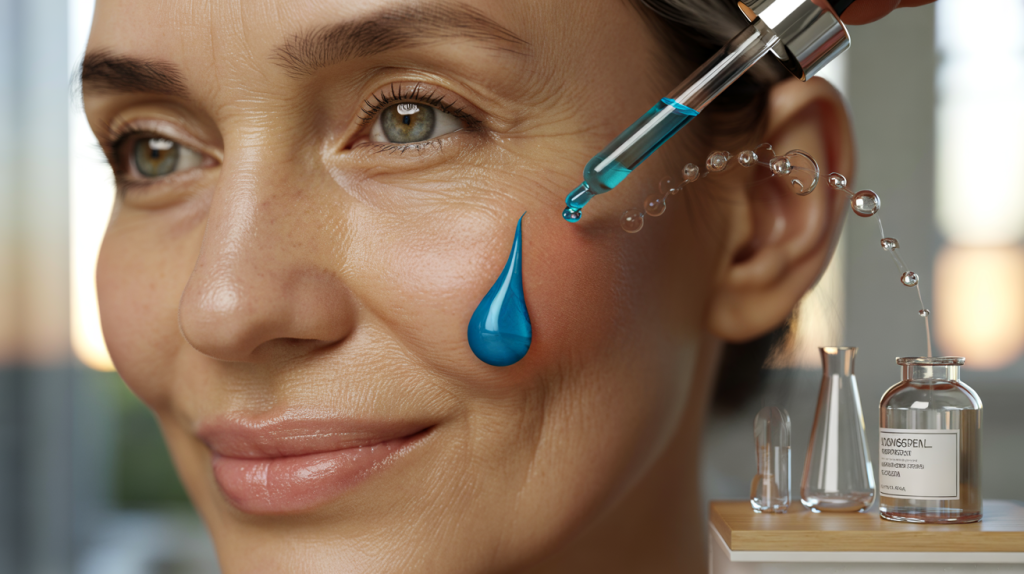
Fine lines showed up, almost overnight. Skin looks a bit deflated. Peptides land right here, as tiny messengers that tell skin to make more of what keeps it bouncy and calm.
Collagen production naturally declines with age, roughly around 1% per year after the mid‑20s, which contributes to thinner and less elastic skin (Shuster S. et al., The British Journal of Dermatology, 1975). Several cosmetic peptides have been studied in humans and lab models, pointing to gains in firmness, wrinkle depth, and barrier support when used consistently.
Peptides for skin : what they do from the first weeks
Main idea first. Peptides are short chains of amino acids. On skin, some act like signals that nudge fibroblasts to produce collagen and extracellular matrix. Others carry minerals such as copper, which skin uses for remodeling. A few relax expression lines by modulating neurotransmitter release.
People come with one big problem to solve: getting results without irritation. Peptides tend to play well with sensitive skin and can sit under or over a moisturizer, which makes them easy to stick with.
Types of peptides and proven benefits
Signal peptides such as palmitoyl pentapeptide‑4 have clinical data. A randomized, double‑blind study by Lori R. Robinson and colleagues followed women for 12 weeks and reported significant improvement versus placebo in facial wrinkles and texture with a palmitoyl pentapeptide‑4 cream (International Journal of Cosmetic Science, 2005). The takeaway is simple : consistent daily use over weeks matters.
Neurotransmitter‑modulating peptides offer a different angle. Acetyl hexapeptide‑8 was described by Antonio Blanes‑Mira and team as inhibiting catecholamine release in vitro, which relates to expression lines from repeated movement (International Journal of Cosmetic Science, 2002). It does not act like a medical toxin, but topical formulas can visibly soften dynamic creases for some users over time.
Carrier peptides deliver trace elements. GHK‑Cu, a copper tripeptide, has been reviewed for roles in wound repair, collagen synthesis, and antioxidant defense pathways in skin biology (Loren Pickart and Anna Margolina, Bioinorganic Chemistry and Applications, 2012). Reviews highlight improvements in elasticity and photoaged appearance across controlled studies, while calling for standardized outcome measures.
How to use peptides in a routine without wasting money
Here is the practical part people ask for. Peptides shine in daily routines that protect during the day and rebuild at night. They layer easily with moisturizers, niacinamide, and many antioxidants.
Some common mistakes keep showing up. Using them for two weeks then quitting. Pairing copper peptides with very low pH acids or strong L‑ascorbic acid in the same step, which formulators often discourage. Expecting them to replace prescription retinoids or in‑office treatments.
One concrete example helps. A nightly serum with palmitoyl pentapeptide‑4 plus a ceramide moisturizer reduced visible dryness and fine creasing on the cheeks by week 4 for a busy teacher who could not tolerate retinoids. Not dramatic, but real life better skin.
For anyone building or upgrading a routine, this short checklist keeps things clear :
- Pick a peptide type for your goal : signal peptides for firmness, copper peptides for repair, acetyl hexapeptide‑8 for expression lines.
- Use a serum or cream twice daily for at least 8 to 12 weeks to fairly judge results, mirroring study timelines.
- Combine with SPF 30 or higher in the morning. SPF 30 filters about 97% of UVB, which protects the collagen you try to regain (American Academy of Dermatology, aad.org, accessed 2025).
- If using strong acids or pure L‑ascorbic acid, apply peptides at a separate time of day, especially copper peptides, to preserve formula stability.
- Sensitive skin? Start three nights per week, then advance as comfort grows to avoid transient tingling or dryness.
What science says : studies, limits, and who benefits most
Numbers and dates keep the claims grounded. The 12‑week Robinson trial on palmitoyl pentapeptide‑4 remains a key human study in photoaged facial skin with measurable wrinkle improvement over placebo (International Journal of Cosmetic Science, 2005). The mechanistic work on acetyl hexapeptide‑8 dates to 2002, clarifying how it targets neurotransmitter release in vitro (International Journal of Cosmetic Science, 2002). Reviews of GHK‑Cu in 2012 mapped gene expression shifts linked to skin remodeling, antioxidant response, and repair pathways (Bioinorganic Chemistry and Applications, 2012).
Limits exist. Studies vary in peptide dose, base cream, instruments, and endpoints, so results cannot be copy‑pasted across every product. Most data cover 8 to 16 weeks, not years. And while improvements show up, peptides do not replace sunscreen or retinoids with decades of evidence in photoaging.
So who wins most from peptides now? Skin that needs gentle, steady firming and better texture without redness. People with dryness or a compromised barrier often notice comfort gains because many peptide formulas sit in hydrating, ceramide‑rich bases. Those prone to expression lines can also see softening with acetyl hexapeptide‑8 when used twice daily.
The missing piece is protection. Daily sunscreen preserves any collagen gains you fight to build. Consistent routine, realistic timelines, and formula choice form the trio that lets peptides deliver benefical results you can actually see and, yes, feel.