
Decode the hottest Pinterest dressing trends: capsule rails, PAX hacks, color-coding and small-space storage, backed by data and practical moves.
Closets are stepping out of the dark. On Pinterest, the dressing space has become a style statement and a daily time saver, with saves surging around capsule wardrobes, IKEA PAX hacks, open rails and calming color stories. The platform’s scale speaks volumes: Pinterest reported 482 million monthly active users in Q3 2023, per Pinterest Investor Relations, which makes it a goldmine to spot what people actually want to build at home.
Trust is part of the appeal. In its 2024 edition, Pinterest Predicts highlighted that 80 percent of its annual trend predictions have come true across past years, a solid track record that keeps home lovers watching for the next wave. And it shows in wardrobes: neutral palettes, glass fronts, uniform hangers, baskets on low shelves, all designed to cut decision fatigue and turn mornings into autopilot rather than chaos.
Pinterest wardrobe trends: capsule closets and open rails
The main idea is simple: less friction, more clarity. Capsule dressing dominates saves because it reduces choice overload and keeps everything visible. The minimalist benchmark many users follow is Project 333 by Courtney Carver – 33 items for 3 months, launched in 2010 – a constraint that quietly upgrades style while shrinking clutter.
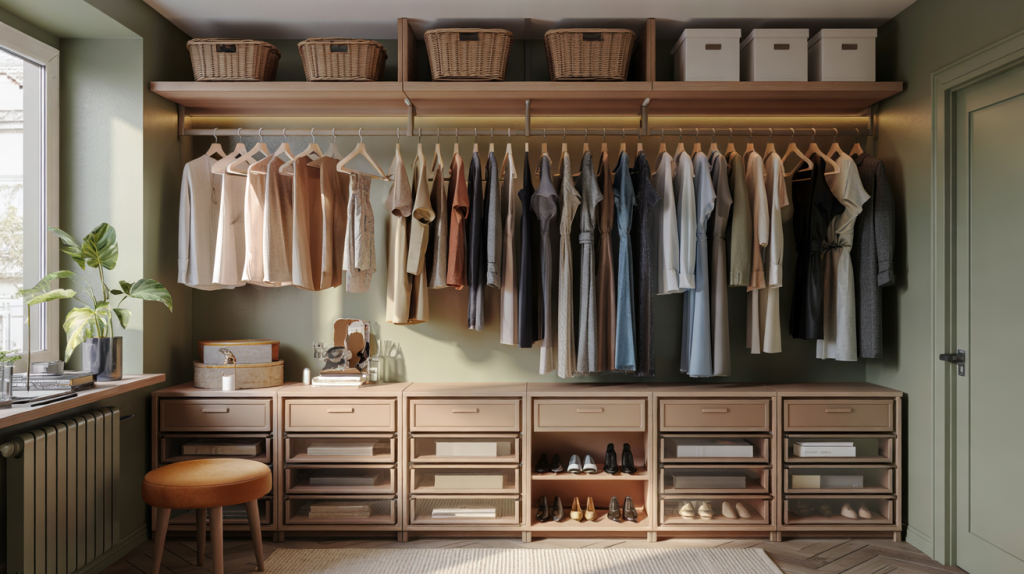
Open rails are the visual partner to a capsule. One rail, one color story, one season in sight. That solves the classic problem: good pieces buried behind bulky storage. A tight rail pushes edit-first behavior, then rewards it with easy access and a boutique feel.
Common misstep spotted across boards: buying storage before editing the wardrobe. The better order is edit, group by use, then measure. That way, the storage serves the clothes, not the other way around. A small shift, big impact.
IKEA PAX hacks and small-space storage that actually work
When the space is tight, Pinterest users keep turning to modular systems. IKEA PAX shows up constantly for a reason – frames come in repeatable widths and heights, and interiors can be mixed to fit shoes, knits, or long dresses. According to IKEA product specs, typical frames offer around 75 or 100 cm widths and two heights, which lets renters and owners scale without custom carpentry.
The winning pattern across top pins: drawers at hip height for tees and knits, shelves above eye level for baskets, a single long-hang bay for dresses or coats, then a slim rail for daily heroes. Glass or mesh fronts keep dust down while letting the eye scan stock in seconds. One more detail people forget: lighting. A single LED strip under the top shelf changes the whole user experience at 7 a.m.
An empathetic note here. Overflow often hides in accessories. Belts, scarves and jewelry sprawl in unpredictable ways. Narrow pull-outs and shallow trays fix it because they force one layer per category. No digging, no wrinkling, less sighing.
Color-coded, label-led: visual systems that stick
Color-coding is not about perfection, it is about speed. Group by tone – lights to darks – and the rail reads like a gradient. The brain loves it. Labels on bins and drawers close the loop so every item goes back to its lane after laundry day.
Uniform hangers are the quiet upgrade. Wood or slim velvet, one type only, keeps lines clean and avoids stretched shoulders. Clear shoe boxes with a simple front label protect suede and keep pairs together. Small move, outsized payback.
For anyone ready to try what keeps trending on Pinterest, here is the concise, evergreen checklist to copy this week :
- Edit using the 33-piece rule for one season – test Project 333 for a fast reset.
- Build one open rail with a single palette – lights left, darks right.
- Use a PAX or similar modular frame – drawers at hip height, long-hang in one bay.
- Add clear bins for off-season and label each by category – knitwear, denim, swim.
- Install a simple LED strip under the top shelf – see everything, dress quicker.
Data signals: what Pinterest Predicts means for your dressing room
Why these trends hold up over time comes back to behavior. Pinterest’s long-view data, and its published hit rate of 80 percent in Pinterest Predicts 2024, favors ideas that are repeatable and visually scannable. Capsule rails, color grouping, modular frames and lit shelves all fit the pattern. They photograph well, yes, but they also stand up to everyday use.
There is a practical path forward. Start with a 48-hour sprint: day one for a ruthless edit – try the 33-item cap for the next quarter – day two for measurements and a modular plan. Photograph the after once, then keep it consistent. Trends will shift, but a clear rail, labeled bins and one reliable system do not.
If one element feels missing, it is usually cadence. Set a 30-minute reset every Sunday. Rotate pieces in, rotate others out, re-label a bin if the season changes. The dressing stays aligned with the life you are actually living, not the wishlist. That is the quiet logic Pinterest boards have been hinting at all along, and it is definitly why these saves keep climbing.