
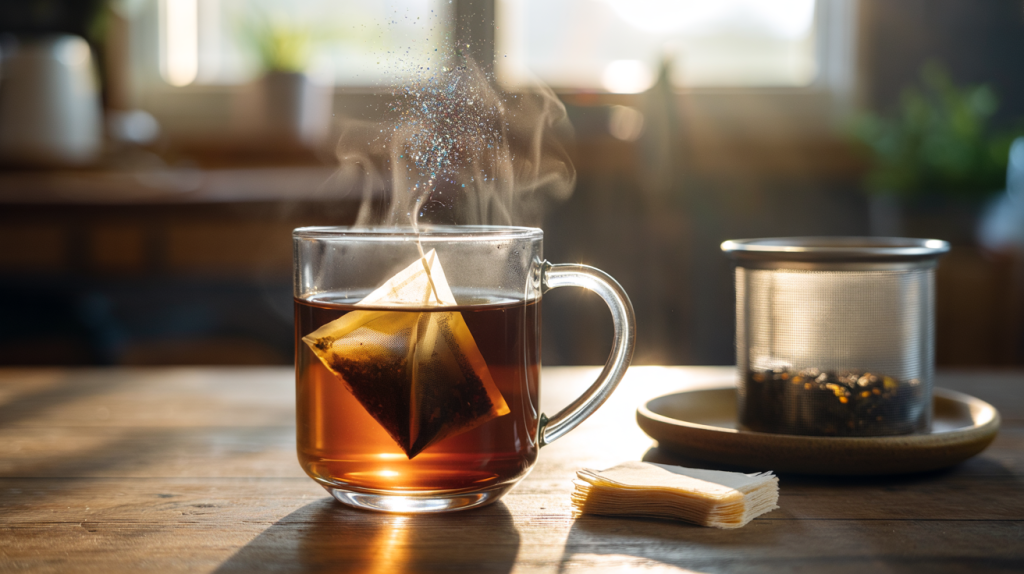
Boiling water, a fragrant blend, a quiet pause. Then a jolt : certain premium tea bags made from plastic mesh can release an eye opening load of microplastics into a single cup. In 2019, researchers at McGill University steeped nylon pyramid tea bags at brewing temperature and measured what escaped : roughly 11.6 billion microplastic particles and 3.1 billion nanoplastic particles per cup, reported in Environmental Science and Technology.
Not only the fancy mesh bags raise questions. Many classic paper tea bags have historically used a thin layer of polypropylene to heat seal the edges. When hot water meets plastic components, particles can shed. That is the crux for anyone searching whether tea bags release plastic particles : yes, some do, and material matters more than brand marketing. The good news : there are simple ways to enjoy tea without that unwanted side.
Tea bags and plastic particles : the core issue, clearly explained
Here is the simple picture. Mesh pyramid bags are often nylon or polyethylene terephthalate. Heat and time drive fragmentation. Paper style bags can include a plastic seal, so they are not always fully plastic free. Loose leaf tea with a stainless steel infuser or unsealed paper filters avoids plastic contact with hot water.
Consumers started asking tougher questions after 2019, and the industry reacted. Some labels switched to plant based polylactic acid meshes or to plastic free crimped paper. Yet lab work shows that PLA can also fragment into microplastics under certain conditions, especially with heat and wear. The material on the label deserves as much attention as the flavor notes on the box.
One more context point helps : microplastics do not stay put in the environment or the body. Studies since 2020 have detected microplastics in human placenta samples and in blood. In March 2024, a study in The New England Journal of Medicine found microplastics and nanoplastics inside carotid artery plaques in 58.4 percent of 257 patients and linked their presence to a higher risk of cardiovascular events over follow up, with a hazard ratio near 4.5. That research does not prove tea is the cause, of course, but it underscores why people want fewer plastic exposures from everyday rituals.
How microplastics end up in your cup : materials, heat, and time
Materials first. Plastic mesh pyramid bags look elegant and brew fast, yet they are typically made from nylon or PET. In the McGill experiment in 2019, researchers cut open commercial plastic mesh bags, removed the tea to avoid confounding, and steeped the empty bag at 95 degrees Celsius. Particle counts reached billions per cup. That is an extreme test, but it shows the shedding potential of the mesh itself.
Paper next. Many paper tea bags rely on a plastic sealing layer so the bag keeps its shape in hot water. The plastic percentage can be small, but contact is direct and sustained during brewing. Brands have been shifting to plastic free crimping or to PLA based seals since 2020, yet labeling still varies widely by country and product line.
Brewing choices add up. Hotter water and longer steeping increase particle release. A rolling boil for several minutes is not the same as a gentle three minute infusion at 80 degrees Celsius. Little changes can cut unnecessary exposure without changing the tea itself.
Health signals : what studies say from 2019 to 2024
Two anchor findings shape the discussion. First, the 2019 McGill study quantified the highest known release from plastic mesh bags : billions of micro and nanoplastic particles per cup at brewing temperature. Second, broader human studies have detected microplastics in the body and linked their presence to disease markers.
In 2020, researchers reported microplastics in human placentas in the journal Environment International. In 2022 and 2023, teams documented microplastics in human blood and lung tissue. Then came 2024 : The New England Journal of Medicine reported microplastics within carotid plaques and an association with later heart attacks, strokes, or death. The mechanism is still being investigated. Yet for a household habit like tea, many readers choose the precautionary path while science fills gaps.
Regulators and standards groups have started to respond. Retailers in the United Kingdom announced shifts to plastic free tea bags starting in 2019 and 2020. Independent tests by consumer organizations have since flagged which products use crimped paper, which use PLA, and which still rely on plastic seals. Labels change, so a quick glance at packaging remains necessary.
Safer tea habits : practical switches that keep the ritual
Switching does not mean sacrificing taste. It comes down to choosing non plastic contact at brewing and controlling temperature. Here is what consistently helps for daily tea drinkers.
- Choose loose leaf with a stainless steel infuser or glass brewer, or paper filters that state plastic free and unsealed by plastic.
- If using tea bags, look for plastic free crimped paper and avoid nylon or PET mesh pyramids.
- Let water cool 30 to 60 seconds after boiling, and keep steep times aligned with the tea style.
- Do not reuse plastic mesh bags, which can shed more with repeated heat cycles.
- Store tea dry and away from sunlight to reduce material degradation before brewing.
For anyone who loves the convenience of a bag, one extra detail can be decisive : does the brand disclose the bag material. Clear labeling that mentions plastic free crimping or unsealed paper helps. If the label only says silky pyramid or mesh, odds are high it is a plastic fiber. That single check prevents a lot of guesswork.
The last missing piece is better transparency. Uniform on pack disclosures across markets would let shoppers compare materials at a glance. Until that arrives, simple tools already sit on the kitchen counter. A kettle, loose leaves, a steel infuser. Same aroma, same pause, fewer microplastics. Small habit, big peace of mind. And yes, a seperate minute to read the label pays off.