
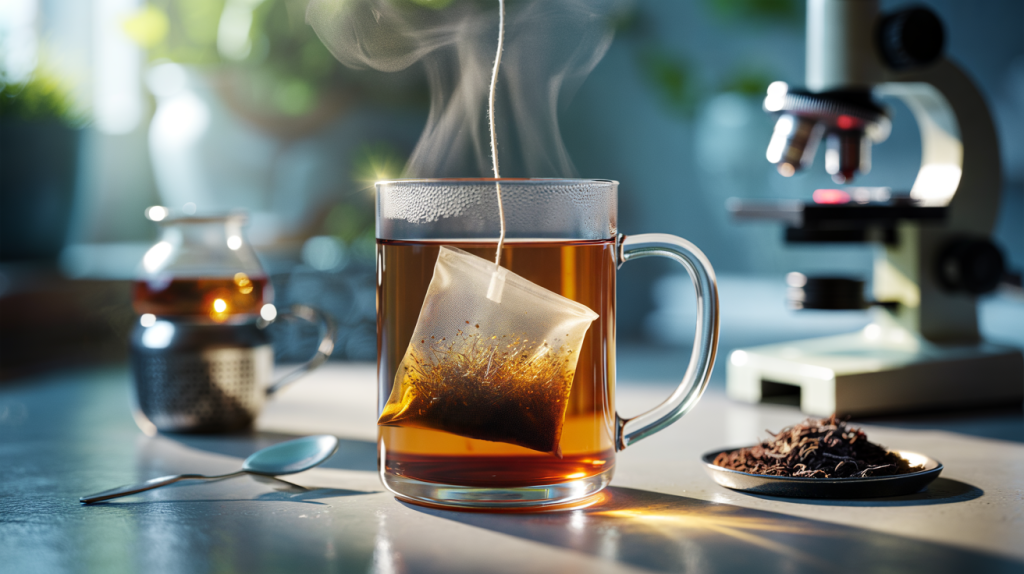
Plastic tea bags and health risks : the key facts in your cup
One cup, billions of particles. In 2019, a McGill University team reported that a single plastic tea bag steeped in near‑boiling water released about 11.6 billion microplastics and 3.1 billion nanoplastics into the brew, published in Environmental Science et Technology. That finding sent a chill through tea lovers, because nylon and PET pyramid bags look premium yet can shed particles at high temperature.
Regulators have not declared everyday tea drinking unsafe, but they are not shrugging either. The World Health Organization said in 2019 that evidence of harm from dietary microplastics remains limited, while urging better data. In 2023, the European Food Safety Authority highlighted potential concerns for immune and gut effects from micro et nanoplastics, yet concluded a full risk assessment is still not possible. People want clarity now, not someday.
What the studies actually show about plastic tea bags
Let’s start with the material. Some pyramid tea bags are made from nylon or polyethylene terephthalate, and many paper-style bags have historically used a thin polypropylene layer for heat sealing. When hot water hits these polymers, shedding happens more readily. The 2019 McGill experiment steeped bags at 95 °C, which is standard for black tea in kitchens.
How much plastic do we already consume across the diet. A 2019 analysis led by Kieran Cox in Environmental Science et Technology estimated that adults ingest roughly 39,000 to 52,000 microplastic particles per year from food and drink, with bottled water potentially adding up to 90,000 more annually compared with tap. Tea could be part of that tally if the bag is plastic-based.
What about health endpoints. WHO’s 2019 report on microplastics in drinking-water judged that larger particles are mostly excreted, while smaller ones could cross biological barriers in theory. EFSA’s 2023 statement pointed to emerging evidence of inflammation and oxidative stress in some animal studies exposed to micro et nanoplastics, but stressed major gaps remain in particle characterization, doses, and real-world relevance. So the risk is plausible, the certainty isn’t there yet.
Everyday habits that quietly raise exposure – and easier, safer swaps
Most tea routines can be tweaked without losing flavor. The goal is simple : reduce contact between near‑boiling water and plastic.
Here’s a practical checklist tea drinkers keep coming back to:
- Prefer loose‑leaf tea with a stainless steel or unglazed ceramic infuser.
- If choosing bags, look for plastic‑free options clearly labeled as made from paper without polypropylene sealing, or certified home‑compostable cellulose.
- Avoid nylon or PET pyramid bags, which lab tests have flagged for higher particle release.
- Let boiled water rest 30 to 60 seconds before pouring. The 2019 lab work used 95 °C; slightly cooler water can still brew well while lowering thermal stress on materials.
- Do not microwave water with the bag already inside, which adds heat directly to the plastic.
- Store tea away from heat and sunlight, and do not re‑use plastic-based bags.
Small shifts help maintain taste et ritual while trimming avoidable exposure. Brands have begun offering plastic‑free strings and tags, so the swap is no longer a hassle. One caveat : some plant‑based or compostable materials still fall under the umbrella of plastics at the particle level, and may shed under stress. Labels can be confusing, which is frustrating.
Where policy and industry stand today – and what’s missing
Change did start. Between 2018 and 2021, several large tea companies in the UK and Europe announced moves toward plastic‑free or plant‑based bags, responding to consumer pressure and waste rules. That helps with composting and litter, yet it does not automatically answer the micro et nanoplastic question at cup level unless bags eliminate polymer sealing or high‑temperature plastics entirely.
On the health side, WHO’s 2019 assessment and EFSA’s 2023 statement converge on the same message : current evidence does not allow a quantitative health risk estimate for dietary microplastics. Data gaps include consistent particle sizing, chemical additives, and realistic human exposure in the gut. Without that, national agencies stop short of strict limits, while funding new projects to close the gaps.
So where does that leave tea drinkers. The strongest data point still comes from 2019 : billions of particles released by plastic tea bags at typical brewing temperatures in a controlled test. Regulatory reviews say harm is not proven, but precautionary steps are reasonable. The near‑term solution is practical procurement – choose loose‑leaf or verifiably plastic‑free bags, brew a touch cooler for delicate teas, and keep plastic out of the kettle. It feels littel, yet it cuts avoidable exposure today while science catches up.