
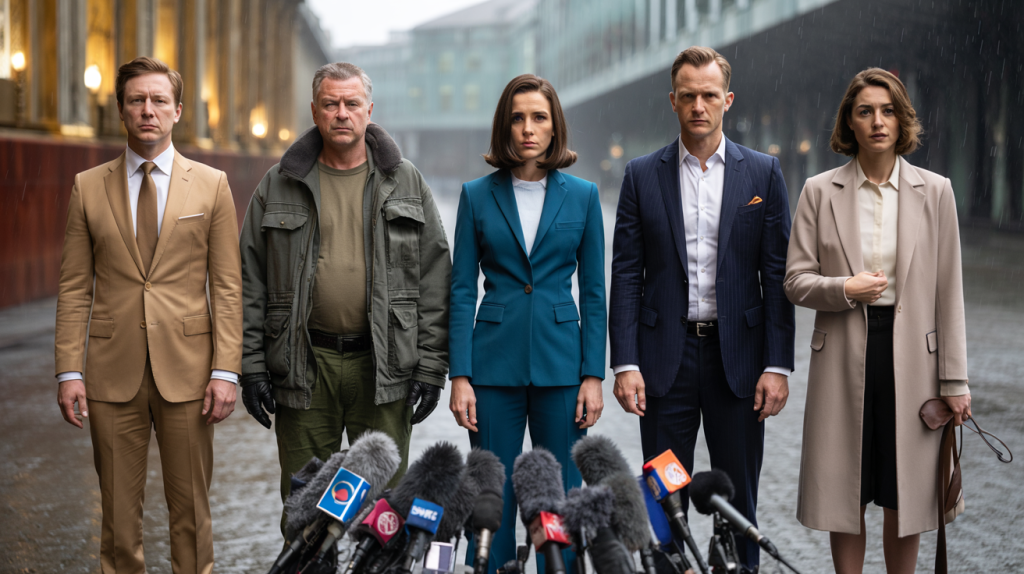
Clothes speak before a single word lands. In politics, that first glance can lift a message or hijack it, as seen with Barack Obama’s 2014 tan suit moment and Volodymyr Zelenskyy’s wartime olive tee and fleece. The outfit becomes the headline, the shorthand, the emotion.
Voters read signals through fabric and color. Research backs that snap judgement: formal dress can push minds toward leadership framing, while casual cues signal proximity and authenticity. Campaigns know this. They plan wardrobes like talking points, because perception sticks faster than policy.
Political style that sets the tone : why clothing shapes power
Evidence first. A 2015 study in Social Psychological and Personality Science by Michael Slepian and colleagues linked formal clothing to more abstract thinking, the mental mode associated with leadership and strategy. Earlier, Hajo Adam and Adam Galinsky found in Journal of Experimental Social Psychology in 2012 that wearing a lab coat described as a doctor’s improved attention and performance, a phenomenon termed “enclothed cognition”.
Translation for public life : a suit or a tailored jacket often frames a candidate as in control, while rolled sleeves or knitwear brings closeness. That’s the push and pull of modern campaigns, where a tie knot can prime how a budget line sounds.
Real-world flashpoints show the stakes. In August 2014, Barack Obama’s tan suit dominated U.S. news cycles for days despite a serious press conference on foreign policy. During the 2022 Russian invasion, Volodymyr Zelenskyy’s plain olive gear signaled continuity under fire and rallied partners. Back in October 2008, Politico revealed the Republican National Committee spent roughly 150,000 dollars on wardrobe for Sarah Palin and her family, turning clothing into a national storyline overnight.
Dress codes, outrage cycles, and the risk of getting it wrong
Institutions set the frame. In the United Kingdom, Speaker John Bercow clarified in 2017 that ties were not compulsory in the House of Commons, shifting expectations for male members. In France, a tie debate reignited in July 2022 when some deputies came without one, and National Assembly President Yaël Braun-Pivet declined to impose a tie rule.
The United States toggled too. After a small uproar about sleeveless dresses, Speaker Paul Ryan signaled updates in 2017 to the U.S. House dress code to accomodate contemporary standards. Then in September 2023, the U.S. Senate briefly relaxed its informal code before passing a bipartisan resolution that codified jackets, ties, and long pants for men.
Missteps often spring from misalignment between setting and message. Justin Trudeau’s exuberant traditional outfits on a 2018 trip to India triggered an international conversation that overpowered policy stops. Alexandria Ocasio-Cortez’s “Tax the Rich” dress at the 2021 Met Gala turned one red carpet into a policy battleground, by design.
What voters actually notice : data, dates, and perception
Coverage that fixates on looks can harm candidates, especially women. The nonpartisan Name It. Change It. research program reported in 2013 that even positive mention of a female candidate’s appearance reduced voter support by several points, with effects near 5 points depending on context.
Signal management matters because news attention is finite. Obama’s 2014 tan suit week is a textbook case of attention displacement, where optics swamped substance. That same logic explains wartime dressing by Volodymyr Zelenskyy in 2022, which fused message and outfit so tightly that one amplified the other.
Patterns hold over time. Angela Merkel’s consistent trouser suits built a stable, low-drama visual brand across four terms, while post-crisis leaders often shift toward simpler palettes to project steadiness. The choice is calculated, not decorative.
How to build a winning political wardrobe strategy
Start with the setting, then the story. Parliament, factory floor, flood zone, summit room. Each place carries a visual language. Clothes need to echo the moment without becoming the moment.
Teams that do this well blend research with logistics: advance photos, lighting tests, regional sensitivities, fabric that travels, and backups for bad weather. The goal is to keep attention on the message while letting the look do quiet work underneath.
Here is a compact checklist used by seasoned communications teams :
- Anchor one visual signature per phase of a campaign : color, jacket shape, or accessory with purpose.
- Test for lighting and lenses : shiny fabrics, busy patterns, or tiny pins can fail on camera.
- Match formality to the audience’s expectations : one notch above the room for authority, equal to the room for closeness.
- Plan crisis wear : breathable layers, neutral palette, no distracting logos, shoes for rough ground.
- Audit news risk : if the outfit is the story, will it advance the policy line or erase it.
The logic stays consistent across countries. Data ties clothes to cognition and to media outcomes, and history supplies clear dates when wardrobe swallowed the narrative. What often goes missing is a simple bridge between evidence and fieldwork: a living wardrobe map that tracks venues, audiences, and messages week by week. Build that map, link it to the comms calendar, and clothing stops being a gamble. It becomes part of the strategy.