
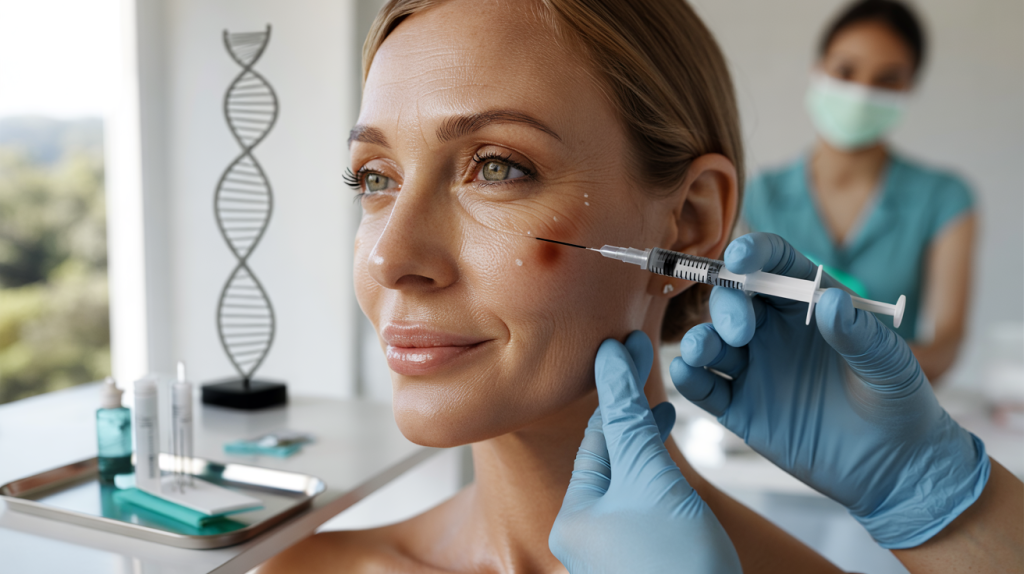
Skin that looks tired even after eight hours of sleep. Fine lines that makeup cannot quite blur. Polynucleotide injections for the face promise a quiet reset, not a dramatic overhaul, by nudging the skin to repair itself over weeks.
These treatments are not classic fillers. They are biostimulators: fragments of DNA – often derived from salmon – that signal fibroblasts to make new collagen and support tissue repair. Early adopters call them skin quality boosters because results build gradually and look unforced. The science sits on known pathways: polydeoxyribonucleotide has been shown to activate adenosine A2A receptors, promoting angiogenesis and collagen synthesis in wound and skin models (Wounds, 2017). That is the core story, and why demand keeps rising alongside other injectables – the U.S. counted 16.3 million minimally invasive cosmetic procedures in 2019, long before the current skin booster wave (American Society of Plastic Surgeons, 2019).
Polynucleotide injections for the face : what they do and who they help
Main idea first. PN treatments target texture, fine creases, mild laxity and dullness on the lower face, cheeks, periocular area and neck. They are often used when hyaluronic acid feels too volumizing or when skin looks thin after sun exposure or stress.
The mechanism is regenerative rather than filling. Polynucleotides act as skin-signaling molecules and can scavenge free radicals, while encouraging fibroblasts to produce type I collagen and extracellular matrix. As a reminder of the baseline biology, adult skin loses roughly 1 percent of its collagen each year from the mid twenties, which slowly thins the dermis (Dermato-endocrinology, 2012). PN aims to push back on that drift.
What to expect in practice. Most protocols are delivered as microinjections across the concern area. Sessions are spaced 2 to 4 weeks apart, commonly in a series of 2 to 4, with maintenance every few months if the goal is sustained glow rather than a one-off refresh. Redness and pinpoint swelling tend to settle in 24 to 72 hours. That low downtime is part of the appeal.
Results, timelines and safety : evidence without the hype
Observation from clinics has been consistent: texture looks smoother by week 4, with better bounce by weeks 8 to 12. Peer-reviewed data remains modest but supportive. Reviews published in 2022 described improvements in elasticity and dermal density in small cohorts using polynucleotide formulations, while underlining the need for larger randomized trials (Aesthetic Plastic Surgery, 2022).
For mechanism-first readers, the tissue repair signal is not fringe science. Polydeoxyribonucleotide has been studied since the 1990s in wound care and chronic ulcers, where it shortened healing time in controlled settings and modulated inflammation via A2A receptor pathways (Wounds, 2017). Translating that to photoaged faces is logical, even if aesthetics-focused trials are newer and smaller.
Safety profile has looked favorable in medical-device PN used for intradermal injection. The most reported side effects are temporary redness, papules, bruising and mild tenderness. Allergic reactions are rare, as PN lacks species proteins after purification, although anyone with fish or seafood allergy should discuss risks carefully since many formulas originate from salmon DNA. As always, infection risk is tied to technique and setting.
Procedure, pain and aftercare : how a PN session actually feels
Pain level stays low to moderate thanks to topical anesthetic and fine needles or cannulas. A typical face session lasts 20 to 40 minutes. Practitioners often blend microdroplet injections superficially with a few deeper points in areas of crêpiness.
Downtime is short but visible if you have multiple microdeposits – expect little bumps that soften within 24 to 48 hours as the product disperses. Makeup usually goes back on the next day. Clinics often advise gentle cleansing that evening, no workouts or saunas for 24 hours, and sun protection as pigment can spike after any needling.
When results kick in, they do not look like a filler. Think healthier-looking skin that reflects light better, less creasing under the eyes, and a subtle lift in snap-back. Candidly, severely etched lines or large-volume loss will not recieve enough change from PN alone.
Costs, candidacy and smart choices : avoid the common mistakes
Pricing varies by country and brand. As a ballpark, public clinic price lists in 2024 showed about 250 to 600 euros per session in parts of Europe, and roughly 300 to 800 dollars in the United States, with packages often reducing the per-session cost.
Good candidates are people with early to moderate texture changes, dullness, fine creases and mild laxity who want natural progress rather than instant volume. Anyone pregnant, breastfeeding, actively infected, or on anticoagulants should review timing and suitability with a qualified clinician. If acne or melasma is active, protocols may need sequencing with other care first.
One thing becomes clear after speaking with experienced injectors: outcomes depend more on assessment and technique than on the logo on the vial. PN can also pair with hyaluronic acid skin boosters or gentle energy devices – just not on the same day – when the plan aims for both hydration and remodeling.
Before booking, run this quick safety checklist once and properly:
- Verify the practitioner’s medical qualification and insurer coverage for injectables.
- Ask which specific polynucleotide product is used, its regulatory status locally, and batch traceability.
- Request pre and post photos from the same device and lighting, taken at 4 and 12 weeks.
- Confirm sterile single-use needles or cannulas and clinic infection-control protocols.
- Discuss a plan for bruising risk, aftercare, and what to do in case of delayed reactions.
Put simply, PN treatments sit in the skin quality space – not the volumizing space. For some, the missing element is patience: results unfold over weeks, then consolidate with maintenance. Those looking for a fresher canvas without obvious filler cues often find that trade-off worth it.
Sources : American Society of Plastic Surgeons, 2019; Dermato-endocrinology, 2012; Wounds, 2017; Aesthetic Plastic Surgery, 2022.