
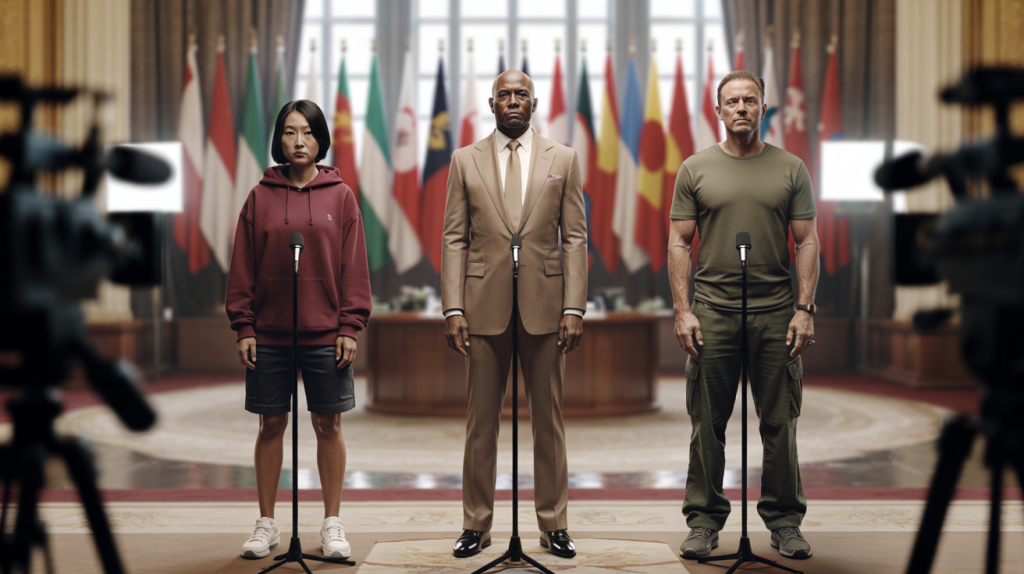
Clothes speak before politicians do. In a world where public trust in institutions sits low, every jacket, tie, sneaker or military T-shirt becomes a message. Voters clock signals fast, then stick with them. That is not a style story – it is strategy.
The stakes are visible. Gallup reported in June 2022 that only 7% of Americans had confidence in Congress, a record low. When trust is fragile, appearance does extra work: it frames credibility, closeness, even competence. Snap judgments form in just 100 milliseconds, as shown by Janine Willis and Alexander Todorov in Psychological Science in 2006. That speed turns wardrobe into a high-risk, high-reward tool for anyone seeking votes – or defending a mandate.
First impressions of politicians: what clothing signals instantly
Voters read intention from the fabric. Dark suits with structured shoulders cue authority and continuity. Rolled sleeves say urgency and hands-on effort. A tieless shirt can signal modernity or carelessness, depending on the room. The code shifts by country and moment, but the reading happens right away.
Academic work backs that reality. The 2006 study by Willis and Todorov showed people form impressions of traits such as competence almost immediately, and those impressions barely change with longer exposure. Other research on formal clothing, including work by Michael W. Kraus and colleagues in 2015, links dressing up to more abstract thinking – a mindset associated with leadership framing and negotiation.
This is why an outfit is never neutral in politics. It primes the audience before the first line lands. And once a frame is set, the rest of the message has to fight to replace it.
From Obama’s tan suit to Fetterman’s hoodie: moments that shifted the dress code debate
Some wardrobe choices became milestones because they reframed what power looks like. On 28 August 2014, President Barack Obama wore a tan suit for a summer press conference. The color choice exploded into a national flashpoint across TV and headlines, turning a normal briefing into a conversation about seriousness and presidential image.
In September 2023, the U.S. Senate briefly relaxed its dress expectations as Senator John Fetterman often appeared in hoodies and shorts. The debate moved fast from fabric to symbolism: authenticity versus respect for institutions. A formal dress code returned days later.
Europe has its own timeline. In June 2017, the French National Assembly ended the rule requiring male deputies to wear ties. The message: modern representation does not always come with a knot. In 2022, President Volodymyr Zelensky addressed parliaments worldwide wearing an olive T-shirt, aligning wartime leadership with frontline simplicity and resolve. Context dictated the uniform – and the narrative stuck.
What the data says about trust, competence and attire
Numbers anchor the intuition. Gallup’s 7% confidence in the U.S. Congress in 2022 shows how shaky the trust base can be, so visual credibility becomes a lever. Rapid-impression research in 2006 set the 100-millisecond bar for first judgments, a window where styling choices do heavy lifting before words register.
Studies in social psychology and negotiation suggest formal clothing nudges both the wearer and the observer toward a leadership frame. Kraus and colleagues reported in 2015 that formal attire increased abstract, big-picture thinking compared with casual dress – exactly the cognitive posture often expected from heads of parties or ministers. Related work finds that even small changes – a tie color, a tailored fit, clean shoes – tilt perceptions to competence or warmth.
Context still rules. Crisis calls for sobriety. Reform seasons tolerate relaxed signals. The same outfit can read opposite ways if it clashes with the moment. Misreads have occured when a festive jacket showed up during austerity talk, or when a leader dressed too casually at a memorial. The public noticed.
The practical wardrobe playbook for candidates and officials
Clothing choices can be managed like a message – consistent, researched, and aligned with the day’s agenda. A few field-tested moves help political teams reduce risk and keep focus on policy.
- Match the moment : formal for institutional gravity, smart-casual for community visits, utility wear for crisis sites.
- Own a signature : one steady element – a color, jacket cut, or pin – helps recognition without shouting.
- Prioritize fit and grooming : a well-fitted mid-range suit reads stronger than an expensive but sloppy one.
- Use color intentionally : darker tones for authority, softer palettes to increase approachability on social tours.
- Test on camera : fabrics, patterns, and shine behave differently under TV lights and phone lenses.
- Localize respectfully : adapt to cultural norms during visits, from headwear etiquette to shoe rules.
- Prepare a crisis kit : neutral attire ready for sudden briefings, so the message is not derailed by the look.
Behind the scenes, the best teams build a visual calendar alongside the policy calendar. They log setting, audience, camera setup, and expected tone for each stop, then align clothing to the script. They monitor how images travel on TikTok, Instagram and TV. They keep a neutral backup outfit in the car.
The goal is simple: reduce visual noise so arguments land cleanly. When trust is scarce and attention jumps, the right jacket or shirt does not win an election alone – it clears the path for the story that can.