
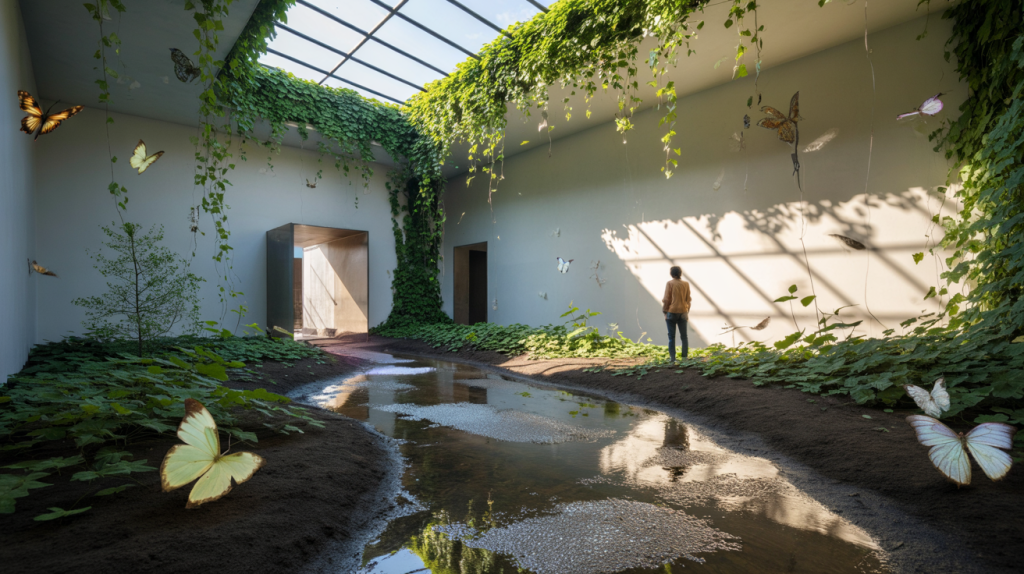
Walk into a Precious Okoyomon installation and the room breathes back. Vines climb. Butterflies flicker. Sugar crusts the ground like memory. The Nigerian American artist and poet has made a distinct mark by treating space as a living text, and growth as a narrative that never sits still. It is sculpture that keeps changing under your eyes.
Institutions have noticed. Okoyomon’s presence at the 59th International Art Exhibition of La Biennale di Venezia in 2022 put this practice on a global stage, while the Chanel Next Prize in 2021 – ten laureates receiving 100,000 euros each – underlined momentum across art and performance. The point is clear : audiences are not just looking at art here, they enter it, then return weeks later to find it transformed.
Who is Precious Okoyomon, artist and poet
Precious Okoyomon works between poetry, performance, and large-scale environments filled with living matter. The materials often carry deep histories : kudzu vines associated with invasive spread, sugar tied to extraction and plantation economies, soil and water as agents of change.
The poetry runs through the installations, sometimes literally as text, sometimes as a pace or rhythm. Lines surface like breath. Time becomes a collaborator, and decay is not a failure but a second act. Viewers read with their feet, moving through an evolving poem.
Anchoring that approach, museums and biennials invite Okoyomon to build ecosystems rather than sets. That choice reframes the gallery as a habitat where growth, death, and care remain visible, not backstage.
Living installations : kudzu, time, and transformation
Kudzu appears again and again. The plant’s speed and reach make it a charged symbol. It signals histories of movement and control that cannot be tidied away. When Okoyomon lets it take hold, the gallery’s white walls become a scene of unfolding consequences.
Live elements mean the work does not freeze after opening day. A garden might look sparse in week one, then dense by week four. Visitors return and realize the piece has shifted tone – lighter where butterflies have emerged, darker where leaves have browned. That variability is the message.
A common mistake : treating these environments as one-off photo ops. The surface delights, sure, but the deeper reading happens across time. Two visits, even three, reveal how care, neglect, and climate inside the gallery write new lines into the artwork.
Key milestones for Precious Okoyomon : Venice Biennale 2022 and Chanel Next Prize
Visibility jumped in 2022 with the 59th Venice Biennale. The exhibition context amplified a practice grounded in living systems, placing it among global conversations about ecology, technology, and bodies in transition.
In 2021, the inaugural Chanel Next Prize recognized Okoyomon within a cohort of ten international artists. The award – 100,000 euros earmarked for creation – signaled institutional trust in work that defies fixed categories. It also opened doors for ambitious, time-based installations that need care teams and space to breathe.
That same year saw major attention for a rooftop garden commission in the United States, where visitors encountered a growing environment rather than a static object. The piece unfolded across seasons, asking audiences to witness change, not just contemplate it. It felt intimate and planetary at once.
How to experience Precious Okoyomon today
These works reward presence, patience, and small returns. The poetry still matters even when no pages are in sight. And yes, reading the room – literally – helps.
Here is a simple way to get closer without missing what the work offers :
- Visit early in a show’s run, then return a few weeks later to notice growth, decay, and shifts in light.
- Listen for performance elements or readings scheduled by the host institution, often announced near opening dates.
- Read recent interviews to track recurring motifs like kudzu, sugar, and time – they thread across exhibitions.
- Look for biennial and museum programs that support living installations, since these spaces can sustain the work’s care needs.
Why this approach resonates now : audiences are searching for art that does not pretend to stand outside the world’s crises. Okoyomon’s ecosystems acknowledge entanglement, then turn it into form. The spaces invite care. They make room for joy and rot in the same breath. That mix feels uncomforatbly honest, but also strangely hopeful.
For readers meeting Precious Okoyomon through the poetry first, expect porous borders between text and soil. Language can sweeten, then sting. Plants do the same. The installations hold that dual truth without smoothing it out.
And if one detail sticks, let it be this : you are not just looking at an artwork, you are entering a clock. Minutes, days, weeks tick inside the piece. Miss a beat, and the scene you remember will not come back. That is the wager – and the invitation – at the heart of Precious Okoyomon’s art and poetry.