
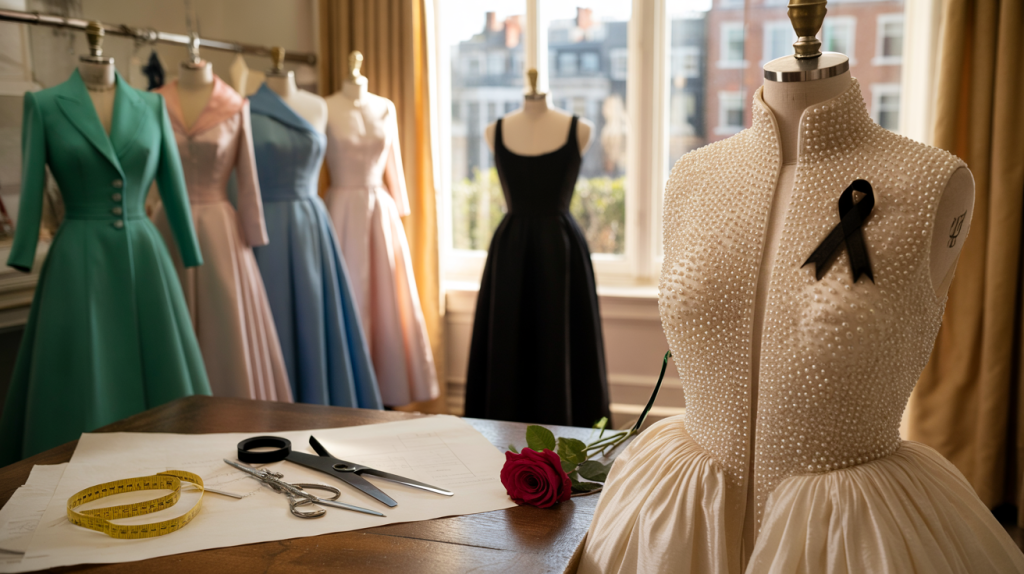
A key architect of Princess Diana’s image is no longer here. Catherine Walker, the French-born designer who dressed the Princess through her most photographed years, died on 23 September 2010 at the age of 65 after a long battle with cancer, according to BBC News on 24 September 2010.
Her name sits behind many of the looks that defined Diana’s evolution from shy newlywed to confident humanitarian. From streamlined daywear to high-glamour evening gowns, Walker’s Chelsea atelier built a modern royal wardrobe with purpose and poise. That is the simple truth readers come for.
Catherine Walker, Princess Diana’s designer : death, dates, facts
Catherine Walker founded her label in 1977 in Chelsea, London. The collaboration with Diana began soon after the 1981 royal wedding and stretched across the following decade and a half. Walker’s death in 2010 closed a seminal chapter in British couture, but the facts remain clear and sourced. BBC News reported the passing on 24 September 2010. The Guardian, on 24 September 2010, recorded Walker’s central role in Diana’s image-making and noted the enduring impact of her designs.
Numbers add context. On 25 June 1997, a Christie’s charity auction of 79 of Diana’s dresses raised 3.25 million dollars for AIDS and cancer causes. Many of the gowns under the hammer were designed by Walker, underscoring just how much of the Princess’s wardrobe she shaped. The black dress in which Diana was laid to rest was also a Catherine Walker creation, as reported by The Guardian in 2010.
Princess Diana’s most familar looks by Catherine Walker
The public memory often snaps to a handful of images. One is the pearl-encrusted white gown and bolero from 1989, nicknamed the “Elvis” dress for its high, sculpted collar. Another is the suite of tailored coatdresses and sleek column gowns that photographed cleanly on overseas tours, where color, line and modesty worked together. These were not costumes. They were tools for diplomacy, designed to work in bright daylight, flashbulbs and crowded hospital corridors.
The method was consistent. Walker’s pieces balanced clarity in silhouette with fabric that moved well on camera. Hemlines held, shoulders softened, and the palette spoke to place. That discipline explains why so many Walker looks resurfaced at auction in 1997 and went on to museums and private archives. It also explains why picture desks kept choosing those images for front pages and anniversaries, year after year.
After Catherine Walker : the label et the ongoing royal connection
Walker’s death did not end the story. The house she co-founded continued under designer Said Cyrus, her husband, maintaining its base in Chelsea and its couture-to-measure approach. The label, established in 1977, remained a quiet constant of British occasionwear in the 2010s and 2020s, with a client list that has included members of the royal family. That continuity matters when judging legacy, because it shows how a design language outlives a designer.
The broader impact is easier to track in images than in words. Diana’s Walker wardrobe set a template for royal dressing that still reads as modern: precise tailoring for daytime engagements, restrained evening wear that lets gestures do the talking, and color used as a soft power tool. Industry observers often point to that alignment of practicality and glamour as a turning point in late twentieth century royal style. The charity figure from 1997 – 3.25 million dollars raised in one night – hints at cultural weight measured not in column inches but in outcomes.
Questions remain for readers who land here from a quick search. Who died, when, and why does it matter. The answers are straightforward. Catherine Walker died on 23 September 2010, aged 65, as reported by BBC News on 24 September 2010. She was central to Princess Diana’s public image for more than a decade, with her work documented by outlets including The Guardian in September 2010 and by Christie’s in June 1997. The legacy continues through the atelier she founded and through a royal dress code her designs helped define, one photograph at a time.