
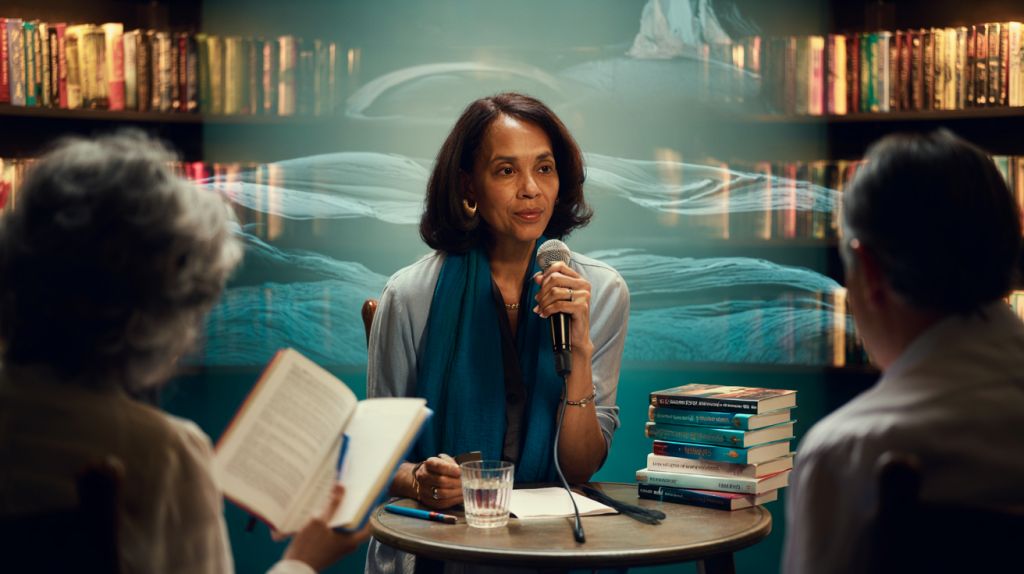
The room grows quiet, then the voice of Nathacha Appanah unfolds with a gentle Indian Ocean lilt. A rencontre with Nathacha Appanah often turns reading into something lived, where islands, exile, and fragile childhoods take center stage.
Readers come with big expectations. They seek the person behind acclaimed novels such as “The Last Brother” (2007) and “Tropic of Violence” (2016). They want context, dates, a sense of place. They get it. Nathacha Appanah was born in 1973 in Mauritius, began as a journalist, then moved to France in 1998. Her books circle memory, displacement, and the quiet shock of growing up, and that is exactly what a live meeting illuminates.
Who Is Nathacha Appanah and Why This Rencontre Matters
Nathacha Appanah writes from the Indian Ocean and speaks to everyone. Early novels such as “Les Rochers de Poudre d’Or” (2003) and “Blue Bay Palace” (2004) mapped Mauritius with tenderness and tension. “The Last Brother” in 2007 revealed hidden history, when Jewish refugees were interned in Mauritius during the 1940s, and connected personal grief with global upheaval. Several of these works have been translated into English, including by Geoffrey Strachan.
“Tropic of Violence” arrived in 2016 and changed the conversation. It won the Prix Femina des lycéens 2016 and the Prix du roman France Télévisions 2016. Set in Mayotte, the novel followed abandoned teens caught in survival loops and asked how society looks away. On stage, Nathacha Appanah often shifts from the intimate to the political with the same calm clarity, which keeps audiences leaning in.
From Mauritius to Mayotte: Places, Dates, and the Themes She Explores
Geography is not a backdrop in Nathacha Appanah’s work. It pulses. Mauritius gives the early novels their heat and class tensions. Mayotte anchors “Tropic of Violence”. That island became an official French department on 31 March 2011, a key date that reframed migration routes and social services in the book’s context. The change in status sits in the margins of the story and explains the pressure that builds on young bodies.
Time markers help readers orient. “The Last Brother” looks back to the 1940s and the little-known camp in Beau-Bassin where refugees waited far from Europe. “Le Ciel par-dessus le toit” appeared in 2019 and turned to family fractures and the power of poetry. In 2021, “Rien ne t’appartient” probed memory and identity with a precise, piercing tone. In a live exchange, dates and places fall into place, and the novels connect like islands in the same archipelago.
How to Prepare for a Rencontre avec Nathacha Appanah
An author meeting is not a lecture. It is a conversation. Readers often arrive with emotion and a bit of awe, then leave with practical insight on how a book was shaped, line by line. Preparation helps, and small, concrete questions work best.
Here is a short checklist that keeps the exchange warm and fruitful :
- Read one novel in full and skim a second for range, for example “Tropic of Violence” and “Blue Bay Palace”.
- Note 3 time anchors: publication year, place, and one historical marker. Bring them into your question.
- Ask about craft: structure, point of view, or why a child’s voice carries the story.
- Connect life and text without prying: journalism in Mauritius, then France since 1998, and how that shaped research.
- Stay open to silence. Nathacha Appanah often lets a pause breathe before a precise answer. Travellling pauses are part of her rhythm.
A common misstep is asking for a full plot summary or a personal confession. Better to ask what changed between drafts, how Mayotte’s realities entered the page, or when a character’s fate became inevitable. These questions respect both reader curiosity and the work’s integrity.
Where to Meet Nathacha Appanah, What to Ask, and How to Follow Up
Nathacha Appanah appears at literary festivals in France, at bookshops, and at library events that mix readings with Q and A. Programs are announced by her French publisher Gallimard and by festival schedules, often a few weeks ahead. Checking local cultural centers and municipal libraries increases the odds of catching an intimate session rather than a large auditorium event.
When the microphone reaches you, keep questions specific. For “Tropic of Violence” (2016), asking how Mayotte’s 2011 department status shifted the narrative frame opens a focused path. For “The Last Brother” (2007), connecting the 1940s Mauritius setting with the novel’s exploration of mourning leads to a concise, revealing reply. After the talk, a quick signing line exchange works: one sentence of context, one question about a scene, a thank you.
That last step matters. Following author news through publisher pages and festival newsletters brings future dates into view. If the next rencontre with Nathacha Appanah is near, being ready with a book freshly read, two precise questions, and a sense of those key years turns a public event into a real meeting, the kind that stays with you long after the lights go up.