
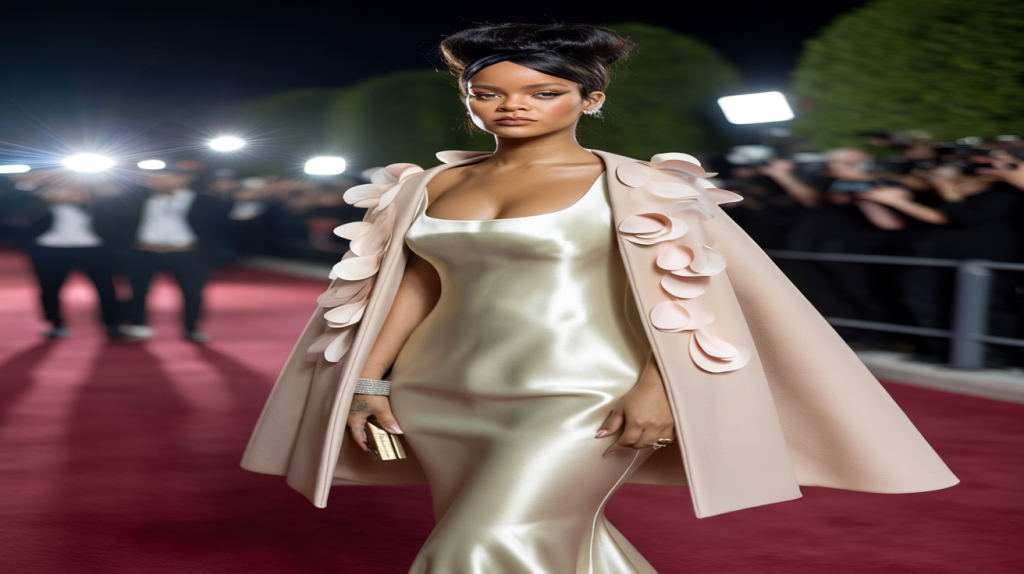
Rihanna meets the 1960s on the red carpet: decode the silhouette, the beauty codes, and the real fashion history that makes the look land now.
Rihanna turns a carpet into a headline. When a 1960s red carpet dress enters her orbit, the formula is simple: sculpted lines, high drama, and a touch of rebellion that photographs like a dream.
Why the 1960s, and why now? Because the era’s clean architecture and bold materials still feel modern under flash bulbs. The Metropolitan Museum of Art traces the shift to streamlined, space-age lines to André Courrèges’ 1964 collection, while Paco Rabanne’s 1966 show “12 Unwearable Dresses in Contemporary Materials” pushed metal discs into couture vocabulary, both cited by The Met’s Costume Institute. The Victoria and Albert Museum’s “Mary Quant” exhibition (2019) documents how the miniskirt moved from subculture to mainstream by 1966. Those dates explain the backbone of a Rihanna-ready red carpet moment.
Rihanna, red carpet et the 1960s look: the main idea
Think architecture first. A 1960s-inspired gown for Rihanna leans into column or A-line shapes, a crisp neckline, and one bold focal point: an opera coat, a petal cape, or jewel-like embellishment. That structure reads instantly on cameras and keeps movement clean.
There is a common hesitation: retro can slip into costume. The fix sits in materials and proportion. Space-age references work when cut in luxe satin, wool gazar, or hand-finished paillettes that catch light without glare. Valentino’s camellia-covered opera coat worn by Rihanna at the 2023 Met Gala – documented by Vogue on 2 May 2023 – showed how a 60s-adjacent cape can feel current with meticulous construction.
Beauty seals the decade. Bardot fringe, a sculpted beehive, or a precise cat-eye instantly anchor the reference. One wrong move and the silouette looks pastiche; one right eyeliner flick and it sings.
What “1960s” really means on a red carpet
Numbers give the picture. Courrèges’ 1964 lines shortened skirts and simplified seams, The Met notes, bringing in A-line geometry. By 1966, Mary Quant had minis well above the knee, says the V&A, proving youth culture drove hemlines higher. Rabanne’s 1966 chain-linked discs reframed eveningwear as engineered objects, a direct ancestor of today’s metal-mesh gowns.
Translate that history to Rihanna’s playbook: a column base, a sculptural topper, and one futuristic surface. She already favors those cues. The 2015 Met Gala showed scale with Guo Pei’s imperial yellow cape; the 2023 Valentino look revived the opera coat for a new audience. Different decades, same discipline: silhouette first, spectacle second.
Accessories stay deliberate. A single cuff or a tiny clutch is enough. In the 60s vocabulary, excess lives in shape, not in a pile-up of jewelry. That restraint lets cameras capture clean lines from every angle.
How to build a Rihanna-level 1960s gown outfit
Start with the base dress. A satin column or a mini-to-midi shift delivers the right canvas. Add a caped shoulder, a cocoon coat, or a petal cape to amplify volume without heaviness.
Use fabric that photographs with depth. Wool gazar – the Balenciaga favorite of the 1960s – holds sculptural forms. Silk faille keeps edges sharp. If shine is needed, consider micro paillettes that echo Rabanne without turning stiff.
Hair and makeup carry the era’s signature: beehive or Bardot waves, a sharp cat-eye, and a neutral lip. Beauty historians often date the global cat-eye fixation to mid 1960s cinema and music videos; that reference still reads immediately on screen.
Fit matters more than theme. Rihanna’s most-cited looks win on tailoring. A 1960s gown skims, not squeezes, and the topper floats with air between fabric and body. That negative space creates drama in motion and keeps the look modern.
- Quick decode: column or A-line base, sculptural topper, luxe fabric with body, one high-impact detail, cat-eye liner, and restrained jewelry.
Costs, fabrics and the sources behind the trend
For couture-level structure, expect architectural fabrics. Wool gazar and silk faille come from mills that specialize in weight and memory. House archives from Balenciaga and Dior in the 1960s leaned on those textiles for clean volume, a fact echoed across The Met’s and the V&A’s collection notes.
Cultural proof sits in the timeline. 1964: Courrèges cleans up lines for a new futurism, The Met archives show. 1966: Mary Quant’s mainstream mini and Paco Rabanne’s metal dresses formalize a high-shine, high-clarity idea of eveningwear. 2019: the V&A’s “Mary Quant” exhibition revisits how a youth-driven cut redefined global fashion. 2023: Rihanna’s Valentino opera coat reminds red carpets that a cape can carry a night – an echo of 60s opera coats rather than a replica.
So the workable solution lands here: pair a disciplined 1960s silhouette with Rihanna’s instinct for scale. Use one engineered surface – metal mesh, mirror paillettes, or lacquered satin – alongside sharp tailoring. The references are historical, cited by The Met’s Costume Institute and the V&A, yet the result reads right now under today’s LEDs and phone flashes.