
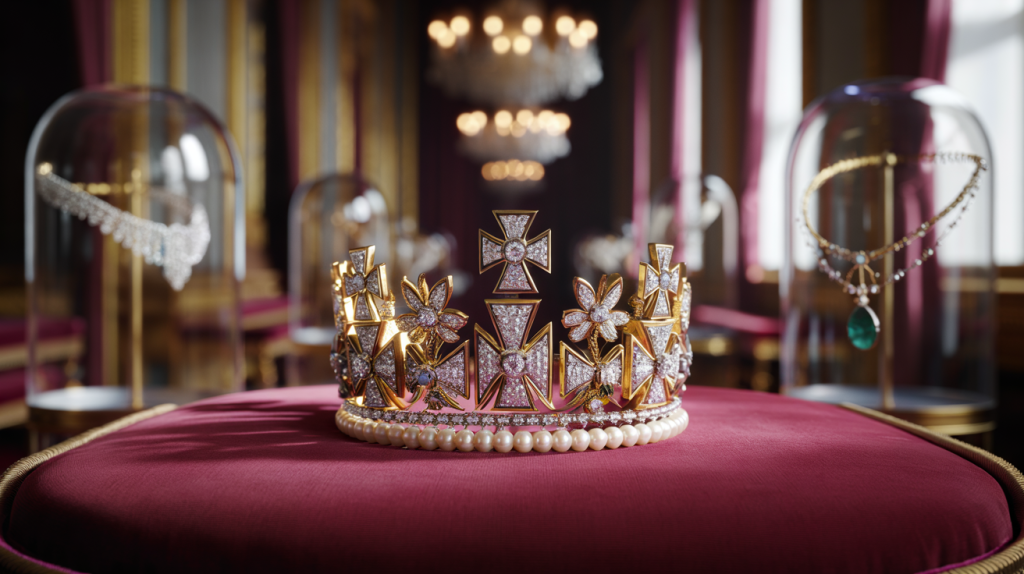
Ask which jewel sums up the British monarchy and the answer lands fast on one piece: the Diamond Diadem, also called the George IV State Diadem. Made in 1820 for the new king’s coronation, it holds 1,333 diamonds and 169 pearls, a shimmering circlet seen on countless banknotes and stamps through the reign of Queen Elizabeth II. According to the Royal Collection Trust, it became the visual shorthand of the Crown, worn by queens at the State Opening of Parliament and official portraits.
That continuity did not stop. Queen Camilla wore the Diamond Diadem for the State Opening of Parliament on 7 November 2023, updating a tradition that stretches across two centuries. Around it, a chorus of iconic tiaras – Queen Mary’s Fringe, the Cambridge Lover’s Knot, the Vladimir Tiara – shapes royal storytelling, each piece signaling duty, continuity, or a quiet nod to personal history.
Diamond Diadem of George IV : the British royal family’s enduring symbol
Facts first. The Diamond Diadem was crafted in 1820 for King George IV and later became most closely associated with queens regnant and consorts. Its profile is unmistakable: four cross pattée and four floral sprays featuring the rose, thistle, and shamrock. The Royal Collection Trust records its 1,333 diamonds and 169 pearls – figures that explain the unmistakable blaze under white light.
Queen Elizabeth II wore it for decades, including to every State Opening of Parliament of her long reign, locking the piece into public memory across the Commonwealth. That frequency built the symbolism: not just a jewel, a signal that constitutional duty is on. When Queen Camilla picked it up in 2023, the message was clear – continuity still holds.
Queen Mary’s Fringe Tiara : a wedding signal from 1919 to 2020
Another storyline sits at the aisle. Queen Mary’s Fringe Tiara was created in 1919 by Garrard from a necklace. On 20 November 1947, Princess Elizabeth wore it for her wedding to Lieutenant Philip Mountbatten – and it famously snapped just before leaving for Westminster Abbey, then was swiftly repaired. That near mishap became part of royal lore.
The piece returned to the spotlight on 17 July 2020 when Princess Beatrice chose the same tiara for her wedding in Windsor, stitching a line from Queen Mary to Queen Elizabeth II to a new generation. The repeat choice reads as deliberate: weddings equal duty plus heritage. Simple, and strong.
Cambridge Lover’s Knot and the Vladimir Tiara : heritage that moves
The Cambridge Lover’s Knot Tiara was commissioned by Queen Mary in 1914, inspired by a nineteenth century piece linked to Princess Augusta of Hesse. Today it is best known from Diana, Princess of Wales, and regularly worn by Catherine, Princess of Wales. Its diamond arches and swinging pearls carry a specific mood – elegance with a hint of drama – which explains why it photographs so well for state banquets.
Then comes the Vladimir Tiara, with a backstory from the Russian court. Originally owned by Grand Duchess Maria Pavlovna, it was smuggled out during the 1917 revolution and purchased by Queen Mary in 1921. It can be worn three ways: as diamonds only, with hanging pearls, or with emerald drops. That modular design – rare and clever – keeps it in rotation for different diplomatic tones.
Diadem vs tiara : what changes, what to look for, where to see them
People often mix the terms. A diadem is a closed or nearly closed circlet with a more crown-like profile. A tiara is lighter and open at the back, made for evening wear. The Diamond Diadem falls in the first camp; the Fringe, Lover’s Knot, and Vladimir belong to the second.
These jewels sit inside a larger story. Historic Royal Palaces notes that the Crown Jewels contain 23,578 gemstones – a scale that explains why coronations and state ceremonies feel like living theater. Not all famous tiaras are part of the Crown Jewels, though; many remain in the Royal Collection and are worn at state events or private royal weddings.
For quick orientation, here are the emblematic pieces and the detail that sets each apart :
- Diamond Diadem (1820) : 1,333 diamonds and 169 pearls, worn at State Openings – the monarchy’s visual signature.
- Queen Mary’s Fringe Tiara (1919) : wedding tiara of Queen Elizabeth II in 1947 and Princess Beatrice in 2020 – ceremony equals continuity.
- Cambridge Lover’s Knot (1914) : commissioned by Queen Mary, later worn by Diana and Catherine – pearls in motion, high-impact photos.
- Vladimir Tiara (acquired 1921) : convertible with pearls or emeralds – adaptability across courts and decades.
- Girls of Great Britain and Ireland Tiara (1893) : a wedding gift to Mary of Teck, later gifted to Queen Elizabeth II in 1947 – seen in many portraits and stamps.
Planning a trip to London helps connect the dots. The Crown Jewels are displayed at the Tower of London, curated by Historic Royal Palaces. The Diamond Diadem appears for major state occasions and in official portraits managed by the Royal Collection Trust. Some tiaras surface at state banquets hosted at Buckingham Palace or during overseas visits – then vanish back into the vaults.
A last tip for the eye. Look for national emblems, number of drops, and whether a piece is a circlet or open at the back. Spot the rose, thistle, and shamrock on the Diamond Diadem and you are already reading the constitution in gemstones. Misspelling it in a note is easy – the mind says crown, the label says diadem – but design tells the final story. If that feels accidentaly simple, that is the point : the monarchy wants everyone to understand it at a glance.