
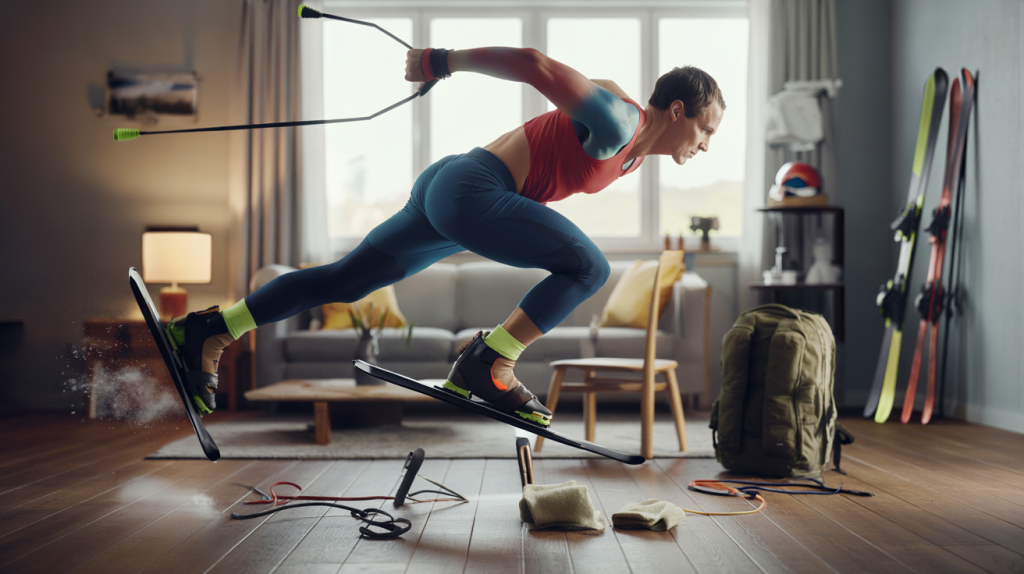
No snow. No problem. Discover a simple at-home ski training plan that builds ski legs, balance, and cardio in 30 minutes, with almost no equipement.
Ski training at home that actually transfers on snow
Pressed for time or far from the mountains, many skiers still want strong quads, calm knees, and lungs that keep up on long reds. The fix lives at home. A focused mix of eccentric leg strength, lateral power, balance drills, and short intervals can mimic turns, protect knees, and raise stamina in four to six weeks.
Here is the fast track. Train three days per week, 30 to 45 minutes. Warm up 5 minutes. Strength 12 to 15 minutes. Power and agility 8 to 10 minutes. Cardio intervals 8 to 12 minutes. Core and balance 5 to 8 minutes. This matches public health guidance for weekly activity volume : the U.S. Department of Health and Human Services 2018 guidelines recommend 150 to 300 minutes of moderate intensity activity and at least two days of muscle strengthening.
The at home workout plan : sets, reps, and intervals
The main idea is simple. Skiing punishes legs eccentrically while demanding hip stability and torso control. Recreate that under control, then add speed. Old mistake spotted everywhere : too many generic squats, not enough lateral load and balance.
Use this plan two to three nonconsecutive days per week for 6 to 8 weeks before the season, or anytime a tune-up is needed. No gym required, a chair, a backpack, resistance bands, a towel, and a hallway work fine. Keep breath steady, land softly, eyes forward.
One session structure below. Rest 30 to 60 seconds between sets, 60 seconds between blocks. On cardio, recover until speech is possible again.
• Warm up 5 minutes : brisk stairs or marching, hip circles, ankle rocks, 10 squat-to-stands.
• Strength 12 to 15 minutes : tempo squats at 3 seconds down, 10 reps, 3 sets. Rear foot elevated split squats, 8 reps each leg, 3 sets. Wall sit, 30 to 45 seconds, 2 sets. Load with a backpack if it feels easy.
• Power and agility 8 to 10 minutes : lateral skater hops, 20 seconds on 20 seconds off, 6 rounds. Step off a small book, stick the landing, 6 reps each side, 2 sets.
• Cardio intervals 8 to 12 minutes : 30 seconds fast shadow skiing turns or jump rope, 30 seconds easy, 10 to 12 rounds. Short, sharp, like a long mogul line.
• Core and balance 5 to 8 minutes : side plank with top-leg lift, 20 seconds each side, 3 sets. Single-leg Romanian deadlift, 8 reps each leg, 2 sets. Pallof press with band, 10 slow reps each side, 2 sets.
Balance, agility, and injury prevention for skiers
Observation : most home plans forget balance when fatigue kicks in. Yet edge control starts at the ankle and hip. Single-leg work stabilizes the knee under rotation, especially late in the day when form usually slips.
Evidence backs the prevention angle. A meta-analysis in the British Journal of Sports Medicine led by Jesper Lauersen in 2014 found strength training reduced sports injuries by up to 66 percent. For balance, a 2019 Cochrane Review reported exercise programs reduced falls by about 23 percent in older adults, a reminder that balance training is protective across ages.
Common mistakes come in three flavors. Going too fast too soon, skipping tempo work, ignoring recovery. Tempo squats and split squats build eccentric braking similar to carving. Lateral hops teach quick force in and out of the turn. Balanced feet, soft knees, tight ribs. That sequence holds the line.
Want a compact move library for variety days, or when time is tight :
- Tempo goblet squat with backpack : 3 sets of 8 to 10
- Reverse lunge to knee drive : 3 sets of 8 each side
- Skater hop to stick : 6 rounds of 20 seconds on 20 seconds off
- Wall sit with heel lift pulses : 2 sets of 30 to 45 seconds
- Single-leg deadlift bodyweight or band : 2 sets of 8 each side
- Pallof press anti-rotation : 2 sets of 10 slow reps each side
- Shadow turns intervals in stance : 10 rounds of 30 seconds on 30 seconds off
Minimal equipment, smart scheduling, and progression
Gear is simple. Resistance bands, a backpack, a sturdy chair, sliders made from towels on a hard floor. A balance board helps but is optional. Tight for space, work in a doorway for stability drills, then use the hallway for skater hops.
Progress every 7 to 10 days. Add load to the backpack in small steps, extend wall sits by 10 seconds, or add one interval round. Keep one easy week every fourth week to let tissues adapt. Ratings of perceived exertion help : strength blocks at 7 of 10, intervals at 8 or 9 during the work part.
Scheduling plays nice with a busy week. Alternate on days and off days : Monday and Thursday strength focused sessions, Saturday a lighter power plus balance mix. If running or cycling already fills the calendar, trim intervals and keep strength and balance as the nonnegotiables.
Aerobic engine matters for long descents. Short interval formats are efficient at home. A 2013 review in the British Journal of Sports Medicine found high intensity intervals improved maximal oxygen uptake across 2 to 12 weeks in active adults. For skiers, that translates into steadier turns and less leg burn when the snow gets chopped.