
Skin Biology 101 : the living shield on your body
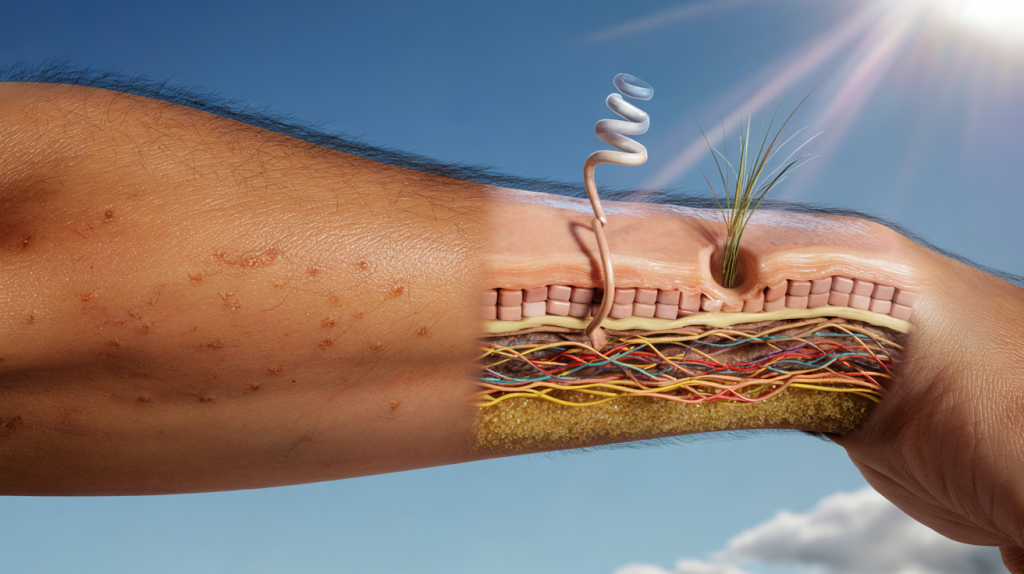
Skin is not a coat. It is a smart, self-repairing organ that covers about 1.5 to 2 m² and can weigh roughly 16 % of body mass according to the U.S. National Library of Medicine (NIH, 2020). That surface defends, senses, cools and communicates while staying only millimeters thick.
Its layers are specialized. The epidermis renews from the bottom up, the dermis provides collagen strength, the hypodermis cushions and stores energy. Thickness swings from about 0.05 mm on eyelids to around 1.5 mm on palms and soles, with function following anatomy (StatPearls, 2023). This is the core of skin biology, and it shapes everything from glow to healing speed.
Barrier, microbiome, melanin : how skin defends you
The outer barrier acts like a brick wall. Dead corneocytes are the bricks, lipids are the mortar. By weight, these lipids are dominated by ceramides near 50 %, then cholesterol and free fatty acids, a composition tied to smoothness and resilience (Journal of Investigative Dermatology, 2014). When that mortar thins, water escapes faster and irritation spikes.
Surface pH sits mildly acidic near 4.7, which helps enzymes mature the barrier and keeps many pathogens in check (American Journal of Clinical Dermatology, 2006). On top of that lives a dense community, often near one million bacteria per square centimeter, with species shifting by site and moisture level (Nature Reviews Microbiology, 2011). Disrupt the pH or lipids and the ecosystem tilts, sometimes toward acne or eczema flares.
Protection also means pigment. Melanin absorbs and redistributes UV energy before it damages DNA. Sun remains the dominant external risk. The Skin Cancer Foundation attributes about 90 % of nonmelanoma skin cancers and 86 % of melanomas to UV exposure (2024). In the United States, one in five people will develop skin cancer by age 70, a stark baseline for daily prevention (American Academy of Dermatology, 2023).
Aging, hormones and damage : what changes in skin over time
Time rewrites the dermis. Classic work in the British Journal of Dermatology reported an average decline in dermal collagen content of roughly 1 % per year after early adulthood, with visible thinning and laxity following suit (1975). Glycation from high sugar diets stiffens remaining fibers. Together they blunt bounce.
Hormones modulate texture and oil. Androgen rises in adolescence drive sebum, while the estrogen drop around menopause reduces hydration and barrier lipids. Sweat also counts. Humans carry around 2 to 4 million sweat glands that help cool during heat waves or workouts, which is why hydration and electrolytes affect skin feel in real life (International Hyperhidrosis Society, 2022).
Injury and repair are constant. Microcracks from wind, detergents or over-exfoliation speed up water loss. The barrier pH drifts upward, enzymes misfire, redness lingers. That is when routines that sounded innocent can sting. The biology quietly explains the sting.
Science-based daily habits linked to skin biology
There is no magic serum. There is physiology. Small changes that align with barrier science and UV data deliver outsized results.
- Cleanse gently once or twice daily with low-foaming, pH-friendly formulas to respect the 4.7 acid mantle and lipid mortar.
- Moisturize with ceramides, cholesterol and fatty acids to mirror the stratum corneum mix documented in dermatology research.
- Use broad-spectrum SPF 30 or higher every morning, reapply outdoors, per World Health Organization sun safety advice (WHO, 2023).
- Consider a retinoid at night to stimulate collagen and normalize turnover, building up frequency slowly to avoid barrier disruption.
- Time exfoliation. Limit acids or scrubs if tingling persists or redness appears, especially in dry climates where TEWL surges.
- Support the microbiome. Avoid constant antibacterial wipes on intact skin. Look for gentle humectants like glycerin.
- Mind hormones and life stages. Post-menopause may benefit from richer lipids and fragrance-free formulas.
Real-world example makes this concrete. Swap a high-pH foaming cleanser for a syndet bar or pH-balanced gel, add a ceramide cream within three minutes after bathing, and use SPF 30 daily. In four weeks, people with dry winter skin often report less tightness and less flaking because the mortar is back in place, the pH is steadier, and UV inflammation drops. That aligns with the barrier and UV evidence cited above.
The open question is often order and patience. Apply water binders first, then occlusives to seal. Introduce actives one at a time, two weeks apart, so the nervous system and microbiome recieve fewer shocks. Patch test behind the ear for 48 hours when trying retinoids or acids. Any persistent burning or rapidly growing spot needs an appointment, not a product.
Numbers give the nudge to act. UV drives the clear majority of skin cancers, with AAD data setting lifetime risk at 20 %. Collagen wanes annually, documented in peer-reviewed work since 1975. Surface acidity around 4.7 optimizes enzymes shown to mature the barrier. Put together, the biology points to a simple plan: protect from sun, rebuild the lipid mortar, keep pH friendly, and add collagen-supporting actives thoughtfully. Where doubt remains, a board-certified dermatologist can tailor the sequence to your skin’s layer-by-layer reality.
Sources : NIH – National Library of Medicine, 2020 ; StatPearls, 2023 ; Journal of Investigative Dermatology, 2014 ; American Journal of Clinical Dermatology, 2006 ; Nature Reviews Microbiology, 2011 ; Skin Cancer Foundation, 2024 ; American Academy of Dermatology, 2023 ; International Hyperhidrosis Society, 2022 ; British Journal of Dermatology, 1975 ; World Health Organization, 2023.