
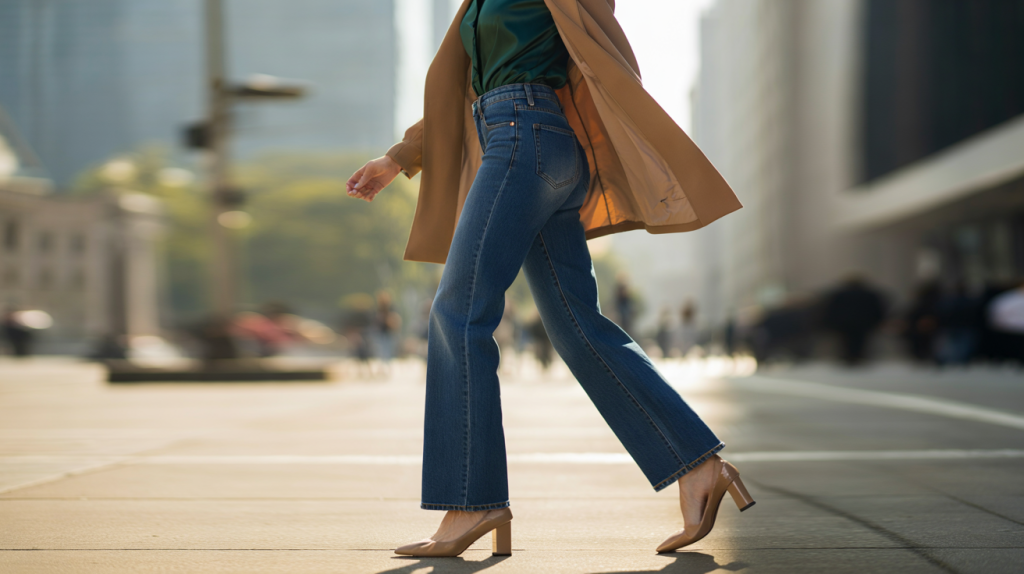
Looking for jeans that make the body look instantly sleeker without shapewear or elaborate styling tricks. Good click. The right pair can visually narrow hips, lift the seat and lengthen the leg line in one go.
Here is the fast truth behind a “jean qui affine la silhouette” : cut, rise, wash and seam placement do the heavy lifting. Denim has evolved since Levi Strauss and Jacob Davis patented riveted trousers in 1873, confirmed by Levi Strauss & Co., and modern stretch blends add comfort without cling when chosen well.
Slimming jeans explained : cuts and details that flatter
The main idea: you want clean vertical lines that guide the eye up and down. A high rise that meets your natural waist locks the tummy zone, a contoured back yoke sculpts the seat, and a straight or gentle boot cut balances the thigh.
Dark, even washes read like a shadow. Heavy whiskers, contrast fades and blown out thighs do the opposite, since they spotlight volume. Keep front pockets sleek and not too shallow so nothing pops out visually.
Seams matter more than most people think. Forward side seams slightly toward the front panel and an inner leg seam that sits close to the body create a narrower column. Hem length that just kisses the top of your shoe stretches the leg, especially with a pointed flat or low block heel.
Style science : why some jeans truly slim
Visual perception plays a role. In 2011, researchers Peter Thompson and Kyriaki Mikellidou published in the journal Perception that horizontal stripes can make figures appear thinner in certain contexts, a twist on the classic Helmholtz illusion. Translation for denim: controlled contrasts and directional lines change how width is read by the eye.
Fabric composition also shapes the silhouette. Denim expert site Heddels notes that stretch denim commonly includes around 1 to 3 percent elastane, enough to recover without sagging. That small percentage helps jeans mold the body rather than squeeze it, key when the goal is a smooth line, not a sausage effect.
Weight counts. According to Heddels’ weight guide, lighter denim typically falls in the 10 to 12 ounce range per square yard, mid weight around 13 to 15 ounces, and heavy above 16 ounces. Mid weight with mild stretch often skims nicely, while very light fabrics can show every bump and very heavy ones can feel rigid on curves.
Common denim fit mistakes that add bulk
Buying the smallest size that zips. If fabric pulls into stress lines across the crotch or hips, the eye sees width first. Size for the widest point, then tailor the waist if needed. Bodies change, brands fit differently, no shame in that.
Chasing super skinny calves when thighs are athletic. A vacuum sealed lower leg exaggerates contrast with the upper leg. A straight leg that stays the same width from knee to hem smooths the transition and looks leaner in photos and real life.
Low rise for a curvier midsection. A low rise slices the tummy and can create a muffin edge. A true high rise holds you at the narrowest part and gives the torso a longer look. Many brand fit guides classify high rise around 10 inches and up on a size small, so check the rise number, not just the name.
Shopping checklist : fabrics, sizes and tests for a trimmer line
A focused list helps in the fitting room or online cart. Save or screenshot this, then run through it fast.
- Pick a high rise that meets your natural waist and passes the sit test without digging.
- Choose a dark, even wash without thigh fading or heavy whiskers to avoid width highlights.
- Aim for mid weight denim, roughly 13 to 15 ounces as referenced by Heddels, for structure that still drapes.
- Look for stretch around 1 to 2 percent elastane so the fabric recovers without bagging, a range commonly cited by Heddels.
- Check pocket placement : back pockets centered and not too far apart visually narrow the seat.
- Favor straight, slim straight or soft boot cut openings to balance the thigh and create a long column.
- Scan the side seams : a slight forward set seam and a shaped back yoke tend to carve a cleaner line.
- Hem to hit the shoe top for maximum length, then add a pointed toe for extra few centimeters of visual leg.
One last layer of logic ties it together. The patent date tells a long story of function first, from 1873 workwear to modern closets. The perception study from 2011 shows why controlled contrast and vertical flow can defintely change how width reads. Fabric data from Heddels on elastane percentages and ounce weights explains why certain jeans skim and others cling. Combine those pieces and the path is clear : choose shape, surface and structure that guide the eye in a single clean line, and the silhouette looks slimmer before any mirror pep talk.