
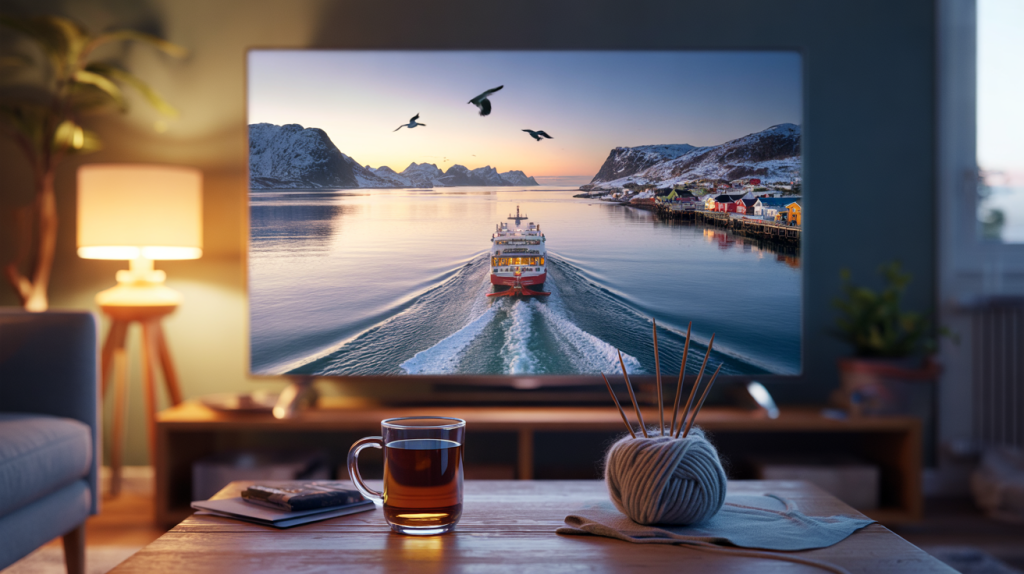
Scrolling feels endless. Then a Norwegian broadcaster aired a 134-hour live boat journey with no host and minimal edits – and millions tuned in. That is Slow TV, a genre built on real time, ordinary motion, and quiet detail that oddly sticks in the mind and softens the day.
The basics are simple. Long, unhurried shots. A train window. Needle and yarn. A ferry slicing the coast. When NRK streamed the coastal voyage “Hurtigruten – minute by minute” in 2011 for five and a half days, NRK figures cited by The New York Times in 2014 put cumulative reach at 3.2 million in a nation of about five million. The signal was clear : in a loud media world, viewers will lean into silence if it feels real.
What Slow TV actually is – and the problem it solves
Slow TV is factual storytelling in real time. No manufactured cliffhangers, few cuts, hardly any voiceover. It replaces overstimulation with steady attention. That hits a nerve. The American Psychological Association’s 2022 Stress in America survey reported that 27 percent of adults felt so stressed most days they could not function. A calmer visual diet is not a cure, yet it offers a practical counterweight.
Fans report falling asleep faster, concentrating longer, or simply feeling less jagged after work. Sounds odd, yes. Works, too. Nature and routine tasks filmed without rush create what psychologists call soft fascination – the mind rests while staying gently engaged.
For anyone who tried meditation apps and bounced off, this is a different doorway. You watch a thing unfold as it would if you were there. No gurus, no goals. Just a restfull pace.
From Norway to Netflix : the key moments and numbers
It started modern life in 2009 when NRK aired “Bergensbanen – minute by minute”, a roughly seven hour ride along the Bergen Line between Bergen and Oslo. Viewers kept it on like a window. That gave NRK confidence to scale up.
In 2011, “Hurtigruten – minute by minute” ran 134 hours live from Bergen to Kirkenes. NRK and international coverage, including The New York Times in 2014, documented the scale : millions sampled the broadcast, with local towns greeting the ship through the night. It was communal and oddly moving.
Then came craft. In 2013, “National Knitting Night” ran for 12 hours on NRK, later extended into a marathon sweater-making challenge. The idea caught on abroad. BBC Four experimented with unhurried strands such as “All Aboard! The Canal Trip” and “All Aboard! The Sleigh Ride” in 2015. By 2016, Netflix had licensed several NRK titles under the banner “Slow TV”, bringing the format to international living rooms.
How to watch Slow TV so it actually helps
Start with intention. Use a screen you can place at the edge of attention – not blasted in your face. Lower the volume to room tone. Let it run while cooking, reading, or winding down. The point is continuity, not plot.
A common mistake is hunting for the perfect episode and giving up after two minutes. Slow TV is not a trailer medium. Give a segment 10 to 20 minutes. Let your nervous system catch up to the frame rate of real life.
If stress is the trigger, pair it with small rituals. Tea at the same minute marker each night. A short stretch as the train enters a tunnel. Research on nature media and mood, including work publicized by BBC Earth in 2017 with University of California Berkeley, has linked immersive nature viewing with higher awe and lower stress. Slow TV is a practical way to tap that response at home.
Where to try Slow TV tonight : trusted programs that set the tone
New to the genre and want an easy entry that has proved its charm over time? These titles keep attention without demanding it, and they come from broadcasters that shaped the movement.
- NRK – “Hurtigruten – minute by minute” : the 134-hour Bergen to Kirkenes coastal voyage that became a national event in 2011.
- NRK – “Bergensbanen – minute by minute” : around seven hours along Norway’s high-mountain railway, first aired in 2009.
- NRK – “National Knitting Night” : 12 hours of wool, rhythm and craft from 2013.
- BBC Four – “All Aboard! The Canal Trip” or “All Aboard! The Sleigh Ride” : unhurried journeys broadcast in 2015 that introduced Slow TV to UK audiences.
- WPIX – “The Yule Log” : a classic fireplace loop first televised in 1966, the seasonal ancestor of the modern genre.
The pattern across these releases is consistent. Long shots cue the body to relax. Real distance covered in real time rewards casual attention. And the absence of constant commentary lowers cognitive load without feeling empty. For busy homes and tired minds, this is a workable media habit, not just a novelty.