
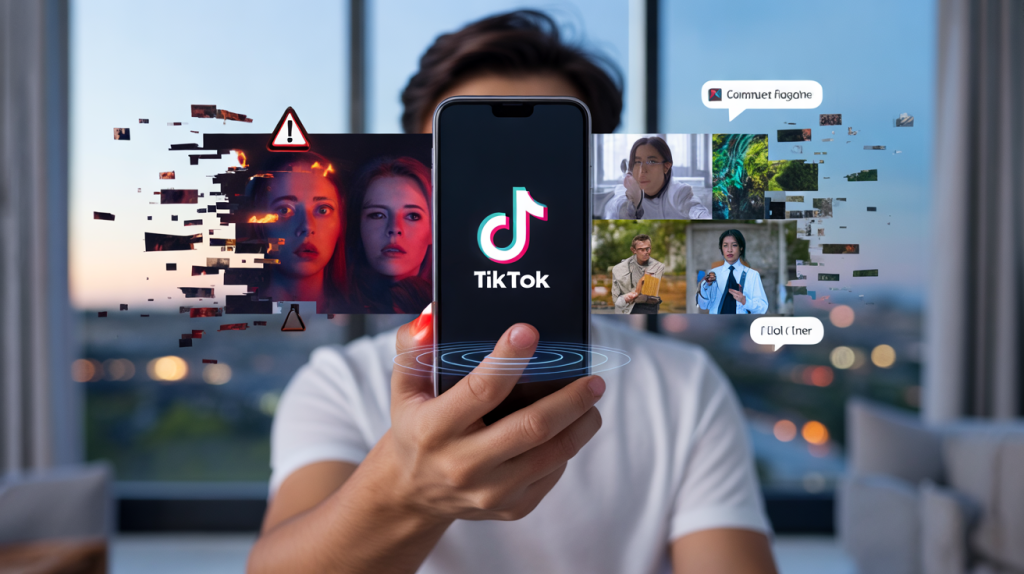
That clip that spikes the pulse, dares a reply, and keeps popping up again and again. Classic rage bait. On TikTok, a few reactive taps can turn a calm For You page into a carousel of fights, callouts, and performative feuds.
Scale makes it stick. TikTok’s ad reach touched 1.56 billion people in 2024, according to DataReportal. Research shows anger accelerates sharing, and false claims travel faster than truth online, as found in Science in 2018 and by Jonah Berger et Katherine Milkman in 2012. The fix starts simple : do not comment in anger, long‑press to hit Not Interested, use keyword filters, and rebalance the feed with trusted sources.
Rage bait on TikTok : what it is and why it hooks the brain
Rage bait is content crafted to provoke outrage for clicks, comments, and duels in the comments. It often relies on clipped context, inflammatory captions, or staged conflicts.
High‑arousal emotion drives virality. The 2012 Journal of Marketing Research paper by Jonah Berger and Katherine Milkman found anger increases the likelihood of sharing. Add the 2018 Science study showing false news spread significantly faster on social platforms, and the pattern looks familiar on short video.
Attention gets hijacked in seconds. A pause, a reply, a share signal the algorithm that the video worked. The loop closes, and similar videos arrive.
How TikTok’s algorithm rewards outrage – and how to sidestep it
TikTok explains its ranking system centers on watch time and interactions like shares, comments, and follows, not on creator size. That’s in TikTok’s own post “How TikTok recommends videos” from 2020.
So a heated clip watched to the end, replayed, or debated in the comments gets a boost. Even a hate‑watch can look like a win to the machine.
Quick detours matter. Scroll away within the first seconds. Long‑press and choose Not Interested. Report when deception or harassment appears. Flip to the Following tab for a calmer stream while the For You recalibrates.
Practical ways to avoid rage bait on TikTok
Pacing beats impulse. Here’s a compact toolkit grounded in platform features and research.
- Wait 5 seconds before reacting. If the urge to reply fades, skip. Anger decays quickly once the first spike passes.
- Use Not Interested on repeats. Long‑press the video and tap Not Interested. Do this three to five times across similar posts to retrain signals.
- Filter trigger words. Settings et privacy : Comments : Filter keywords. TikTok expanded comment controls in 2021, letting users hold comments for review and block phrases (TikTok Newsroom, May 2021).
- Avoid angry comments, duets, or stitches with bait. All count as engagement and extend reach.
- Check source and date. Search the claim, open the original, and look for full context before interacting.
- Diversify inputs. Follow credible outlets and creators who cite sources. Pew Research Center reported in Nov. 2023 that 14% of U.S. adults get news on TikTok, up from 3% in 2020, so quality curation matters.
- Use screen time tools. TikTok introduced new teen‑focused screen time controls in Feb. 2023, also useful for adults seeking guardrails (TikTok Newsroom, 2023).
- If a creator baits repeatedly, block or mute. Starve the loop. Your feed adapts faster than people think.
Protect attention and community : settings, routines, signals to watch
Some patterns are telltale. All‑caps captions with sweeping claims. Cropped clips with no source and tons of exclamation points. Calls like “no one is talking about this.” A creator who posts only outrage topics across days.
On the viewer side, small routines stabilise the feed. Start sessions on Following, not For You. Open one trusted account first to seed the session. Pair every scroll session with a time box, then stop when the timer ends.
Creators can lower collateral damage too. Limit comments to followers or friends when discussing sensitive topics, and pre‑set keyword filters so dog‑whistles never appear. These tools shipped in 2021 alongside bulk delete and block for abusive commenters, documented by TikTok.
One more layer : evidence beats emotion. When a video triggers anger, ask three checks in under 20 seconds – who posted it, where the original comes from, and when it was recorded. If any answer is fuzzy, disengage. The algorithm learns either way, so choose the signal that serves you, not the bait.
For broader context, the Science 2018 study quantified that false stories reached more people, more quickly, and were 70% more likely to be retweeted on X’s predecessor. Different platform, same human wiring. TikTok’s architecture amplifies what people respond to. Change the response, and the feed definately follows.
Sources : DataReportal 2024 ; TikTok Newsroom 2020 ; Science 2018 ; JMR 2012 ; Pew Research Center 2023 ; TikTok Newsroom 2023 ; TikTok Newsroom 2021.