
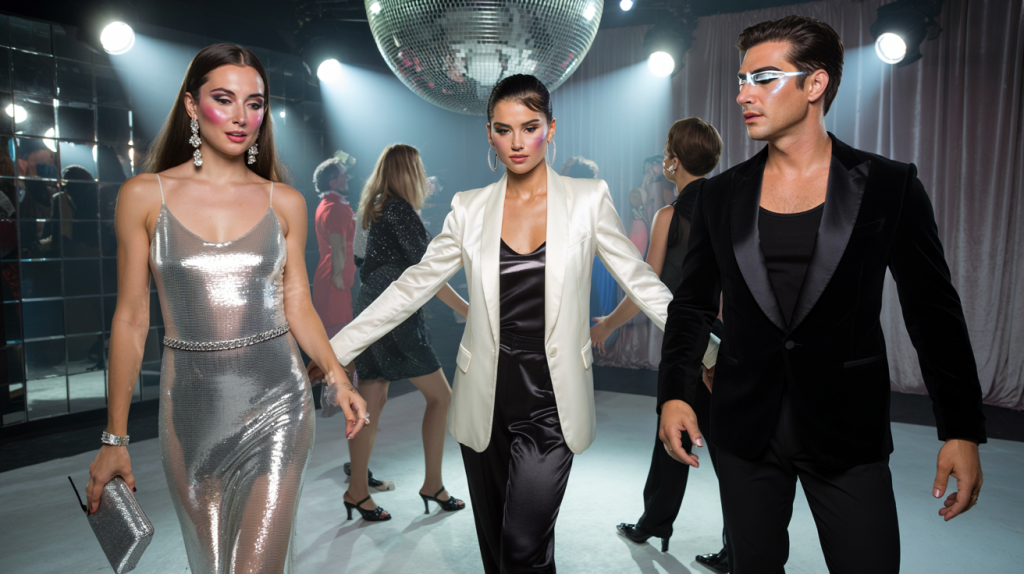
Holiday party invite in hand, sparkle on the brain. Studio 54 is the clearest style shortcut right now, because the formula is simple, photogenic, and still feels modern. Think liquid fabrics, clean lines, and a hit of disco drama that turns a dance floor into a stage.
The reference is not vague. Studio 54 opened in April 1977 and quickly became a fashion laboratory for sleek gowns, satin tuxedos and shimmering jersey, documented in countless images of Bianca Jagger, Liza Minnelli and Halston’s inner circle. The story keeps coming back: the Brooklyn Museum dedicated a major show to it in 2020, tracing the club’s aesthetic power and cultural impact, while Encyclopaedia Britannica records its first run ending in 1980, a reopening in 1981, and a final close in 1986. That pedigree explains why these looks still win every holiday season.
Studio 54 outfits for the holidays : the formula that works
Here is the main idea. Disco glam is not about costume pieces. It is about movement, shine and clean shapes that let light do the job. A slinky slip dress, a satin tuxedo jacket over a body skimming top, a sequin column that catches a phone flash.
The problem many party looks face is bulk. Too many ruffles or stiff fabrics kill the ease that made Studio 54 silhouettes feel effortless. The winning approach uses bias cuts, jersey, lamé or satin that fluidly trace the body without squeezing it into armor.
Observation from the archives: when fabrics flow, confidence reads on camera. The club’s mirror ball and theatrical lighting made surfaces glow, a detail underlined in the Brooklyn Museum’s 2020 exhibition notes. That same logic applies to living room parties and hotel bars tonight.
From Bianca Jagger to Halston : the references to copy
Dates matter because they anchor the vibe. Bianca Jagger’s white looks from spring 1977 cemented the idea that a minimal palette can be the most dramatic in a room full of color. Jerry Hall walked in liquid sequins that photographed like mercury. Liza Minnelli favored streamlined Halston gowns that moved with every beat.
Design legend Roy Halston Frowick reduced eveningwear to essential geometry, then let satin, velvet or chiffon deliver the glamour. Encyclopaedia Britannica credits Halston with defining American clean lines through the 1970s, which is exactly why a tuxedo jacket with nothing more than a camisole still feels right for a holiday cocktail.
Context adds clarity. Studio 54’s first chapter ran 1977 to 1980, then returned in 1981 under new management and stayed until 1986. These years framed disco dressing as sleek and sensual, not loud for the sake of it. That is the source to echo, not a parody of it.
Modern styling tips that avoid the costume trap
Common mistake number one: going literal from head to toe. A metallic dress plus metallic shoes plus metallic bag reads like a theme party. Anchor shine with one matte element, such as a black tux blazer or a simple leather sandal.
Common mistake number two: forgetting texture scale. Micro sequins look liquid on camera, while giant paillettes flick like fish scales. For small spaces and lots of flash, smaller surfaces gliter better.
A concrete way to test the look before leaving: take two phone photos, one with flash and one without. If the fabric looks flat, swap for satin, lamé, charmeuse, or a fine gauge jersey. This tiny step saves the night, every time.
The Studio 54 party checklist
Build the outfit from the pieces that worked then and still win now. One well chosen item is enough, two at most. The rest should whisper.
- Sequin slip or column dress in black, silver or white
- Satin or velvet tuxedo jacket over a minimal camisole
- Bias cut midi skirt with a jersey one shoulder top
- Metallic platform sandals or glossy patent pumps
- Crystal drop earrings and a thin chain belt
- Clutch in satin or mirrored finish
- Healthy skin glow : body oil on shoulders and collarbones
- Eye focus : smoked liner or a single chrome lid
- Slick hair, side part, or a soft wave that moves
One last piece of logic ties it all together. Studio 54 style came alive under light, then disappeared into the dark between songs. Choose fabrics that respond to flash, keep lines clean, and let the accessories set the tempo. The place may be different, but the rules still deliver results grounded in what the Brooklyn Museum and Britannica document across 1977 to 1986: simplicity, shine, and a little audacity on the dance floor.